
[Paper Review] Knowledge-Infused LLM-Powered Conversational Health Agent: A Case Study for Diabetes Patients
This paper proposes a knowledge-infused LLM-powered conversational health agent (CHA) for diabetes management by integrating the American Diabetes Association’s dietary guidelines and Nutritionix’s nutritional database into the open-source openCHA framework. Enhanced with analytical tools for nutrient calculation and risk assessment, the CHA outperforms GPT-4 in accurately identifying dietary risks across seven key nutrients, demonstrating superior reliability and explainability in clinical decision support.
Effective diabetes management is crucial for maintaining health in diabetic patients. Large Language Models (LLMs) have opened new avenues for diabetes management, facilitating their efficacy. However, current LLM-based approaches are limited by their dependence on general sources and lack of integration with domain-specific knowledge, leading to inaccurate responses. In this paper, we propose a knowledge-infused LLM-powered conversational health agent (CHA) for diabetic patients. We customize and leverage the open-source openCHA framework, enhancing our CHA with external knowledge and analytical capabilities. This integration involves two key components: 1) incorporating the American Diabetes Association dietary guidelines and the Nutritionix information and 2) deploying analytical tools that enable nutritional intake calculation and comparison with the guidelines. We compare the proposed CHA with GPT4. Our evaluation includes 100 diabetes-related questions on daily meal choices and assessing the potential risks associated with the suggested diet. Our findings show that the proposed agent demonstrates superior performance in generating responses to manage essential nutrients.
Motivation & Objective
- To address the limitations of general-purpose LLMs in diabetes management, particularly their tendency to hallucinate or lack domain-specific accuracy.
- To enhance the reliability and explainability of LLM-based health agents by integrating verified medical knowledge and analytical tools.
- To develop a customizable, transparent conversational agent that supports personalized, guideline-compliant dietary recommendations for diabetic patients.
- To evaluate the performance of the knowledge-infused CHA against GPT-4 on real-world diabetes-related meal assessment queries.
Proposed method
- The study leverages the open-source openCHA framework as a foundation for building a LLM-powered conversational health agent.
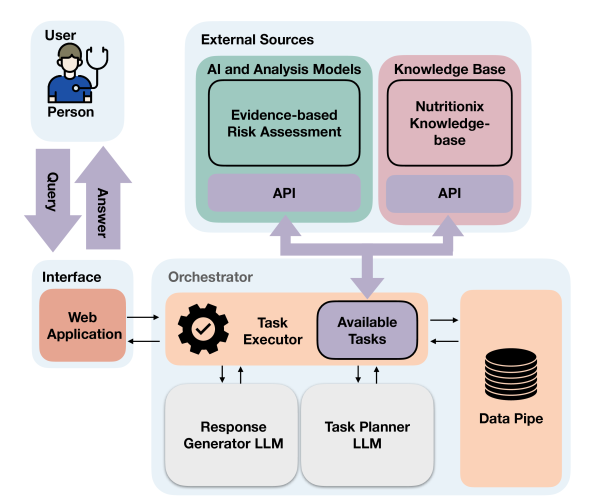
- External knowledge is integrated via the American Diabetes Association’s dietary guidelines and the Nutritionix API for real-time nutritional data retrieval.
- An analytical module computes total daily intake of seven key nutrients (carbohydrates, fat, saturated fat, protein, sodium, sugars, fiber) and compares them against recommended ranges.
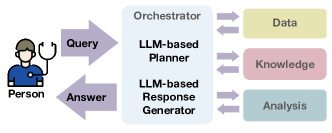
- The system uses an LLM-based orchestrator to coordinate knowledge retrieval, analysis, and response generation, ensuring traceability and transparency.
- A custom prompt engineering strategy is applied to GPT-4 to ensure comparable input and evaluation conditions.
- Evaluation is conducted on 100 real-world meal-related queries, with ground truth derived from manual nutritional calculations and guideline alignment.
Experimental results
Research questions
- RQ1Can a knowledge-infused LLM-based CHA outperform a general-purpose LLM like GPT-4 in assessing dietary risks for diabetic patients?
- RQ2To what extent does integrating verified medical guidelines and nutritional databases improve the accuracy of LLM-generated health recommendations?
- RQ3How does the inclusion of analytical tools for nutrient calculation affect the reliability and consistency of dietary risk assessments?
- RQ4Can the CHA provide explainable reasoning for its risk assessments, enhancing user trust and transparency?
Key findings
- The proposed CHA achieved a risk assessment accuracy of 84% for carbohydrates, significantly outperforming GPT-4’s 49%.
- For saturated fat, the CHA reached 99% accuracy, compared to GPT-4’s 68%.
- The CHA demonstrated superior performance across all seven nutrients, with accuracy ranging from 84% (carbohydrates) to 95% (sodium).
- The CHA’s performance was most improved in protein (90% vs. 17%) and dietary fiber (92% vs. 46%), indicating strong gains in complex nutrient evaluation.
- The system’s ability to integrate and reason over structured knowledge and analytical tools reduced hallucination and improved consistency.
- The CHA provides explainable responses, allowing users to trace the data sources and calculation logic behind each assessment.
Read this paper
Open the full text in the Nubint reader and ask about any passage as you read.
Read this paper on NubintThis review was generated by AI from the original paper. Please check the paper before citing it.