
[Paper Review] Komodo: A Linguistic Expedition into Indonesia's Regional Languages
Komodo-7B-Instruct, a 7-billion-parameter multilingual language model, is designed to bridge the NLP resource gap for Indonesia’s regional languages by achieving state-of-the-art performance across Indonesian, English, and 11 regional languages. Trained on curated, high-quality open-source and manually collected data with rigorous preprocessing, it outperforms leading models like GPT-3.5, Llama-2-13B, and Mixtral-8x7B on multilingual benchmarks and enables direct, high-quality translation from English to 11 regional languages, significantly advancing linguistic inclusivity and educational equity in Indonesia.
The recent breakthroughs in Large Language Models (LLMs) have mostly focused on languages with easily available and sufficient resources, such as English. However, there remains a significant gap for languages that lack sufficient linguistic resources in the public domain. Our work introduces Komodo-7B, 7-billion-parameter Large Language Models designed to address this gap by seamlessly operating across Indonesian, English, and 11 regional languages in Indonesia. Komodo-7B is a family of LLMs that consist of Komodo-7B-Base and Komodo-7B-Instruct. Komodo-7B-Instruct stands out by achieving state-of-the-art performance in various tasks and languages, outperforming the benchmarks set by OpenAI's GPT-3.5, Cohere's Aya-101, Llama-2-Chat-13B, Mixtral-8x7B-Instruct-v0.1, Gemma-7B-it , and many more. This model not only demonstrates superior performance in both language-specific and overall assessments but also highlights its capability to excel in linguistic diversity. Our commitment to advancing language models extends beyond well-resourced languages, aiming to bridge the gap for those with limited linguistic assets. Additionally, Komodo-7B-Instruct's better cross-language understanding contributes to addressing educational disparities in Indonesia, offering direct translations from English to 11 regional languages, a significant improvement compared to existing language translation services. Komodo-7B represents a crucial step towards inclusivity and effectiveness in language models, providing to the linguistic needs of diverse communities.
Motivation & Objective
- Address the significant performance gap in NLP for low-resource regional languages in Indonesia, particularly those lacking sufficient linguistic resources.
- Develop a high-performing, multilingual large language model tailored specifically for Indonesian and 11 regional languages to overcome the limitations of existing models trained primarily on English.
- Improve cross-lingual understanding and translation capabilities to support educational access and content dissemination across diverse linguistic communities in Indonesia.
- Create a model that surpasses existing benchmarks in multilingual and language-specific tasks, including translation and instruction following, for under-resourced languages.
Proposed method
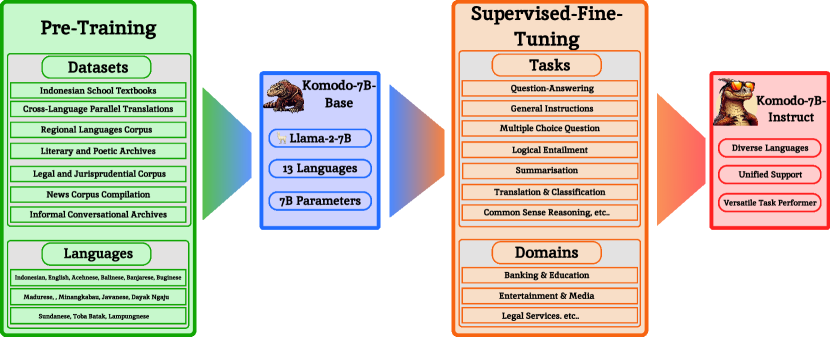
- Pre-training and instruction tuning on a curated dataset combining diverse open-source sources and manually collected, high-quality data for 13 languages, including 11 regional Indonesian languages.
- Employing rigorous data preprocessing, including repetition removal using n-gram analysis and quality filtering to eliminate low-quality or redundant content.
- Utilizing a mixture-of-experts (MoE) architecture for efficient parameter scaling and improved performance, inspired by state-of-the-art models like Mixtral.
- Implementing a two-stage training pipeline: first, pre-training on a large, filtered multilingual corpus, followed by instruction tuning on curated, instruction-based data for enhanced zero-shot and few-shot generalization.
- Leveraging a specialized tokenizer optimized for morphological diversity and low-resource language characteristics to improve tokenization efficiency and representation.
- Evaluating performance across multiple benchmarks, including multilingual instruction following, translation, and zero-shot transfer, to ensure robustness across languages.
Experimental results
Research questions
- RQ1Can a 7B-parameter LLM achieve state-of-the-art performance across 13 languages, including 11 low-resource regional languages of Indonesia, when trained on curated, high-quality data?
- RQ2How does Komodo-7B-Instruct compare to leading multilingual models like GPT-3.5, Llama-2-13B, and Mixtral-8x7B in cross-lingual understanding and zero-shot generalization?
- RQ3To what extent can Komodo-7B-Instruct enable high-quality, direct translation from English to 11 regional Indonesian languages, surpassing existing services like Google Translate?
- RQ4Does the model’s performance significantly outperform existing Indonesian-specific LLMs like SEA-LION across diverse NLP tasks?
- RQ5Can Komodo-7B-Instruct effectively reduce educational disparities by enabling multilingual content access and translation in Indonesia’s linguistically diverse regions?
Key findings
- Komodo-7B-Instruct outperforms GPT-3.5, Cohere’s Aya-101, Llama-2-13B, Mixtral-8x7B-Instruct-v0.1, and Gemma-7B-it across multiple multilingual benchmarks, demonstrating state-of-the-art performance.
- The model achieves superior performance in both language-specific and overall evaluations, particularly excelling in cross-lingual understanding and zero-shot transfer capabilities.
- Komodo-7B-Instruct surpasses the existing Indonesian LLM SEA-LION in nearly all evaluated tasks, indicating a significant performance margin.
- It enables direct, high-quality translation from English to 11 regional Indonesian languages, including Javanese and Sundanese, outperforming Google Translate, which only supports Indonesian, Javanese, and Sundanese.
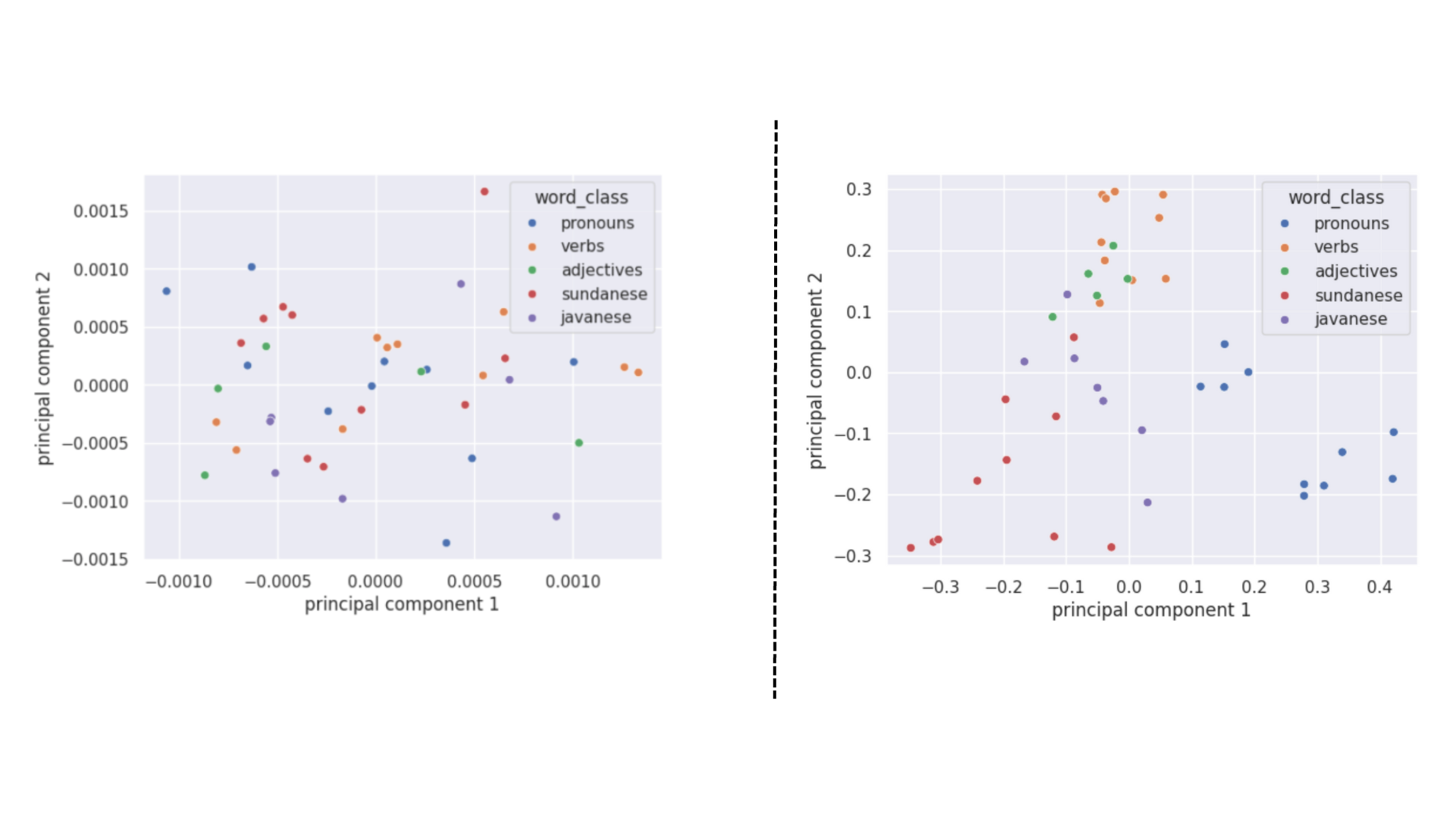
- The model’s performance is robust across diverse linguistic typologies, demonstrating strong generalization across morphologically and syntactically distinct regional languages.
- The model’s success is attributed to high-quality, curated training data and effective preprocessing, including repetition removal and quality filtering, rather than massive data scale.
Read this paper
Open the full text in the Nubint reader and ask about any passage as you read.
Read this paper on NubintThis review was generated by AI from the original paper. Please check the paper before citing it.