
[Paper Review] Koopman Operators in Robot Learning
This paper surveys Koopman operator theory for robotics, provides a practical tutorial with executable code, and discusses data-driven modeling, state estimation, and control across diverse robotic platforms using EDMD and related approaches.
Koopman operator theory offers a rigorous treatment of dynamics and has been emerging as an alternative modeling and learning-based control method across various robotics sub-domains. Due to its ability to represent nonlinear dynamics as a linear (but higher-dimensional) operator, Koopman theory offers a fresh lens through which to understand and tackle the modeling and control of complex robotic systems. Moreover, it enables incremental updates and is computationally inexpensive, thus making it particularly appealing for real-time applications and online active learning. This review delves deeply into the foundations of Koopman operator theory and systematically builds a bridge from theoretical principles to practical robotic applications. We begin by explaining the mathematical underpinnings of the Koopman framework and discussing approximation approaches for incorporating inputs into Koopman-based modeling. Foundational considerations, such as data collection strategies as well as the design of lifting functions for effective system embedding, are also discussed. We then explore how Koopman-based models serve as a unifying tool for a range of robotics tasks, including model-based control, real-time state estimation, and motion planning. The review proceeds to a survey of cutting-edge research that demonstrates the versatility and growing impact of Koopman methods across diverse robotics sub-domains: from aerial and legged platforms to manipulators, soft-bodied systems, and multi-agent networks. A presentation of more advanced theoretical topics, necessary to push forward the overall framework, is included. Finally, we reflect on some key open challenges that remain and articulate future research directions that will shape the next phase of Koopman-inspired robotics. To support practical adoption, we provide a hands-on tutorial with executable code at https://shorturl.at/ouE59.
Motivation & Objective
- Motivate runtime learning for robots operating in novel environments with small data.
- Present Koopman operator theory as a data-efficient, interpretable, linear-representation framework for nonlinear robotic dynamics.
- Survey and synthesize recent algorithmic and application advances in robotics using Koopman operators.
- Provide practical tutorials and executable code to help practitioners implement Koopman-based modeling and control.
Proposed method
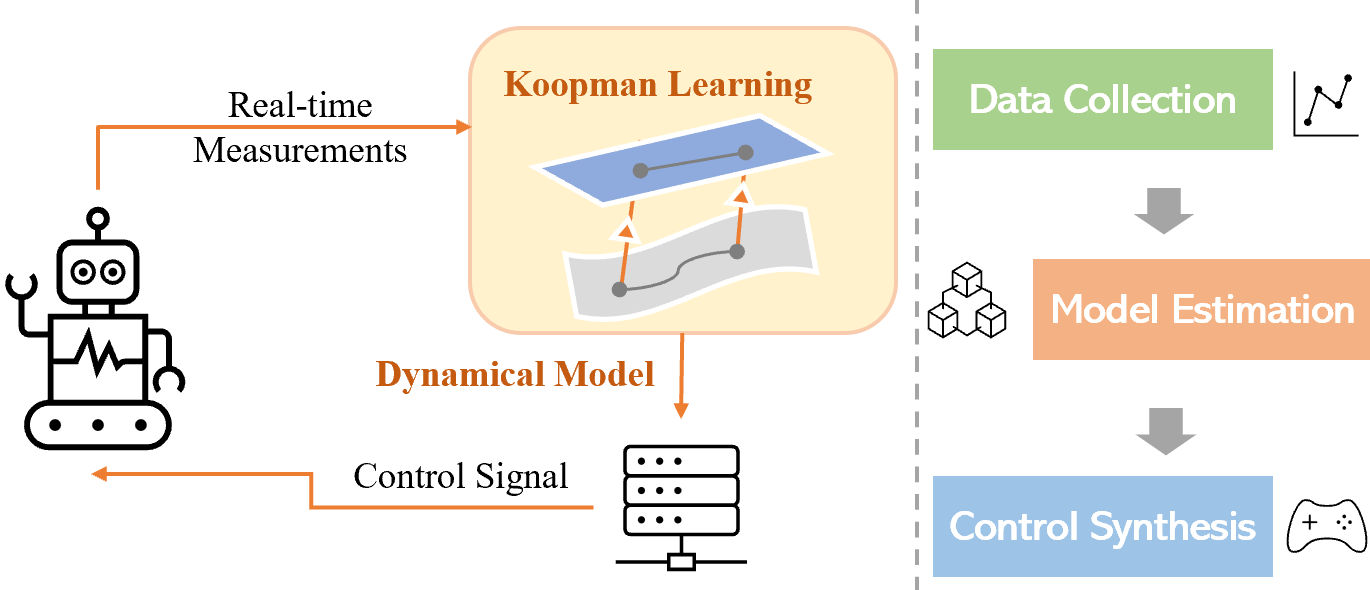
- Explain the Koopman operator concept and the idea of lifting states to a space where nonlinear dynamics are linear.
- Introduce finite-dimensional invariant subspaces and the EDMD approach to approximate the Koopman operator from data.
- Discuss handling of inputs and control in Koopman-based modeling and how to augment states or use bilinear forms.
- Outline data collection, lifting function selection, operator estimation, and stability considerations for Koopman-based controllers.
- Describe how linear controllers (e.g., LQR) or nonlinear MPC can be built on top of Koopman models.
Experimental results
Research questions
- RQ1How can Koopman operator theory enable runtime, data-efficient learning for nonlinear robotic systems?
- RQ2What are effective data-driven methods (like EDMD) to approximate Koopman operators from finite data in robotics?
- RQ3How should lifting dictionaries be chosen to balance accuracy and dimensionality in robotic applications?
- RQ4How can inputs and control signals be incorporated into Koopman-based modeling and control frameworks?
- RQ5What are the practical workflows for data collection, model training, and controller design in Koopman-based robotics?
Key findings
- Koopman operators provide a linear representation of nonlinear robotic dynamics, enabling linear control tools like LQR.
- Data-efficient learning is possible because EDMD and related methods approximate the operator from sparse data, enabling online updates.
- The approach offers interpretability and potential stability guarantees through operator-theoretic properties and eigenstructure analysis.
- EDMD-based predictors approximate the Koopman action within a chosen dictionary, with convergence properties as dictionary size grows under certain conditions.
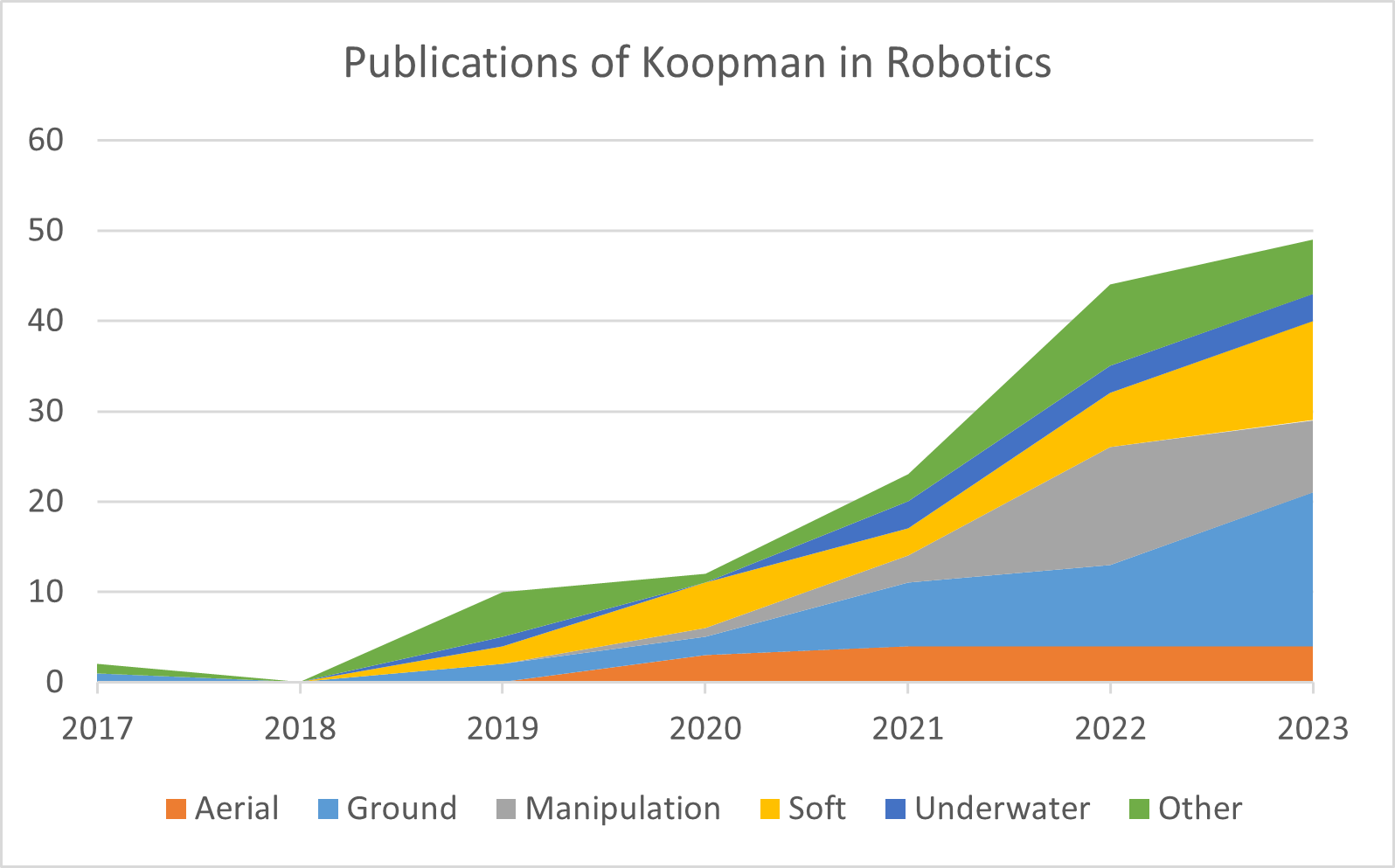
- The survey covers a wide range of robotic platforms (aerial, legged, wheeled, underwater, soft, manipulators) and discusses practical tutorials, code, and implementation guidance.
- The framework supports runtime learning and real-time control by integrating data collection, model learning, and control synthesis steps.
Read this paper
Open the full text in the Nubint reader and ask about any passage as you read.
Read this paper on NubintThis review was generated by AI from the original paper. Please check the paper before citing it.