
[Paper Review] Krylov Complexity in Lifshitz-type Scalar Field Theories
This paper investigates Lanczos coefficients and Krylov complexity in free Lifshitz scalar field theories with integer dynamical exponent $z$ at finite temperature. It shows that despite non-relativistic scaling, the Lanczos coefficients exhibit universal linear growth at late times, leading to exponential K-complexity with slope $2/pi\beta$, independent of $z$, while mass and UV cutoff modify the behavior, with K-complexity and K-entropy showing distinct scaling under finite-size effects.
We investigate various aspects of the Lanczos coefficients in a family of free Lifshitz scalar theories, characterized by their integer dynamical exponent, at finite temperature. In this non-relativistic setup, we examine the effects of mass, finite ultraviolet cutoff, and finite lattice spacing on the behavior of the Lanczos coefficients. We also investigate the effect of the dynamical exponent on the asymptotic behavior of the Lanczos coefficients, which show a universal scaling behavior. We carefully examine how these results can affect different measures in Krylov space, including Krylov complexity and entropy. Remarkably, we find that our results are similar to those previously observed in the literature for relativistic theories.
Motivation & Objective
- To understand the behavior of Lanczos coefficients in non-relativistic Lifshitz-type scalar field theories with integer dynamical exponent $z$.
- To examine how mass, finite UV cutoff, and lattice spacing affect Krylov complexity and entropy in these theories.
- To test the universality of the universal operator growth hypothesis in non-relativistic settings.
- To compare results with relativistic models and assess whether K-complexity and K-entropy exhibit similar scaling across different critical exponents and mass regimes.
Proposed method
- The Lanczos algorithm is applied to construct the Krylov basis from nested commutators of a local operator with the Hamiltonian.
- The Lanczos coefficients $b_n$ are computed numerically in both continuum and discretized versions of the Lifshitz scalar theory.
- Finite-temperature effects are incorporated via the thermal density matrix, and the Krylov complexity $K_{\mathcal{O}}(t)$ is computed from the time evolution of the operator in the Krylov basis.
- The K-entropy $S_{\mathcal{O}}(t)$ is evaluated from the probability distribution of the operator's expansion coefficients in the Krylov basis.
- Hard UV cutoffs and finite lattice spacing are introduced to regularize the continuum theory and study their impact on Lanczos coefficient saturation and complexity growth.
- Numerical simulations are performed across varying $z$, mass $m$, and temperature $\beta^{-1}$ to extract scaling behavior and asymptotic trends.
Experimental results
Research questions
- RQ1How do the Lanczos coefficients behave in a free Lifshitz scalar theory with integer dynamical exponent $z$ at finite temperature?
- RQ2Does the universal operator growth hypothesis—linear growth of $b_n$—hold in non-relativistic, scale-invariant field theories?
- RQ3How do mass and finite UV cutoffs modify the asymptotic behavior of Krylov complexity and K-entropy?
- RQ4What is the relationship between K-complexity and K-entropy in Lifshitz theories, especially under finite-size effects?
- RQ5Is the observed behavior in Krylov complexity universal across different values of $z$, or does the critical exponent significantly alter the dynamics?
Key findings
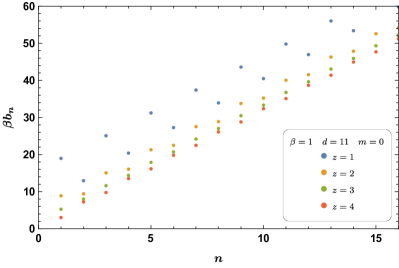
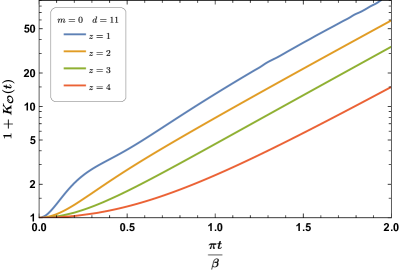
- In the massless continuum case, Lanczos coefficients $b_n$ grow linearly with $n$, with slope independent of $z$, and K-complexity exhibits exponential growth with late-time exponent $\lambda = 2\pi/\beta$, regardless of $z$.
- The K-variance stabilizes to a constant at late times, and its fluctuations decrease with increasing $z$, indicating reduced quantum noise in higher-$z$ theories.
- For massive theories, the slope of $b_n$ is bounded by $\pi/\beta$ (the massless limit) and decreases monotonically with mass, while the odd-even staggering increases with $z$ and is proportional to $m^z$.
- With a hard UV cutoff, Lanczos coefficients initially grow linearly then saturate, causing K-complexity to transition from exponential to linear growth at late times.
- K-entropy shows approximate logarithmic growth in the saturation phase, consistent with linear complexity growth, and numerically, $1 + K_{\mathcal{O}}(t) \sim e^{a S_{\mathcal{O}}(t)}$ with $a < 1$, though the relation is not universal.
- The behavior of K-complexity and K-entropy is qualitatively similar across massless and massive cases, with both decreasing as $z$ or $m$ increases, reflecting reduced quantum fluctuation length.
Read this paper
Open the full text in the Nubint reader and ask about any passage as you read.
Read this paper on NubintThis review was generated by AI from the original paper. Please check the paper before citing it.