
[Paper Review] Label-Retrieval-Augmented Diffusion Models for Learning from Noisy Labels
This paper reframes learning from noisy labels as a stochastic conditional label generation problem and introduces LRA-diffusion, which uses diffusion models with neighbor-label retrieval and pre-trained encoders (e.g., CLIP, SimCLR) to achieve SOTA performance on noisy-label benchmarks.
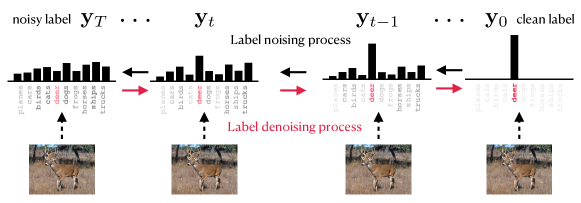
Learning from noisy labels is an important and long-standing problem in machine learning for real applications. One of the main research lines focuses on learning a label corrector to purify potential noisy labels. However, these methods typically rely on strict assumptions and are limited to certain types of label noise. In this paper, we reformulate the label-noise problem from a generative-model perspective, $ extit{i.e.}$, labels are generated by gradually refining an initial random guess. This new perspective immediately enables existing powerful diffusion models to seamlessly learn the stochastic generative process. Once the generative uncertainty is modeled, we can perform classification inference using maximum likelihood estimation of labels. To mitigate the impact of noisy labels, we propose the $ extbf{L}$abel-$ extbf{R}$etrieval-$ extbf{A}$ugmented (LRA) diffusion model, which leverages neighbor consistency to effectively construct pseudo-clean labels for diffusion training. Our model is flexible and general, allowing easy incorporation of different types of conditional information, $ extit{e.g.}$, use of pre-trained models, to further boost model performance. Extensive experiments are conducted for evaluation. Our model achieves new state-of-the-art (SOTA) results on all the standard real-world benchmark datasets. Remarkably, by incorporating conditional information from the powerful CLIP model, our method can boost the current SOTA accuracy by 10-20 absolute points in many cases.
Motivation & Objective
- Motivate learning from noisy labels via a generative-process perspective rather than traditional discriminative/maintenance methods.
- Develop a diffusion-based framework that models conditional label generation under noise.
- Leverage neighbor-consistency through label retrieval to create pseudo-clean targets for diffusion training.
- Incorporate powerful pre-trained encoders (e.g., CLIP, SimCLR) to condition the diffusion process and boost performance.
- Demonstrate state-of-the-art results on real-world noisy-label benchmarks and assess efficiency with accelerated inference.
Proposed method
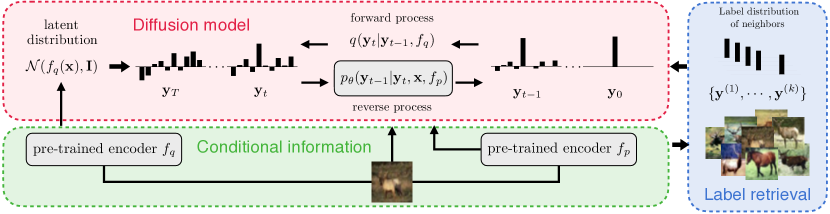
- Adopt a diffusion-model backbone (CARD) to learn the conditional distribution of labels given an image.
- Introduce label-retrieval augmentation: retrieve labels from k-nearest neighbors in a learned feature space to form pseudo-clean targets for training.
- Use two encoders: f_q (mean estimator for y_T, possibly 0) and f_p (high-dimensional feature extractor) to condition the diffusion process.
- Train with an ELBO objective, employing a simple loss that matches predicted noise to true noise in the diffusion steps.
- Accelerate inference with a generalized DDIM-based sampling to reduce steps while preserving the marginal distribution.
- Allow flexible conditioning by not enforcing f_q = f_p and enable integration of large pre-trained models like CLIP as f_p.
Experimental results
Research questions
- RQ1How can diffusion models be used to model the stochastic process of label generation under noise?
- RQ2Does retrieving neighbor labels in a learned feature space improve robustness to noisy labels when training diffusion-based classifiers?
- RQ3Can pre-trained encoders (e.g., CLIP, SimCLR) enhance diffusion-based learning from noisy labels through conditioning?
- RQ4What are the efficiency gains from acceleration techniques (DDIM) in diffusion-based label inference, and how do they affect accuracy?
- RQ5How does LRA-diffusion perform on synthetic and real-world noisy-label benchmarks compared to state-of-the-art methods?
Key findings
- LRA-diffusion achieves state-of-the-art performance on standard real-world noisy-label benchmarks.
- Incorporating CLIP-conditioned features yields substantial accuracy gains, with notable improvements over prior methods.
- Label retrieval augmentation enables the diffusion model to learn from neighborhood labels, improving robustness to label noise.
- Accelerated inference via a generalized DDIM reduces computation while maintaining performance (e.g., using fewer steps).
- On synthetic noise benchmarks (CIFAR-10/100), LRA-diffusion with CLIP significantly outperforms baselines across PMD and mixed-noise settings.
- Real-world results show strong improvements over prior methods on WebVision, ILSVRC2012, and Food-101N datasets.
Read this paper
Open the full text in the Nubint reader and ask about any passage as you read.
Read this paper on NubintThis review was generated by AI from the original paper. Please check the paper before citing it.