
[Paper Review] LaFTer: Label-Free Tuning of Zero-shot Classifier using Language and Unlabeled Image Collections
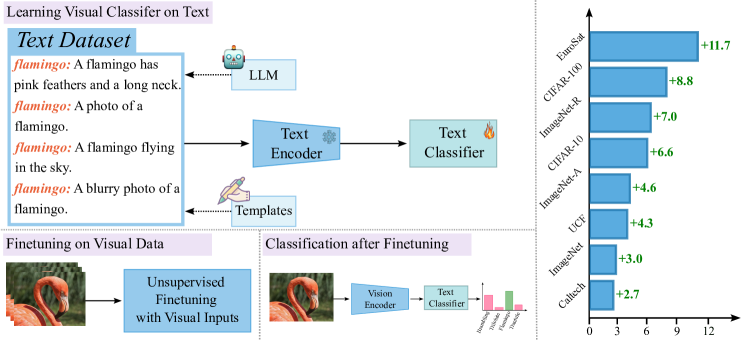
LaFTer proposes a label-free, parameter-efficient method to fine-tune zero-shot vision-language models using only text descriptions generated by a large language model (LLM) and an unlabeled image collection. By training a text-only classifier on LLM-generated descriptions and using it to pseudo-label images, LaFTer achieves up to 11.7% absolute accuracy gain over base CLIP and matches or exceeds few-shot baselines without any labeled data.
Recently, large-scale pre-trained Vision and Language (VL) models have set a new state-of-the-art (SOTA) in zero-shot visual classification enabling open-vocabulary recognition of potentially unlimited set of categories defined as simple language prompts. However, despite these great advances, the performance of these zeroshot classifiers still falls short of the results of dedicated (closed category set) classifiers trained with supervised fine tuning. In this paper we show, for the first time, how to reduce this gap without any labels and without any paired VL data, using an unlabeled image collection and a set of texts auto-generated using a Large Language Model (LLM) describing the categories of interest and effectively substituting labeled visual instances of those categories. Using our label-free approach, we are able to attain significant performance improvements over the zero-shot performance of the base VL model and other contemporary methods and baselines on a wide variety of datasets, demonstrating absolute improvement of up to 11.7% (3.8% on average) in the label-free setting. Moreover, despite our approach being label-free, we observe 1.3% average gains over leading few-shot prompting baselines that do use 5-shot supervision.
Motivation & Objective
- To close the performance gap between zero-shot vision-language models and supervised classifiers without using any labeled data.
- To enable parameter-efficient fine-tuning of vision-language models using only text embeddings and unlabeled images.
- To demonstrate that cross-modal transfer from text-only training can effectively improve visual classification performance.
- To achieve state-of-the-art results in label-free fine-tuning across 12 diverse benchmarks.
- To outperform few-shot prompting baselines despite using zero labeled samples.
Proposed method
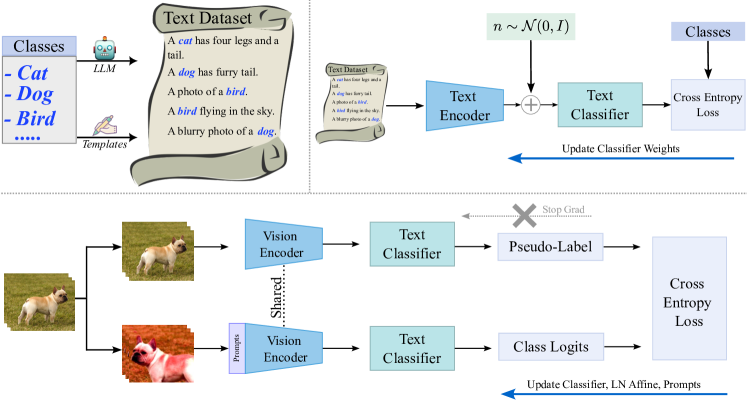
- Generate diverse text descriptions for target classes using a large language model (LLM) and handcrafted templates to form a text-only dataset.
- Train a lightweight text classifier on the generated text dataset to predict source class labels, leveraging the shared text-image embedding space of the VL model.
- Use the pre-trained text classifier to assign pseudo-labels to an unlabeled image collection.
- Fine-tune the CLIP vision encoder via Visual Prompt Tuning and adaptive normalization layers (scale/shift) in a parameter-efficient manner.
- Apply the pseudo-labeling pipeline inspired by FixMatch to improve robustness and reduce overfitting during unsupervised adaptation.
- Combine the adapted vision encoder with the text classifier for final inference, enabling zero-shot generalization to new categories.
Experimental results
Research questions
- RQ1Can a text-only classifier trained on LLM-generated descriptions be effectively transferred to improve visual classification without any labeled images?
- RQ2To what extent can unsupervised fine-tuning using only unlabeled images and synthetic text improve zero-shot vision-language model performance?
- RQ3How does the diversity of LLM-generated descriptions affect the final classification accuracy in a label-free setting?
- RQ4Can a label-free approach outperform few-shot prompting methods that rely on 5 labeled examples per class?
- RQ5What is the impact of different architectural components (e.g., visual prompts, normalization adaptation) on the overall performance of the label-free fine-tuning pipeline?
Key findings
- LaFTer achieves an absolute improvement of up to 11.7% and an average improvement of 3.8% over the base CLIP model in the label-free setting, outperforming prior SOTA methods.
- The method improves zero-shot performance by 6.7% on average and up to 28% on individual benchmarks like EuroSAT.
- LaFTer matches or exceeds the average performance of 5-shot few-shot prompting baselines, despite using zero labeled data.
- The text-only pre-training component contributes significantly, yielding up to 4.2% absolute improvement on EuroSAT when combined with pseudo-labeling.
- Removing key components such as the text classifier or visual prompts leads to substantial performance drops (e.g., -4.2 percentage points without visual prompts).
- TSNE visualizations show that LaFTer improves inter-class separation and aligns text embeddings more closely with visual clusters in the shared embedding space.
Read this paper
Open the full text in the Nubint reader and ask about any passage as you read.
Read this paper on NubintThis review was generated by AI from the original paper. Please check the paper before citing it.