
[Paper Review] LaneRCNN: Distributed Representations for Graph-Centric Motion Forecasting
LaneRCNN proposes a graph-centric motion forecasting model that uses actor-specific LaneRoI representations to encode local map topology and past trajectories, enabling map-aware, distributed interaction modeling via a global lane graph. It achieves state-of-the-art performance on the Argoverse benchmark, securing 1st place on the leaderboard with significant improvements over prior methods.
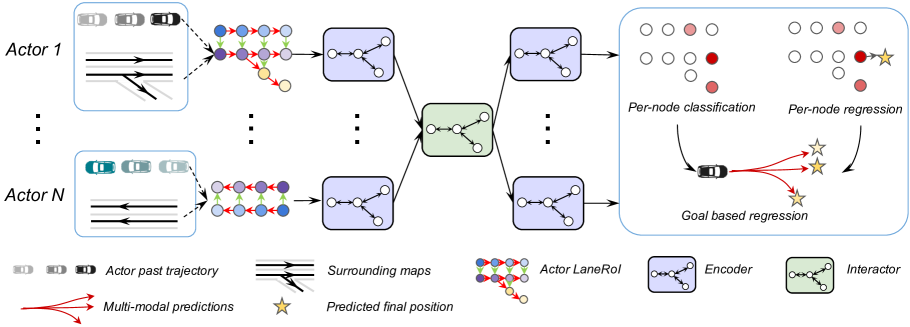
Forecasting the future behaviors of dynamic actors is an important task in many robotics applications such as self-driving. It is extremely challenging as actors have latent intentions and their trajectories are governed by complex interactions between the other actors, themselves, and the maps. In this paper, we propose LaneRCNN, a graph-centric motion forecasting model. Importantly, relying on a specially designed graph encoder, we learn a local lane graph representation per actor (LaneRoI) to encode its past motions and the local map topology. We further develop an interaction module which permits efficient message passing among local graph representations within a shared global lane graph. Moreover, we parameterize the output trajectories based on lane graphs, a more amenable prediction parameterization. Our LaneRCNN captures the actor-to-actor and the actor-to-map relations in a distributed and map-aware manner. We demonstrate the effectiveness of our approach on the large-scale Argoverse Motion Forecasting Benchmark. We achieve the 1st place on the leaderboard and significantly outperform previous best results.
Motivation & Objective
- To address the limitations of single-vector encoding in motion forecasting, which fails to preserve spatial and map structure.
- To model actor interactions in a map-aware manner, avoiding oversimplified assumptions in fully-connected interaction graphs.
- To improve trajectory prediction accuracy by leveraging lane topology as an inductive bias in the output parameterization.
- To enable more expressive and distributed representation of actor context through localized lane graph regions (LaneRoI).
Proposed method
- The model constructs a LaneRoI per actor by embedding nodes along relevant lanes, where each node encodes local motion and map semantics.
- A dedicated encoder processes each LaneRoI to produce node-level embeddings, preserving fine-grained spatial and topological information.
- Actor representations are projected into a shared global lane graph, enabling efficient message passing among overlapping or interacting LaneRoI regions.
- An interaction module uses learnable graph operators to propagate information across LaneRoI nodes, with a shortcut mechanism that pools features along the actor’s past trajectory for enhanced receptive field.
- Future trajectories are predicted in a fully-convolutional manner using nodes in the LaneRoI as anchors, with output parameterization grounded in lane structure.
- The decoding head generates full trajectories by regressing from predicted positions on the lane graph, ensuring map-consistent outputs.

Experimental results
Research questions
- RQ1Can a distributed, graph-based representation of actor context improve motion forecasting beyond single-vector encodings?
- RQ2How does map-aware interaction modeling via a shared global lane graph enhance prediction accuracy compared to fully-connected graphs?
- RQ3To what extent does using lane graphs as a parameterization for future trajectories reduce unrealistic or out-of-road predictions?
- RQ4What is the impact of the trajectory-aware shortcut mechanism on feature propagation and model performance?
Key findings
- LaneRCNN achieved 1st place on the Argoverse motion forecasting leaderboard, significantly outperforming previous state-of-the-art methods.
- The model demonstrates superior generalization on complex scenarios, including curved lanes, intersections, and obstacle avoidance, with accurate multi-modal predictions.
- The proposed shortcut mechanism, which pools features along the actor’s past trajectory, yields substantial performance gains over global average pooling or center-based pooling.
- Ablation studies show that map-aware interaction via the global lane graph outperforms fully-connected GNNs and attention mechanisms, even when the latter are matched in capacity.
- Qualitative results confirm that LaneRCNN generates map-consistent trajectories, including appropriate speeds for turning and lane-changing maneuvers.
- The method effectively captures realistic behaviors such as yielding, overtaking, and speed modulation near intersections.
Read this paper
Open the full text in the Nubint reader and ask about any passage as you read.
Read this paper on NubintThis review was generated by AI from the original paper. Please check the paper before citing it.