
[Paper Review] Language Agent Tree Search Unifies Reasoning Acting and Planning in Language Models
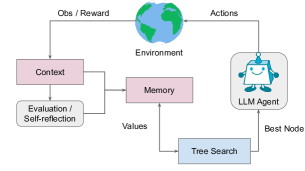
LATS unifies planning, acting, and reasoning in language models by casting LM components as an agent, value function, and optimizer within a Monte Carlo Tree Search framework, using external feedback and self-reflection to improve decision-making across diverse tasks.
While language models (LMs) have shown potential across a range of decision-making tasks, their reliance on simple acting processes limits their broad deployment as autonomous agents. In this paper, we introduce Language Agent Tree Search (LATS) -- the first general framework that synergizes the capabilities of LMs in reasoning, acting, and planning. By leveraging the in-context learning ability of LMs, we integrate Monte Carlo Tree Search into LATS to enable LMs as agents, along with LM-powered value functions and self-reflections for proficient exploration and enhanced decision-making. A key feature of our approach is the incorporation of an environment for external feedback, which offers a more deliberate and adaptive problem-solving mechanism that surpasses the constraints of existing techniques. Our experimental evaluation across diverse domains, including programming, interactive question-answering (QA), web navigation, and math, validates the effectiveness and generality of LATS in decision-making while maintaining competitive or improved reasoning performance. Notably, LATS achieves state-of-the-art pass@1 accuracy (92.7%) for programming on HumanEval with GPT-4 and demonstrates gradient-free performance (average score of 75.9) comparable to gradient-based fine-tuning for web navigation on WebShop with GPT-3.5. Code can be found at https://github.com/lapisrocks/LanguageAgentTreeSearch
Motivation & Objective
- Motivate the need for autonomous LM agents that can plan, act, and reason in external environments.
- Propose LATS, a general LM-based Monte Carlo Tree Search framework that leverages environment feedback and self-reflection.
- Demonstrate LATS across diverse domains (programming, open-domain QA, and web navigation) to show broad applicability.
- Show that external feedback and an integrated reasoning-acting-planning loop improve performance over prior prompting methods.
Proposed method
- Repurpose a pretrained LM as an LM agent, value function, and optimizer within an MCTS-like search.
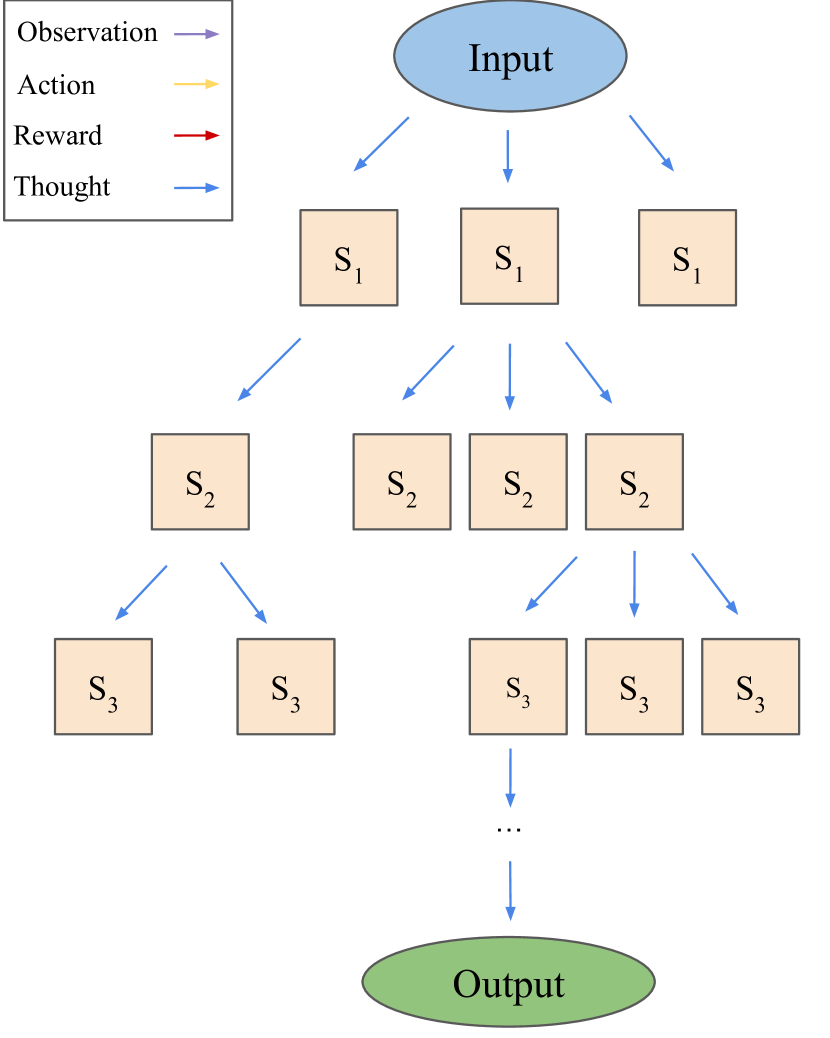
- Define a node as [x, a1..i, o1..i], and perform standard MCTS operations (selection, expansion, evaluation, simulation, backpropagation) with LM prompts guiding actions and value estimates.
- Use the LM to generate n actions at expansion and to score leaf nodes as the value function, enabling deliberate trajectory construction.
- Incorporate external feedback via environment observations and a self-reflection module that annotates failed trajectories and is stored for in-context learning.
- Include a reflection step that augments future trials with semantic guidance, enriching the scalar reward signal.
- Allow the LM to interact with external tools or APIs (as in ReAct) within the action set to bridge reasoning with action in real environments.
- Evaluate LATS on programming (HumanEval with GPT-4), HotPotQA, and WebShop to illustrate versatility and performance gains.
Experimental results
Research questions
- RQ1Can an LM-based Monte Carlo Tree Search framework unify reasoning, planning, and acting for decision-making tasks?
- RQ2Does leveraging external environmental feedback and LM-generated reflections improve performance beyond prior prompting methods like ReAct, CoT, ToT, and RAP?
- RQ3How does LATS perform across domains requiring programming, multi-hop QA, and web navigation?
- RQ4What is the impact of varying the expansion width (n) and trajectory samples (k) on performance and computation?
- RQ5To what extent does self-reflection contribute to performance gains in LM-driven planning and acting?
Key findings
- LATS achieves 94.4% Pass@1 on HumanEval programming with GPT-4, setting a state-of-the-art in that setup.
- On WebShop with GPT-3.5, LATS attains an average score of 75.9 and demonstrates superior exploration-based planning over baselines.
- In HotPotQA, LATS achieves the highest acting-based EM (0.61) among evaluated methods and is competitive on reasoning (0.61 vs 0.60–0.64 range across baselines).
- LATS outperforms ReAct across sampling budgets for HotPotQA, with larger node expansions (n) yielding consistent gains.
- Self-reflection contributes modestly to performance (about a 0.05-pt gain in some ablations), indicating semantic feedback provides complementary value beyond scalar backpropagation.
- Ablations show removing components (LM heuristic, reflection, or DFS configurations) degrades performance, underscoring the importance of the full LATS design.
Read this paper
Open the full text in the Nubint reader and ask about any passage as you read.
Read this paper on NubintThis review was generated by AI from the original paper. Please check the paper before citing it.