
[Paper Review] Language agents achieve superhuman synthesis of scientific knowledge
PaperQA2, a frontier language-model agent, matches or exceeds PhD-level humans on literature retrieval and summarization tasks, outperforms others on LitQA2, and enables large-scale contradiction detection with ContraCrow and WikiCrow evaluations.
Language models are known to hallucinate incorrect information, and it is unclear if they are sufficiently accurate and reliable for use in scientific research. We developed a rigorous human-AI comparison methodology to evaluate language model agents on real-world literature search tasks covering information retrieval, summarization, and contradiction detection tasks. We show that PaperQA2, a frontier language model agent optimized for improved factuality, matches or exceeds subject matter expert performance on three realistic literature research tasks without any restrictions on humans (i.e., full access to internet, search tools, and time). PaperQA2 writes cited, Wikipedia-style summaries of scientific topics that are significantly more accurate than existing, human-written Wikipedia articles. We also introduce a hard benchmark for scientific literature research called LitQA2 that guided design of PaperQA2, leading to it exceeding human performance. Finally, we apply PaperQA2 to identify contradictions within the scientific literature, an important scientific task that is challenging for humans. PaperQA2 identifies 2.34 +/- 1.99 contradictions per paper in a random subset of biology papers, of which 70% are validated by human experts. These results demonstrate that language model agents are now capable of exceeding domain experts across meaningful tasks on scientific literature.
Motivation & Objective
- Motivate reliable, fact-grounded AI use for scientific literature search and synthesis.
- Develop and validate a rigorous human-AI comparison framework across retrieval, summarization, and contradiction detection tasks.
- Create and benchmark datasets (LitQA2, ContraDetect) to guide model and system design.
- Demonstrate scalable tools (WikiCrow, ContraCrow) that improve factuality and detect contradictions in biology literature.
Proposed method
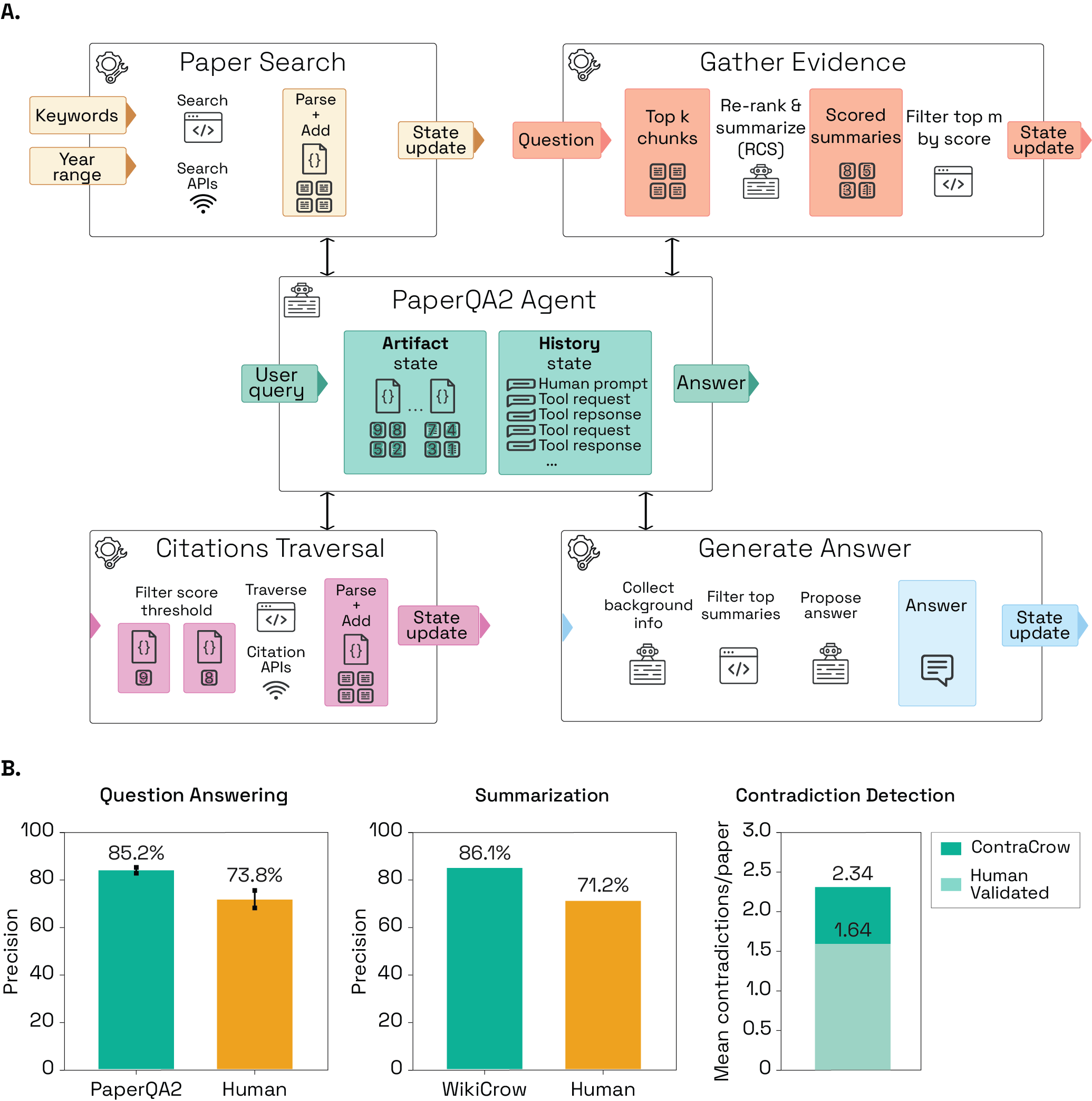
- Develop PaperQA2, a retrieval-augmented generation agent with a multi-step toolset (Paper Search, Gather Evidence, Generate Answer, Citation Traversal).
- Ground responses with contextual summaries (RCS) and top-k ranking of evidence to improve relevance and factuality.
- Create LitQA2 as 248 multiple-choice retrieval questions focusing on non-abstract evidence, with DOIs used to match sources.
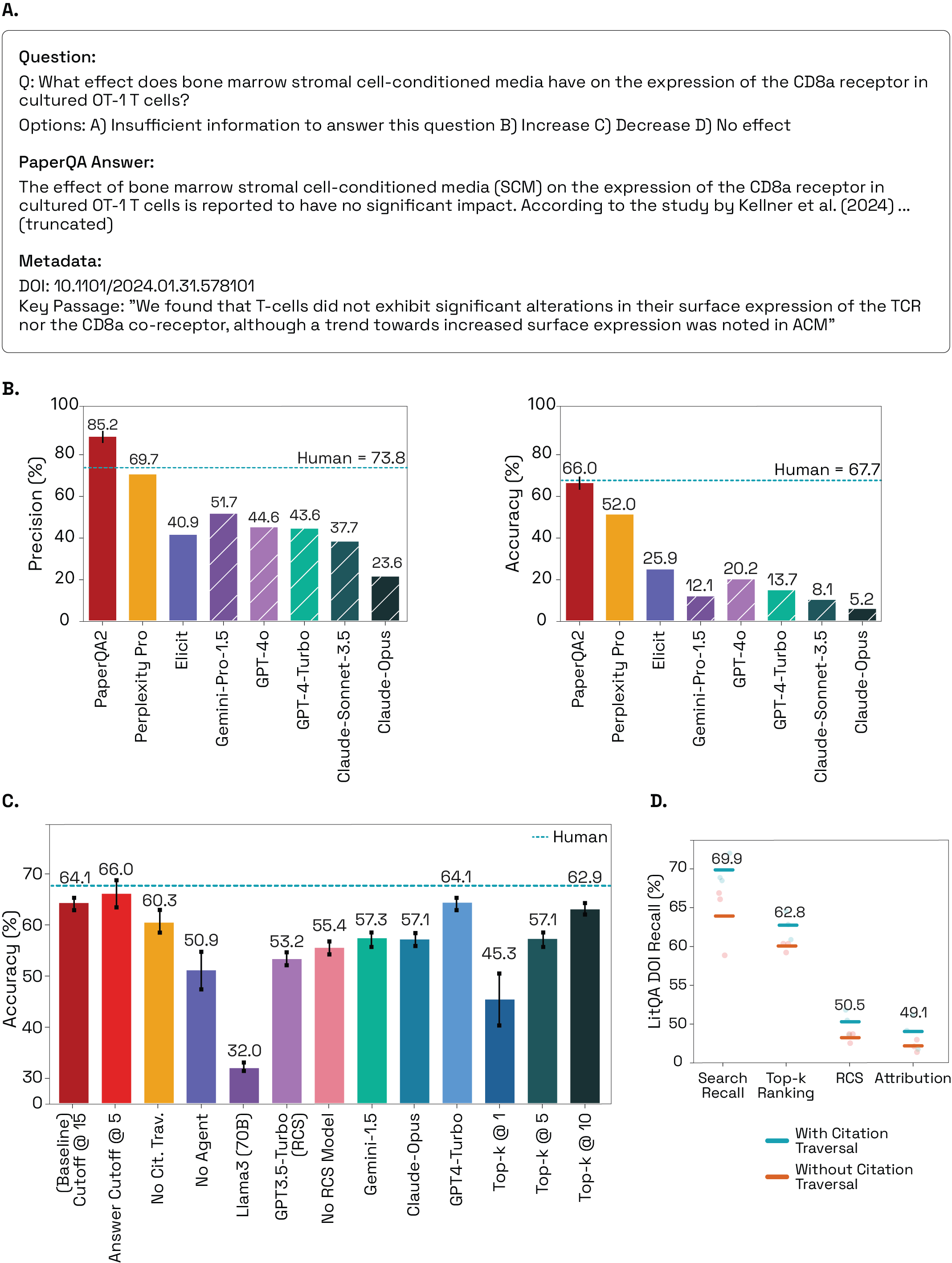
- Compare PaperQA2 against human experts and other systems using LitQA2 metrics (precision, accuracy, recall).
- Engineer WikiCrow to generate Wikipedia-style gene articles and evaluate factuality against human Wikipedia articles.
- Build ContraCrow to detect contradictions by extracting claims and evaluating them against the literature via a contradiction-detection prompt and Likert-scale scoring.
Experimental results
Research questions
- RQ1Can a language-model agent achieve human- or superhuman-level performance on real-world scientific literature retrieval tasks?
- RQ2How does a retrieval-augmented generation agent perform on summarization tasks compared to human-written scientific summaries?
- RQ3Can an AI system systematically identify contradictions in the scientific literature at scale, and how do its findings compare to expert evaluation?
- RQ4What design choices (RCS, citation traversal, context depth) most affect factuality and retrieval accuracy?
- RQ5How do AI-derived contradictions compare with human judgments in biology literature?
Key findings
- PaperQA2 achieves precision of 85.2% and accuracy of 66.0% on LitQA2, surpassing human-annotated baselines for precision and matching human accuracy.
- Humans achieved 73.8% precision and 67.7% accuracy on LitQA2, with PaperQA2 statistically exceeding human precision (p=0.0036) and not significantly different in accuracy (p=0.66).
- Deep contextual summaries (RCS) and citation traversal substantially improve retrieval accuracy and DOI recall across LitQA2 stages.
- WikiCrow produces 240 gene articles with lower uncitedness (3.5%) than Wikipedia (13.6%), and higher precision (86.1%) than Wikipedia (71.2%), while being longer on average.
- ContraCrow detects an average of 2.34 ± 1.99 contradictions per biology paper (n=93), with 70% of evaluated contradictions validated by human experts.
- ContraDetect-based evaluation yields ROC AUC of 0.842, with 88% precision at a threshold of 8 for contradiction detection.
Better researchstarts right now
From reading papers to final review, dramatically reduce your research time.
No credit card · Free plan available
This review was created by AI and reviewed by human editors.