
[Paper Review] Language Agents with Reinforcement Learning for Strategic Play in the Werewolf Game
The paper proposes a framework that combines large language models with reinforcement learning to build strategic language agents for Werewolf, addressing intrinsic bias and hidden-information deduction, and shows superior performance to baselines including human-level play.
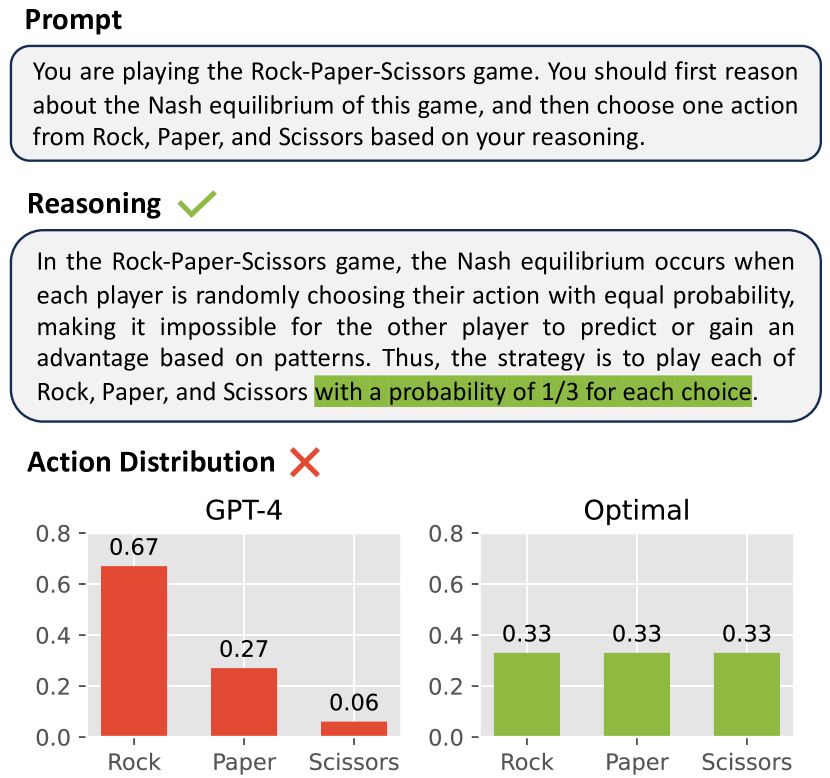
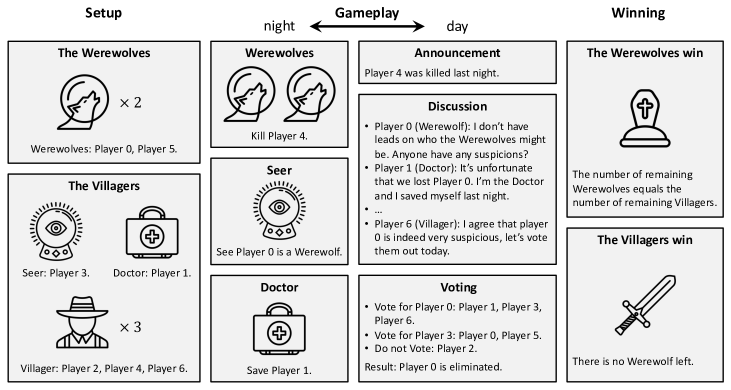
Agents built with large language models (LLMs) have shown great potential across a wide range of domains. However, in complex decision-making tasks, pure LLM-based agents tend to exhibit intrinsic bias in their choice of actions, which is inherited from the model's training data and results in suboptimal performance. To develop strategic language agents, i.e., agents that generate flexible language actions and possess strong decision-making abilities, we propose a novel framework that powers LLM-based agents with reinforcement learning (RL). We consider Werewolf, a popular social deduction game, as a challenging testbed that emphasizes versatile communication and strategic gameplay. To mitigate the intrinsic bias in language actions, our agents use an LLM to perform deductive reasoning and generate a diverse set of action candidates. Then an RL policy trained to optimize the decision-making ability chooses an action from the candidates to play in the game. Extensive experiments show that our agents overcome the intrinsic bias and outperform existing LLM-based agents in the Werewolf game. We also conduct human-agent experiments and find that our agents achieve human-level performance and demonstrate strong strategic play.
Motivation & Objective
- Motivate the development of strategic language agents capable of complex decision-making in social deduction games.
- Address intrinsic bias in pure LLM-based agents through diverse action generation and reinforcement learning.
- Enable hidden-role deduction to handle deceptive information and improve subsequent decisions.
Proposed method
- Hidden role deduction: use an LLM to organize observations, categorize truths and deceptions, and generate attributes (role, reliability, reasoning, evidence).
- Diverse action generation: produce multiple action candidates (N) via vanilla prompting or iterative prompting to reduce action bias and improve strategic variety.
- Population-based RL training: learn a lightweight policy that selects among language action candidates using a self-attention-based network fed with embeddings from the LLM; train against a population of diverse agents to improve robustness.
- Action selection: vectorize observations and candidates with an LLM embedding API, use a residual self-attention encoder to compute a probability proportional to scaled dot-product between observation and candidate embeddings.
Experimental results
Research questions
- RQ1How can we overcome intrinsic bias in pure LLM-based agents when playing complex language-based games?
- RQ2Can combining LLM reasoning with a learned RL policy improve strategic decision-making in Werewolf?
- RQ3Does generating a diverse set of language actions plus population-based training yield more robust policies against a variety of opponents?
Key findings
- Agents with the proposed RL framework overcome intrinsic bias and display more uniform, strategic action distributions than pure LLM-based agents.
- In round-robin tournaments, the strategic language agents achieve the highest win rates as both Villagers and Werewolves against multiple baselines.
- Human-agent experiments show agents reach comparable win rates to humans, and in some setups even exceed human performance.
- Ablations show all three components—hidden role deduction, diverse action generation, and population-based RL—contribute to performance gains, with the RL policy essential to overcoming bias.
Read this paper
Open the full text in the Nubint reader and ask about any passage as you read.
Read this paper on NubintThis review was generated by AI from the original paper. Please check the paper before citing it.