
[Paper Review] Language-based Action Concept Spaces Improve Video Self-Supervised Learning
The paper adapts image CLIP to video using language-grounded action concept spaces and self-distillation, improving zero-shot, linear probing, and transductive zero-shot on action recognition benchmarks.
Recent contrastive language image pre-training has led to learning highly transferable and robust image representations. However, adapting these models to video domains with minimal supervision remains an open problem. We explore a simple step in that direction, using language tied self-supervised learning to adapt an image CLIP model to the video domain. A backbone modified for temporal modeling is trained under self-distillation settings with train objectives operating in an action concept space. Feature vectors of various action concepts extracted from a language encoder using relevant textual prompts construct this space. We introduce two train objectives, concept distillation and concept alignment, that retain generality of original representations while enforcing relations between actions and their attributes. Our approach improves zero-shot and linear probing performance on three action recognition benchmarks.
Motivation & Objective
- Motivate learning robust video representations without per-video labels by leveraging language-conditioned action concepts.
- Propose action concept spaces (category and description) derived from language representations to guide SSL.
- Develop two SSL objectives (concept distillation and concept alignment) to preserve CLIP-like generality while capturing action-attribute relations.
- Enable zero-shot downstream action recognition directly from video-trained models without captions or per-video labels.
Proposed method
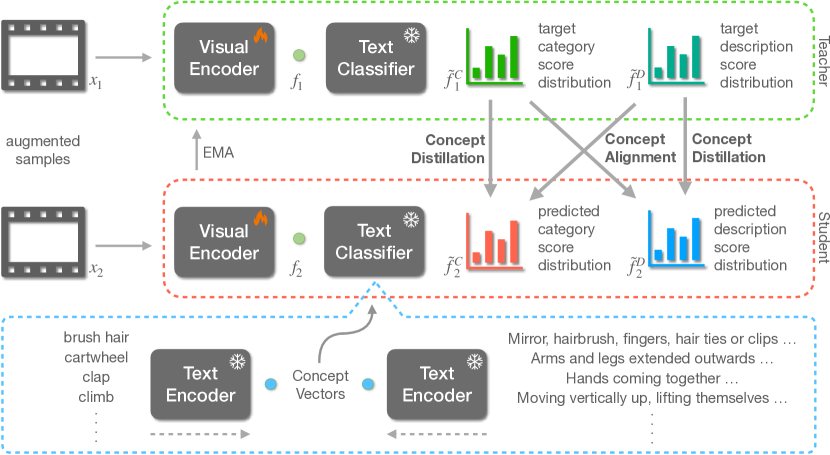
- Use a CLIP-based visual backbone augmented for temporal modeling via factorized space-time attention.
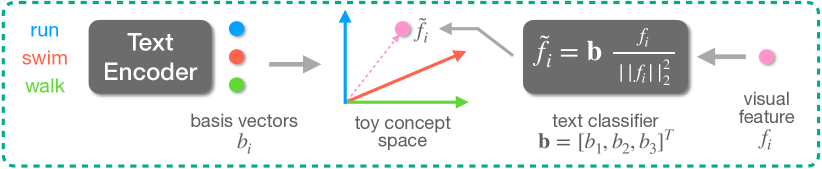
- Introduce a text classifier (frozen embeddings from CLIP text encoder) to project visual features into an action concept space.
- Construct two concept spaces from language: category concept space (action labels) and description concept space (descriptions/attributes).
- Define concept distillation loss that aligns two augmented views in each concept space using EMA teacher-student setup and a sharpened softmax over concept scores.
- Add a uniform distribution prior to prevent collapse and a concept alignment loss that ties category and description spaces across views.
- Support variants of the category concept space (LSS-A, LSS-B, LSS-C) to explore label generation and scalability without leaking downstream labels.
Experimental results
Research questions
- RQ1Can language-derived action concepts improve video SSL so that CLIP-like representations transfer better to video tasks?
- RQ2Do concept distillation and concept alignment in language-aligned concept spaces yield better zero-shot and linear probing performance on standard benchmarks?
- RQ3How do different constructions of category/description concept spaces (including LLM-generated labels) affect SSL outcomes and scalability?
Key findings
- Achieves state-of-the-art linear probing results on HMDB-51 and UCF-101 compared to prior SSL methods without using video-level labels or captions.
- Outperforms baseline CLIP-like models on zero-shot transfer to HMDB-51 and UCF-101, and shows strong transductive zero-shot performance across HMDB-51, UCF-101, and Kinetics-400.
- Two novel SSL objectives (concept distillation and concept alignment) consistently improve over baselines, including when combined with a uniform distribution prior.
- Demonstrates that language-aligned action concept spaces retain and improve transferability of image CLIP representations to the video domain, with zero-shot capabilities.
Read this paper
Open the full text in the Nubint reader and ask about any passage as you read.
Read this paper on NubintThis review was generated by AI from the original paper. Please check the paper before citing it.