
[Paper Review] Language-Driven Representation Learning for Robotics
This paper introduces Voltron, a language-driven visual representation learning framework for robotics that jointly optimizes for masked visual reconstruction and visually-grounded language generation using human videos and captions. By balancing low-level spatial pattern learning and high-level semantic understanding through a tunable language conditioning mechanism, Voltron achieves state-of-the-art performance across five diverse robot learning tasks, especially excelling in high-level semantic tasks like language-conditioned imitation and intent scoring.
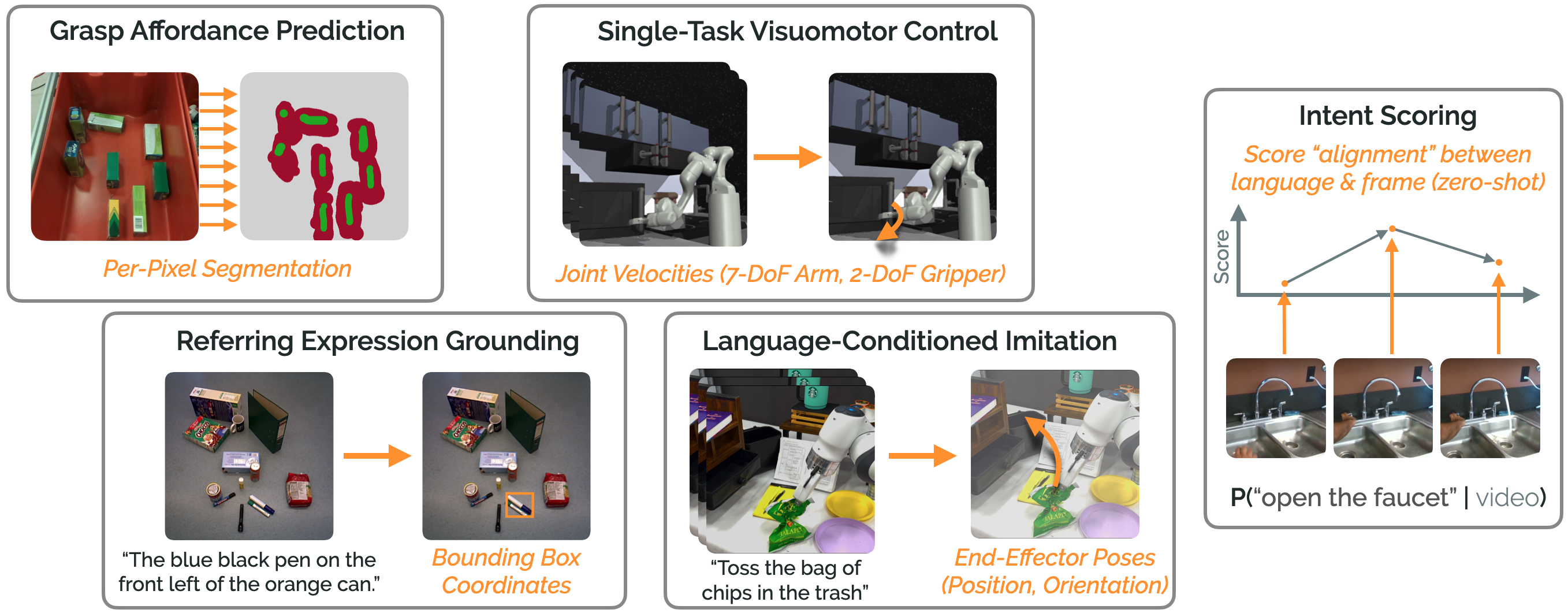
Recent work in visual representation learning for robotics demonstrates the viability of learning from large video datasets of humans performing everyday tasks. Leveraging methods such as masked autoencoding and contrastive learning, these representations exhibit strong transfer to policy learning for visuomotor control. But, robot learning encompasses a diverse set of problems beyond control including grasp affordance prediction, language-conditioned imitation learning, and intent scoring for human-robot collaboration, amongst others. First, we demonstrate that existing representations yield inconsistent results across these tasks: masked autoencoding approaches pick up on low-level spatial features at the cost of high-level semantics, while contrastive learning approaches capture the opposite. We then introduce Voltron, a framework for language-driven representation learning from human videos and associated captions. Voltron trades off language-conditioned visual reconstruction to learn low-level visual patterns, and visually-grounded language generation to encode high-level semantics. We also construct a new evaluation suite spanning five distinct robot learning problems $\unicode{x2013}$ a unified platform for holistically evaluating visual representations for robotics. Through comprehensive, controlled experiments across all five problems, we find that Voltron's language-driven representations outperform the prior state-of-the-art, especially on targeted problems requiring higher-level features.
Motivation & Objective
- To address the inconsistency of existing visual representations across diverse robot learning tasks, such as grasp affordance prediction and language-conditioned imitation.
- To develop a unified framework that captures both low-level visual patterns and high-level semantic understanding for robotics.
- To evaluate visual representations holistically across five distinct robot learning applications beyond visuomotor control.
- To demonstrate that language supervision can be leveraged effectively in a dual objective: language conditioning for reconstruction and language generation for semantics.
- To establish a new evaluation suite for benchmarking visual representations across diverse robotics tasks.
Proposed method
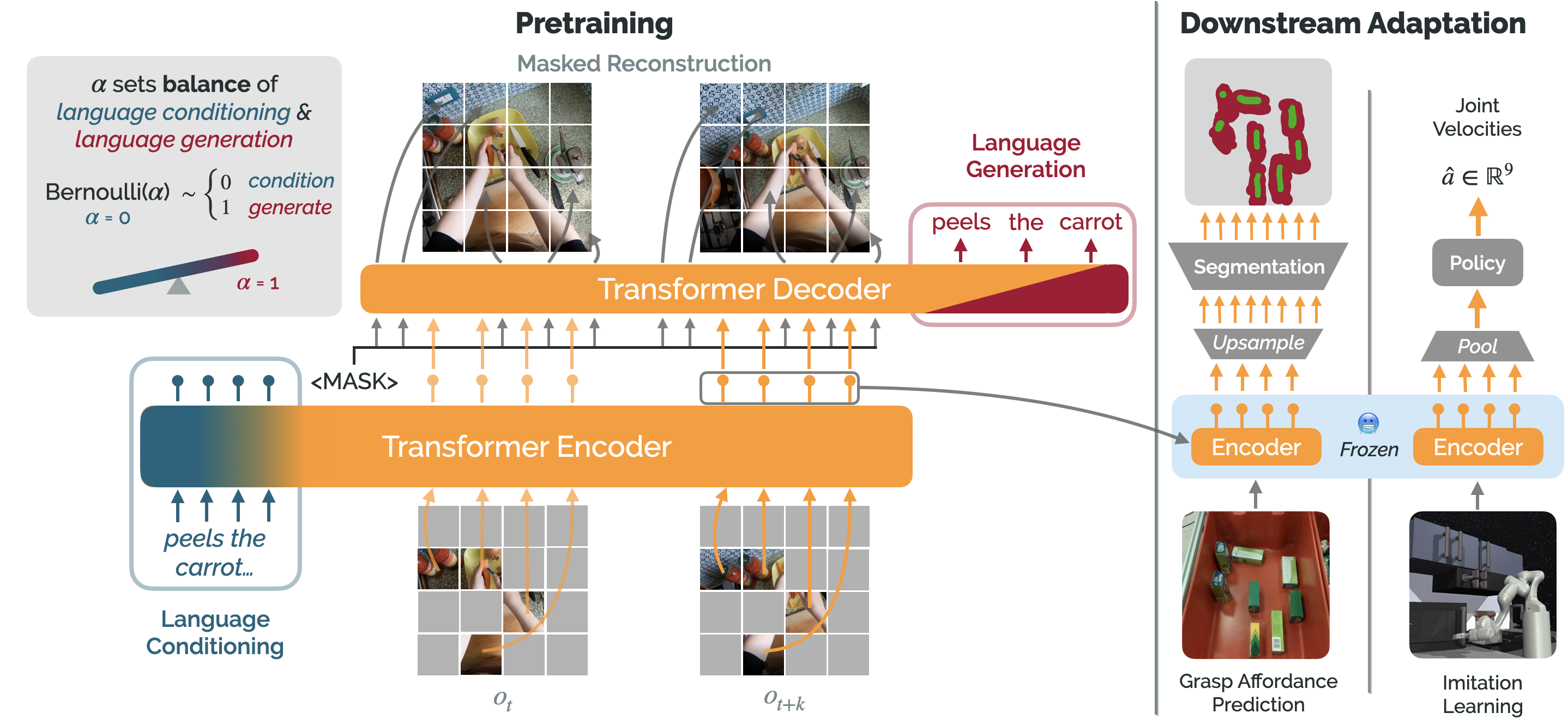
- Voltron uses a Vision Transformer encoder to process video frames and associated language captions, with a masked autoencoding objective for visual reconstruction.
- It introduces a tunable probability α to control whether language is used as a conditioning signal (α=0) or generated from visual features (α>0), enabling trade-offs between low-level and high-level feature learning.
- The framework employs dual-frame contexts (initial and current observation) to model temporal change, especially useful for tasks involving action progression.
- For adaptation, it uses task-specific heads: PUP blocks for segmentation, MLPs for bounding box prediction, and simple MLPs for policy learning.
- The model is pre-trained on egocentric video datasets (e.g., Ego4D) with masked frames and corresponding captions, using a combination of reconstruction and contrastive objectives.
- Evaluation is conducted across five tasks: grasp affordance prediction, referring expression grounding, visuomotor control, language-conditioned imitation, and zero-shot intent scoring.
Experimental results
Research questions
- RQ1Can language supervision improve visual representations for robotics beyond visuomotor control, especially in tasks requiring high-level semantics?
- RQ2How does the trade-off between language-conditioned reconstruction and language generation affect performance across diverse robot learning tasks?
- RQ3Do representations pre-trained with language supervision generalize better than prior state-of-the-art methods like MVP and R3M across a broad suite of tasks?
- RQ4Can a unified representation learning framework effectively balance low-level spatial features and high-level semantic understanding?
- RQ5Does the use of dual-frame contexts enhance learning for tasks involving temporal dynamics and human intent?
Key findings
- Voltron’s language-driven representations outperform prior state-of-the-art methods, including MVP and R3M, across all five evaluated tasks, with significant gains in high-level semantic tasks.
- On language-conditioned imitation learning, Voltron (specifically the V-Gen variant) achieves a 22.5% success rate on the real-world Franka Kitchen task, outperforming R3M and MVP.
- For zero-shot intent scoring, V-Gen achieves a 78.3% accuracy on the WHiRL dataset, significantly outperforming CLIP and R3M.
- In grasp affordance prediction, Voltron achieves a 91.2% mean IoU on the EGTEA Gaze+ dataset, surpassing MVP and R3M.
- The V-Dual variant, which uses dual-frame conditioning, shows improved performance on tasks requiring temporal reasoning, such as referring expression grounding.
- The ablation study confirms that the balance between language conditioning and generation (via α) is crucial, with α=0.5 yielding optimal performance across tasks.
Read this paper
Open the full text in the Nubint reader and ask about any passage as you read.
Read this paper on NubintThis review was generated by AI from the original paper. Please check the paper before citing it.