
[Paper Review] Language Instructed Reinforcement Learning for Human-AI Coordination
The paper introduces instructRL, a framework that uses natural language instructions and large language models to regularize multi-agent RL so AI partners coordinate with humans toward human-aligned equilibria, demonstrated in Say-Select and Hanabi.
One of the fundamental quests of AI is to produce agents that coordinate well with humans. This problem is challenging, especially in domains that lack high quality human behavioral data, because multi-agent reinforcement learning (RL) often converges to different equilibria from the ones that humans prefer. We propose a novel framework, instructRL, that enables humans to specify what kind of strategies they expect from their AI partners through natural language instructions. We use pretrained large language models to generate a prior policy conditioned on the human instruction and use the prior to regularize the RL objective. This leads to the RL agent converging to equilibria that are aligned with human preferences. We show that instructRL converges to human-like policies that satisfy the given instructions in a proof-of-concept environment as well as the challenging Hanabi benchmark. Finally, we show that knowing the language instruction significantly boosts human-AI coordination performance in human evaluations in Hanabi.
Motivation & Objective
- Enable AI partners to coordinate with humans by guiding equilibrium selection through natural language instructions.
- Leverage pretrained language models to generate a prior policy conditioned on human instructions.
- Regularize RL training with the LLM prior to converge to human-preferred equilibria.
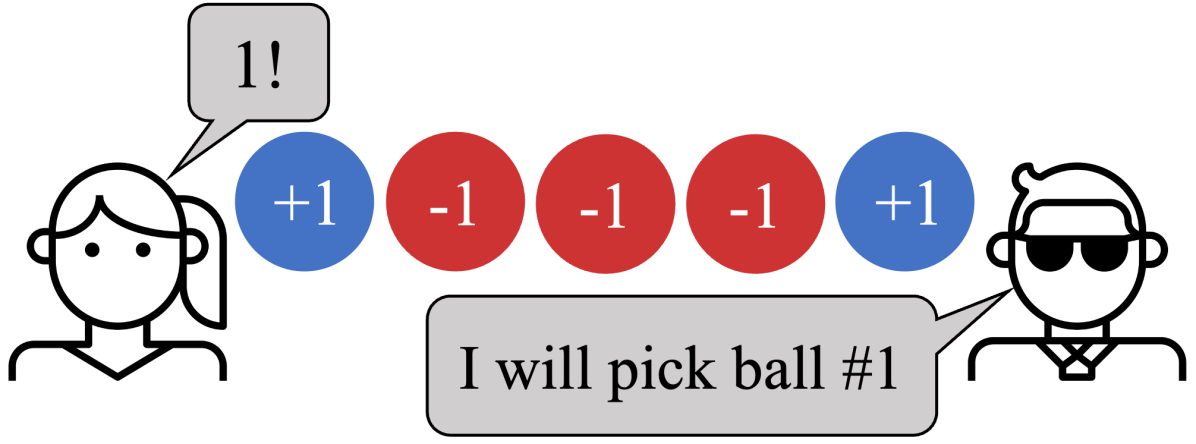
- Demonstrate the approach in a designed Say-Select game and the Hanabi benchmark.
- Show through human evaluations that language-informed agents improve coordination when instructions are known.
Proposed method
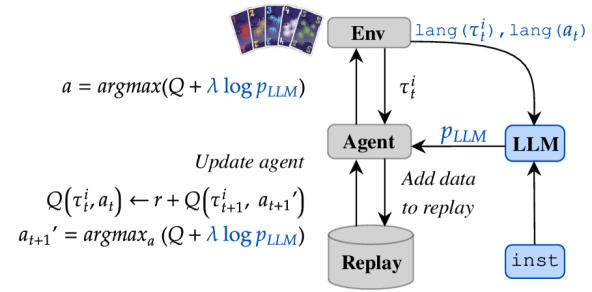
- Construct an LLM-based prior policy conditioned on the human instruction and current observation description.
- Map actions and observations to language descriptions to query the LLM for plausible actions.
- Regularize Q-learning and PPO with the LLM prior via log-probability augmentation or KL penalty.
- Show that instructRL can steer toward equilibria that satisfy the language instructions.
- Provide two concrete algorithmic instantiations: instructQ (Q-learning with log pLLM) and instructPPO (PPO with KL to pLLM).
- Apply parallel training and anneal the regularization weight to integrate the LLM guidance during RL.
Experimental results
Research questions
- RQ1Can natural language instructions steer multi-agent RL toward human-preferred equilibria in cooperative tasks?
- RQ2Does conditioning policy learning on LLM priors lead to human-compatible policies in Say-Select and Hanabi?
- RQ3Do agents trained with language-guided regularization improve human-AI coordination compared to standard MARL baselines?
- RQ4Are the resulting policies interpretable and align with the given instructions in different environments?
Key findings
- In Say-Select, instructQ yields a policy aligned with the instruction “I should select the same number as my partner.”
- In Hanabi, instructQ and instructPPO produce semantically different policies (color-based vs rank-based) as dictated by the instruction.
- Both instructQ and instructPPO achieve self-play and intra-AXP performance comparable to vanilla baselines, indicating robust convergence.
- Human evaluation shows coordinating with language-informed agents improves performance when the instruction is known to humans.
- The method demonstrates that giving agents language-based guidance can steer equilibria without requiring large human demonstration datasets.
Read this paper
Open the full text in the Nubint reader and ask about any passage as you read.
Read this paper on NubintThis review was generated by AI from the original paper. Please check the paper before citing it.