
[Paper Review] Language models are weak learners
The paper demonstrates that prompt-based large language models can act as weak learners and, when embedded in a boosting framework with data-described prompts, outperform zero-shot/few-shot and even some fine-tuning baselines on tabular data.
A central notion in practical and theoretical machine learning is that of a $ extit{weak learner}$, classifiers that achieve better-than-random performance (on any given distribution over data), even by a small margin. Such weak learners form the practical basis for canonical machine learning methods such as boosting. In this work, we illustrate that prompt-based large language models can operate effectively as said weak learners. Specifically, we illustrate the use of a large language model (LLM) as a weak learner in a boosting algorithm applied to tabular data. We show that by providing (properly sampled according to the distribution of interest) text descriptions of tabular data samples, LLMs can produce a summary of the samples that serves as a template for classification and achieves the aim of acting as a weak learner on this task. We incorporate these models into a boosting approach, which in some settings can leverage the knowledge within the LLM to outperform traditional tree-based boosting. The model outperforms both few-shot learning and occasionally even more involved fine-tuning procedures, particularly for tasks involving small numbers of data points. The results illustrate the potential for prompt-based LLMs to function not just as few-shot learners themselves, but as components of larger machine learning pipelines.
Motivation & Objective
- Explore whether prompt-based LLMs can function as weak learners in a boosting setting for tabular data.
- Develop a pipeline to convert tabular data into text descriptions suitable for LLM prompting.
- Investigate summarization as a mechanism to create effective weak learners without LLM fine-tuning.
Proposed method
- Convert tabular records to natural language data descriptions via zero-shot prompting.
- Use LLMs to generate summaries (weak learners) from sampled data descriptions.
- Apply cluster-based sampling to select representative subsets within LLM context limits.
- Integrate summaries into an AdaBoost framework to form an ensemble of weak learners.
- Compare Summary and Summary Boosting against zero-shot, few-shot, and conventional tabular methods.
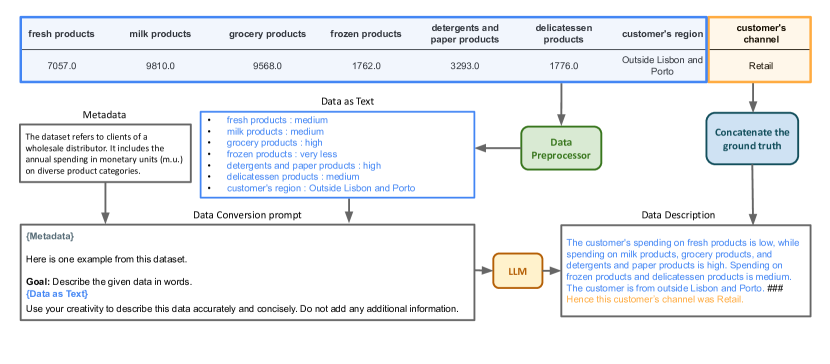
Experimental results
Research questions
- RQ1Can LLMs serve as weak learners within a boosting framework for tabular data via prompt-driven summarization?
- RQ2Does summarization of data descriptions yield better weak learners than naive few-shot prompts?
- RQ3How does the proposed Summary Boosting approach compare with traditional tabular methods and prompting baselines?
Key findings
- Zero-shot performance is inconsistent and generally worse across datasets.
- Few-shot improves over zero-shot on most datasets, except a few where it does not.
- Summary outperforms Few-shot and Zero-shot across datasets.
- Summary Boosting often surpasses both Summary and other prompting baselines.
- On very small datasets, Summary Boosting can outperform some finetuned or non-prompt baselines.
- Performance degrades for datasets with many continuous attributes unless LLMs are finetuned or newer models are used.

Read this paper
Open the full text in the Nubint reader and ask about any passage as you read.
Read this paper on NubintThis review was generated by AI from the original paper. Please check the paper before citing it.