
[Paper Review] Language Models for Text Classification: Is In-Context Learning Enough?
The paper conducts a large-scale evaluation comparing zero- and few-shot prompting of large language models to fine-tuned smaller models across 16 datasets, finding that fine-tuned smaller models often outperform few-shot LLMs, though prompting shows strengths in low-resource settings for certain tasks.
Recent foundational language models have shown state-of-the-art performance in many NLP tasks in zero- and few-shot settings. An advantage of these models over more standard approaches based on fine-tuning is the ability to understand instructions written in natural language (prompts), which helps them generalise better to different tasks and domains without the need for specific training data. This makes them suitable for addressing text classification problems for domains with limited amounts of annotated instances. However, existing research is limited in scale and lacks understanding of how text generation models combined with prompting techniques compare to more established methods for text classification such as fine-tuning masked language models. In this paper, we address this research gap by performing a large-scale evaluation study for 16 text classification datasets covering binary, multiclass, and multilabel problems. In particular, we compare zero- and few-shot approaches of large language models to fine-tuning smaller language models. We also analyse the results by prompt, classification type, domain, and number of labels. In general, the results show how fine-tuning smaller and more efficient language models can still outperform few-shot approaches of larger language models, which have room for improvement when it comes to text classification.
Motivation & Objective
- Assess how well zero- and few-shot prompting with large language models (LLMs) performs on text classification tasks compared to fine-tuned smaller models.
- Identify strengths and weaknesses of prompting versus fine-tuning across binary, multiclass, and multilabel tasks.
- Analyze performance trends across domains, dataset properties, and label counts to understand generalisability and limitations.
Proposed method
- Evaluate five model types (generative LLMs, RoBERTa base/large, T5, Flan-T5, FastText) on 16 datasets spanning binary, multiclass, and multilabel tasks.
- Compare zero- and one-shot prompting for LLaMA-1, LLaMA-2, Flan-T5, and GPT-3.5-Turbo to fine-tuning baselines (RoBERTa, T5, FastText).
- Use three prompt styles (generic, task, domain) to assess prompt sensitivity.
- Fine-tune RoBERTa and T5 on each dataset and compare against prompting baselines.
- Report micro- and macro-F1, plus wrong-label counts, across datasets and domains.
Experimental results
Research questions
- RQ1How do zero- and one-shot prompting methods for LLMs compare to fine-tuning smaller language models on text classification tasks?
- RQ2Are prompting-based approaches more data-efficient than fine-tuning for binary, multiclass, and multilabel classification tasks?
- RQ3What are the strengths and weaknesses of LLM prompting vs fine-tuning across different domains and label counts?
- RQ4How does prompt design (generic, task, domain) influence performance and robustness across models?
- RQ5Do domain-specific or task-specific datasets exhibit different trends in prompting versus fine-tuning?
Key findings
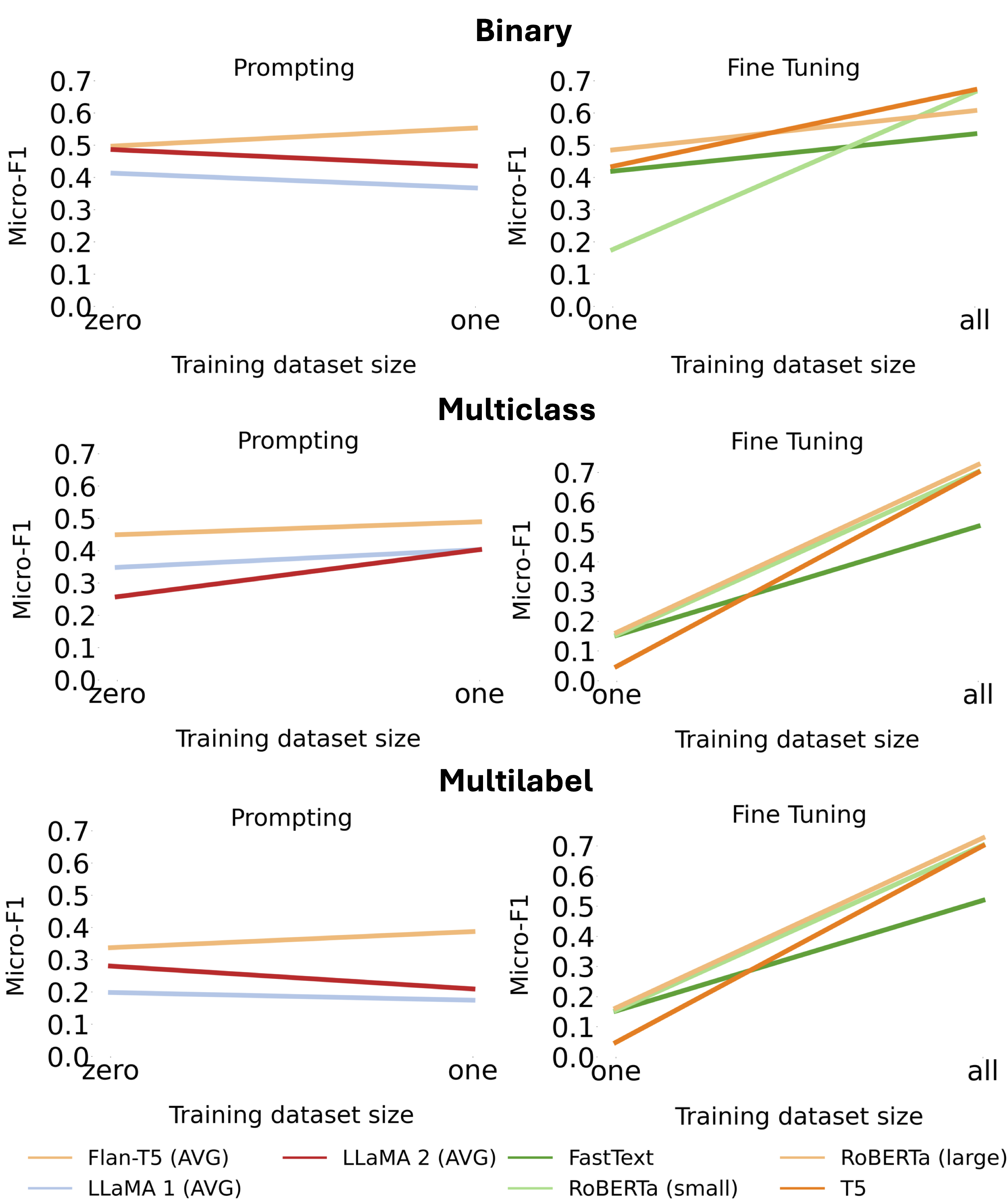
- Fine-tuned smaller language models (e.g., RoBERTa) often outperform few-shot prompting of larger LLMs on text classification tasks.
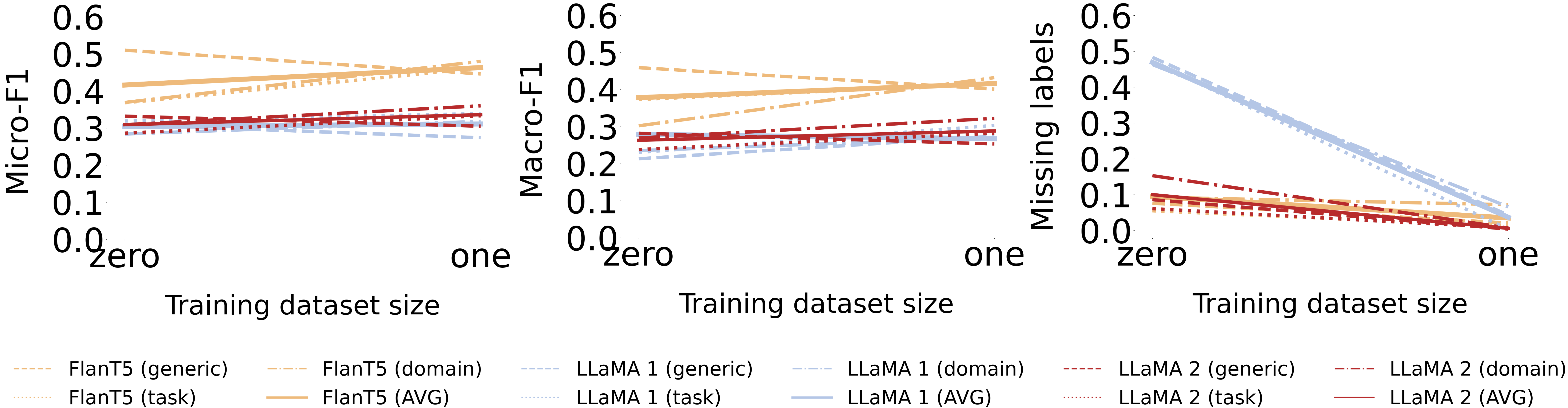
- Among prompting models, Flan-T5 tends to achieve higher micro- and macro-F1 in zero- and one-shot settings compared to LLaMA variants.
- One-shot prompting generally improves performance and reduces wrong labels across models, with Flan-T5 showing notable gains.
- For multiclass and multilabel tasks, fine-tuned masked language models often surpass prompting approaches, indicating room for improvement in LLM prompting for complex classifications.
- Prompt choice shows limited impact on model behavior overall, though smaller models like Flan-T5 can be more sensitive to prompts in zero-shot settings.
- Across diverse domains (including legal, medical, crime), fine-tuning remains competitive or superior for many datasets, while prompting offers value in low-resource scenarios.
Read this paper
Open the full text in the Nubint reader and ask about any passage as you read.
Read this paper on NubintThis review was generated by AI from the original paper. Please check the paper before citing it.