
[Paper Review] Language Models Learn Rare Phenomena from Less Rare Phenomena: The Case of the Missing AANNs
This paper demonstrates that large language models learn rare syntactic constructions like the English Article+Adjective+Numeral+Noun (AANN) pattern not through memorization, but by generalizing from more frequent, related constructions such as 'a few days'. Through systematic corpus manipulations and controlled training, the authors show that models retain and generalize AANN patterns even when the target construction is entirely absent from training data, provided related structures are present and exhibit high slot variability.
Language models learn rare syntactic phenomena, but the extent to which this is attributable to generalization vs. memorization is a major open question. To that end, we iteratively trained transformer language models on systematically manipulated corpora which were human-scale in size, and then evaluated their learning of a rare grammatical phenomenon: the English Article+Adjective+Numeral+Noun (AANN) construction (``a beautiful five days''). We compared how well this construction was learned on the default corpus relative to a counterfactual corpus in which AANN sentences were removed. We found that AANNs were still learned better than systematically perturbed variants of the construction. Using additional counterfactual corpora, we suggest that this learning occurs through generalization from related constructions (e.g., ``a few days''). An additional experiment showed that this learning is enhanced when there is more variability in the input. Taken together, our results provide an existence proof that LMs can learn rare grammatical phenomena by generalization from less rare phenomena. Data and code: https://github.com/kanishkamisra/aannalysis.
Motivation & Objective
- To investigate whether language models learn rare grammatical phenomena like the AANN construction through generalization or memorization.
- To test whether the absence of direct AANN examples in training data prevents learning, and if so, whether related constructions can substitute as learning triggers.
- To examine how variability in slot fillers (adjectives, numerals, nouns) within AANN instances affects model generalization ability.
- To determine whether models can generalize to novel AANN combinations when exposed to diverse, non-redundant exemplars.
- To provide empirical evidence that LMs can acquire rare syntactic patterns through inductive learning from more frequent, structurally similar constructions.
Proposed method
- Trained transformer-based language models on a human-scale corpus (BabyLM, ~100M words) with systematically manipulated versions to isolate the effects of specific constructions.
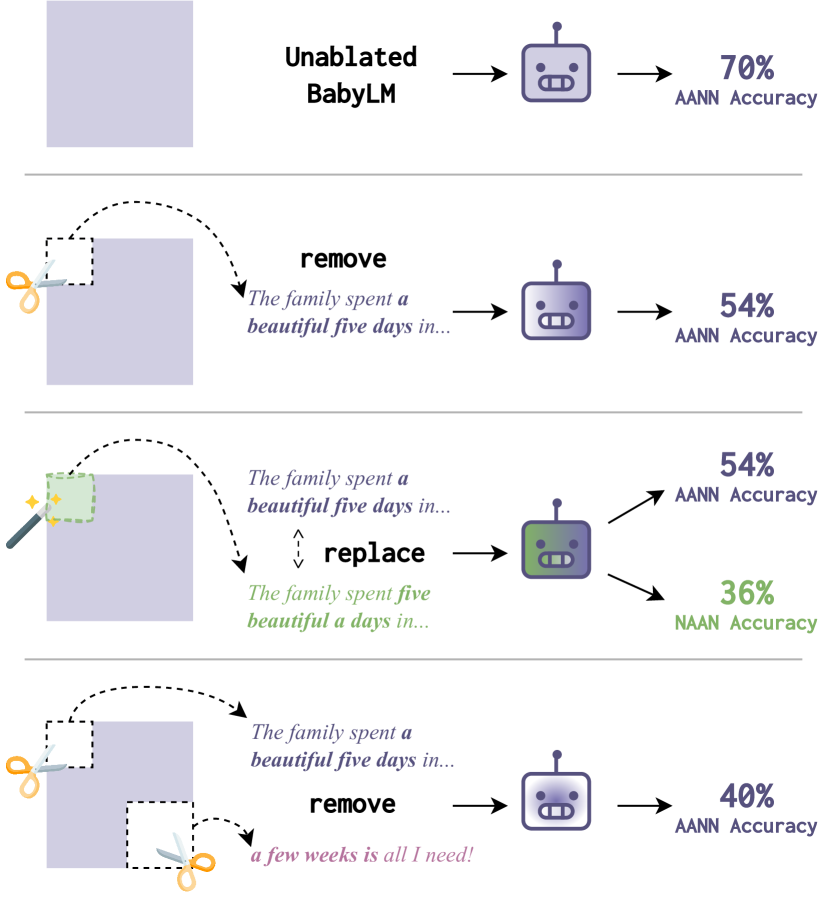
- Created counterfactual corpora: one with all AANNs removed, one with AANNs replaced by corrupted variants (e.g., 'beautiful a five days'), and one with AANNs and related constructions (e.g., 'a few weeks is') removed.
- Measured model performance using the Sentence Likelihood of Repeatedness (SLOR), a metric assessing model likelihood for unseen AANN-like constructions.
- Partitioned AANN instances into two subsets: one with high slot variability (diverse adjectives, numerals, nouns), and one with low variability (repetitive fillers), then trained models on each subset.
- Used representational editing and ablation techniques to isolate the influence of specific construction types on model behavior.
- Compared model performance across conditions to assess generalization capacity and sensitivity to input diversity.
Experimental results
Research questions
- RQ1Can language models learn the rare AANN construction when it is entirely absent from the training data?
- RQ2To what extent do related, more frequent constructions (e.g., 'a few days') support the learning of the AANN pattern?
- RQ3How does the variability of fillers in the open slots of AANNs affect model generalization to novel combinations?
- RQ4Does the model’s ability to generalize to unseen AANNs depend on the diversity of training exemplars, even when the target construction is not directly present?
- RQ5Is the model’s performance on AANNs better explained by memorization or by inductive generalization from related structures?
Key findings
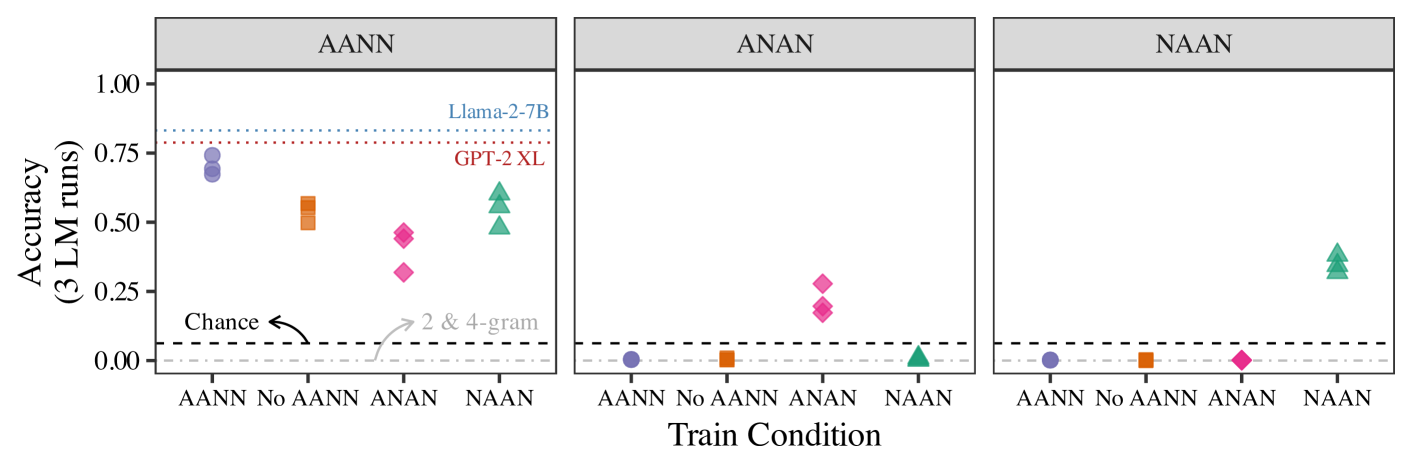
- Language models trained without any AANN examples still achieved high SLOR scores for unseen AANNs, indicating generalization rather than memorization.
- Models trained on corpora lacking AANNs but containing related constructions (e.g., 'a few days') learned the AANN pattern as effectively as models trained on corpora containing AANNs.
- Models exposed to AANNs with high slot variability (diverse adjectives, numerals, nouns) showed SLOR scores comparable to or higher than those trained on the full AANN corpus.
- Models trained only on low-variability AANN instances performed no better than models trained without any AANNs, suggesting overfitting to limited patterns.
- The presence of related constructions such as 'a few weeks is' significantly enhanced AANN learning, even when AANNs were absent.
- Slot variability served as a strong cue for model generalization, with high-variability inputs leading to greater productivity in generating novel AANNs.
Read this paper
Open the full text in the Nubint reader and ask about any passage as you read.
Read this paper on NubintThis review was generated by AI from the original paper. Please check the paper before citing it.