
[Paper Review] Language models scale reliably with over-training and on downstream tasks
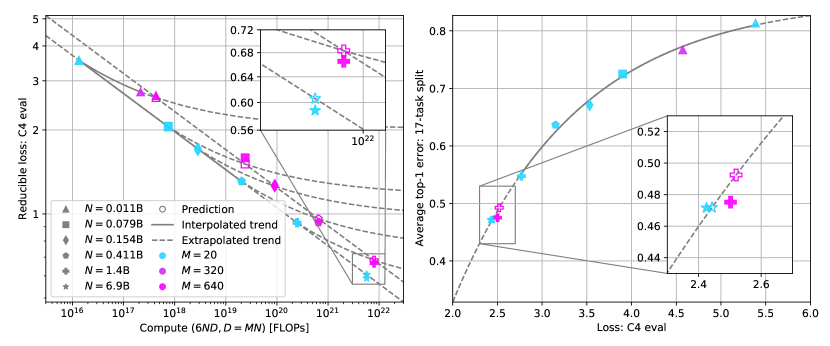
This paper establishes reliable scaling laws for language models in the over-trained regime and links language modeling perplexity to downstream task performance via power laws. Using 104 models trained on three datasets, it predicts validation loss and average downstream top-1 error for large-scale models with up to 300× and 20× less compute than required for direct training, respectively.
Scaling laws are useful guides for derisking expensive training runs, as they predict performance of large models using cheaper, small-scale experiments. However, there remain gaps between current scaling studies and how language models are ultimately trained and evaluated. For instance, scaling is usually studied in the compute-optimal training regime (i.e., "Chinchilla optimal" regime). In contrast, models are often over-trained to reduce inference costs. Moreover, scaling laws mostly predict loss on next-token prediction, but models are usually compared on downstream task performance. To address both shortcomings, we create a testbed of 104 models with 0.011B to 6.9B parameters trained with various numbers of tokens on three data distributions. First, we fit scaling laws that extrapolate in both the amount of over-training and the number of model parameters. This enables us to predict the validation loss of a 1.4B parameter, 900B token run (i.e., 32$ imes$ over-trained) and a 6.9B parameter, 138B token run (i.e., a compute-optimal run)$\unicode{x2014}$each from experiments that take 300$ imes$ less compute. Second, we relate the perplexity of a language model to its downstream task performance by proposing a power law. We use this law to predict top-1 error averaged over downstream tasks for the two aforementioned models, using experiments that take 20$ imes$ less compute. Our experiments are available at https://github.com/mlfoundations/scaling.
Motivation & Objective
- Address the gap between compute-optimal scaling laws and real-world over-training practices in large language model development.
- Investigate whether scaling laws remain predictable when models are trained beyond compute-optimal regimes.
- Establish a quantitative link between language modeling perplexity and downstream task performance to enable early prediction of model efficacy.
- Provide a scalable experimental testbed to validate extrapolation of scaling laws across model size and training compute.
- Enable efficient model development by reducing the need for expensive full-scale training runs through accurate low-compute extrapolation.
Proposed method
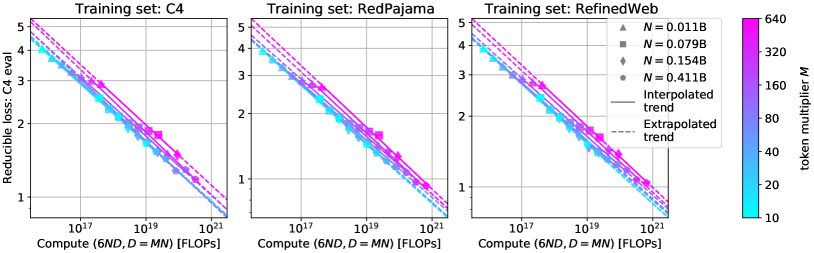
- Train 104 language models with parameter counts from 0.011B to 6.9B across three data distributions: RedPajama, C4, and RefinedWeb.
- Fit scaling laws relating model validation loss to training compute (C) and token-to-parameter ratio (M = D/N), using power-law forms L′ = λ·C^(-α_C).
- Extrapolate scaling laws trained on small models to predict performance of large models trained with 300× more compute (e.g., 1.4B, 900B token run).
- Establish a power-law relationship between model perplexity and average downstream top-1 error across 17 tasks, enabling error prediction from low-compute experiments.
- Use bootstrap confidence intervals and compute-vs-error trade-off analysis to validate reliability and efficiency of scaling law predictions.
- Release all experimental results and code at https://github.com/mlfoundations/scaling to support reproducibility and further research.
Experimental results
Research questions
- RQ1Can scaling laws reliably extrapolate to models trained with significantly more compute than used in training the scaling law, particularly in the over-trained regime?
- RQ2How does the scaling exponent α_C vary with the token-to-parameter ratio M, and is it stable across different data distributions and model sizes?
- RQ3To what extent can a model’s perplexity on a next-token prediction task predict its average downstream top-1 error across diverse benchmarks?
- RQ4What is the trade-off between compute invested in fitting a scaling law and the resulting prediction accuracy for loss versus downstream error?
- RQ5Can scaling laws trained on small, compute-optimal models accurately predict the performance of large, over-trained models?
Key findings
- Scaling laws trained on small models in the compute-optimal regime can accurately predict the validation loss of a 1.4B parameter model trained on 900B tokens—requiring 300× more compute—using only 2.4×10^19 FLOPs.
- The scaling exponent α_C remains approximately constant across different token-to-parameter ratios M, indicating consistent generalization of scaling behavior in the over-trained regime.
- A power-law relationship between perplexity and average downstream top-1 error enables prediction of model performance on 17 tasks with less than 1 percentage point error from a 6.9B model trained on 138B tokens—using only 2.7×10^20 FLOPs, or 20× less than direct training.
- Predicting downstream error requires more compute to achieve the same relative error than predicting loss, indicating that error prediction is more sensitive and less efficient than loss prediction.
- The experimental testbed of 104 models across three datasets demonstrates that scaling laws remain robust and predictable even under significant over-training.
- The results confirm that reliable extrapolation is possible in both over-training and downstream performance prediction, enabling efficient model development workflows.
Read this paper
Open the full text in the Nubint reader and ask about any passage as you read.
Read this paper on NubintThis review was generated by AI from the original paper. Please check the paper before citing it.