
[Paper Review] Large Knowledge Model: Perspectives and Challenges
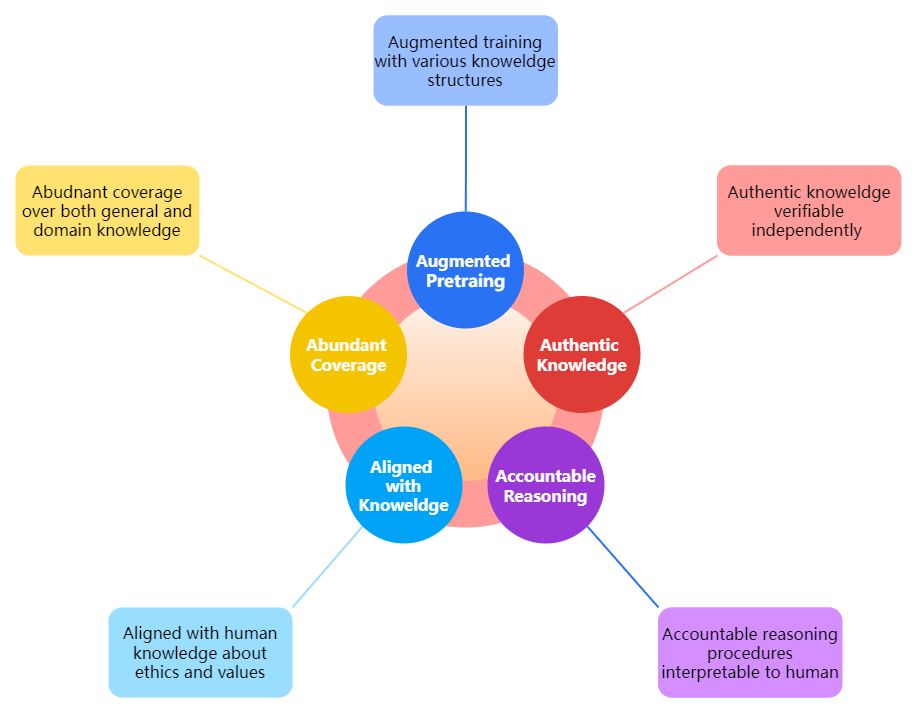
This paper proposes Large Knowledge Models (LKM) as an integrated framework that unifies large language models (LLMs) and knowledge graphs (KGs) to handle diverse knowledge structures more effectively. By combining symbolic knowledge representations with neural parameterization, LKMs aim to enhance reasoning, reduce hallucinations, and improve interpretability through a five-“A” principle: Augmented pretraining, Authentic knowledge, Accountable reasoning, Abundant coverage, and Aligned with knowledge.
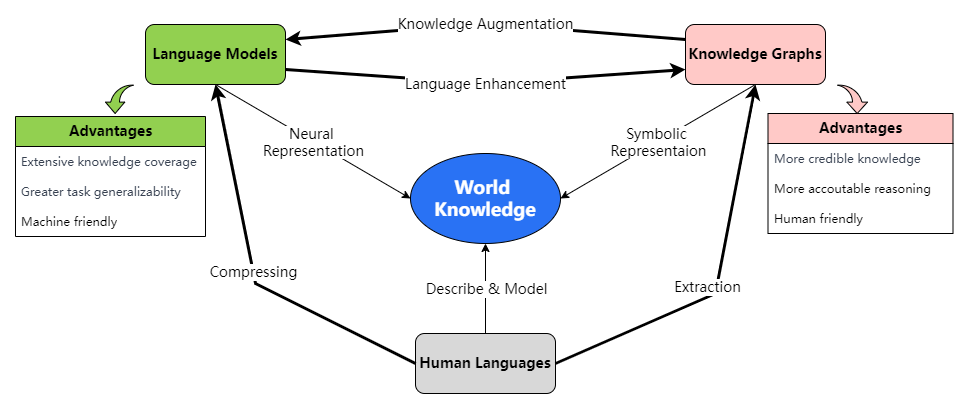
Humankind's understanding of the world is fundamentally linked to our perception and cognition, with \emph{human languages} serving as one of the major carriers of \emph{world knowledge}. In this vein, \emph{Large Language Models} (LLMs) like ChatGPT epitomize the pre-training of extensive, sequence-based world knowledge into neural networks, facilitating the processing and manipulation of this knowledge in a parametric space. This article explores large models through the lens of "knowledge". We initially investigate the role of symbolic knowledge such as Knowledge Graphs (KGs) in enhancing LLMs, covering aspects like knowledge-augmented language model, structure-inducing pre-training, knowledgeable prompts, structured CoT, knowledge editing, semantic tools for LLM and knowledgeable AI agents. Subsequently, we examine how LLMs can boost traditional symbolic knowledge bases, encompassing aspects like using LLM as KG builder and controller, structured knowledge pretraining, and LLM-enhanced symbolic reasoning. Considering the intricate nature of human knowledge, we advocate for the creation of \emph{Large Knowledge Models} (LKM), specifically engineered to manage diversified spectrum of knowledge structures. This promising undertaking would entail several key challenges, such as disentangling knowledge base from language models, cognitive alignment with human knowledge, integration of perception and cognition, and building large commonsense models for interacting with physical world, among others. We finally propose a five-"A" principle to distinguish the concept of LKM.
Motivation & Objective
- Address the limitations of current LLMs in handling structured, symbolic knowledge and reducing hallucinations.
- Overcome the rigidity and scalability issues of traditional symbolic knowledge bases like knowledge graphs.
- Integrate the strengths of LLMs (generalization, language understanding) with symbolic knowledge (interpretability, structure) for more reliable AI systems.
- Develop a unified framework for managing diverse knowledge structures—textual, ontological, logical, and commonsense—within a single model architecture.
- Establish a principled foundation for trustworthy, human-aligned AI through a five-“A” framework for LKM design and evaluation.
Proposed method
- Propose a five-“A” principle framework to guide the design of Large Knowledge Models (LKM): Augmented pretraining, Authentic knowledge, Accountable reasoning, Abundant coverage, and Aligned with knowledge.
- Integrate knowledge graphs (KGs) into LLMs via knowledge-augmented pretraining, structured prompts, and knowledge editing to improve factual consistency.
- Use LLMs as controllers and builders for knowledge graphs, enabling automated knowledge extraction, reasoning, and dynamic updates.
- Enhance reasoning in LLMs by combining chain-of-thought (CoT) with symbolic knowledge bases, enabling traceable, logical inference.
- Decouple knowledge representation from language model parameters to allow independent verification, maintenance, and upgrading of knowledge.
- Foster knowledge exchange among AI agents through shared, structured knowledge bases and LLM-powered reasoning to scale coverage and coherence.
Experimental results
Research questions
- RQ1How can knowledge graphs be effectively integrated into large language models to improve factual accuracy and reasoning?
- RQ2What are the key architectural and training principles needed to build a Large Knowledge Model (LKM) that unifies symbolic and neural representations?
- RQ3How can hallucinations in LLMs be reduced while maintaining their generalization and adaptability?
- RQ4In what ways can LLMs enhance traditional knowledge graph technologies such as knowledge extraction, querying, and reasoning?
- RQ5How can Large Knowledge Models be aligned with human values and ethical knowledge to ensure trustworthy and accountable AI?
Key findings
- Knowledge-augmented language modeling significantly improves factual consistency and reduces hallucinations in LLMs by grounding outputs in structured knowledge.
- Structure-inducing pretraining enhances both inter-sample and intra-sample coherence, leading to more reliable and interpretable model behavior.
- LLMs can act as effective controllers and builders for knowledge graphs, enabling scalable, automated knowledge base construction and dynamic updates.
- Integrating symbolic reasoning with LLMs enables accountable, traceable reasoning processes that improve reliability and human interpretability.
- Decoupling knowledge representation from language models allows for independent verification and maintenance, increasing authenticity and trustworthiness.
- The five-“A” principle provides a comprehensive framework for designing LKMs that balance coverage, alignment, authenticity, and reasoning accountability.
Better researchstarts right now
From reading papers to final review, dramatically reduce your research time.
No credit card · Free plan available
This review was created by AI and reviewed by human editors.