
[Paper Review] Large Language Model Agent for Hyper-Parameter Optimization
This paper introduces AgentHPO, a novel LLM-powered agent framework that automates hyperparameter optimization by employing specialized Creator and Executor agents to interpret natural language task descriptions, iteratively refine hyperparameters, and reduce trial counts. It achieves state-of-the-art performance on 12 diverse ML tasks while providing interpretable, human-like optimization with minimal expert intervention.
Hyperparameter optimization is critical in modern machine learning, requiring expert knowledge, numerous trials, and high computational and human resources. Despite the advancements in Automated Machine Learning (AutoML), challenges in terms of trial efficiency, setup complexity, and interoperability still persist. To address these issues, we introduce a novel paradigm leveraging Large Language Models (LLMs) to automate hyperparameter optimization across diverse machine learning tasks, which is named AgentHPO (short for LLM Agent-based Hyperparameter Optimization). Specifically, AgentHPO processes the task information autonomously, conducts experiments with specific hyperparameters (HPs), and iteratively optimizes them based on historical trials. This human-like optimization process largely reduces the number of required trials, simplifies the setup process, and enhances interpretability and user trust, compared to traditional AutoML methods. Extensive empirical experiments conducted on 12 representative machine-learning tasks indicate that AgentHPO not only matches but also often surpasses the best human trials in terms of performance while simultaneously providing explainable results. Further analysis sheds light on the strategies employed by the LLM in optimizing these tasks, highlighting its effectiveness and adaptability in various scenarios.
Motivation & Objective
- To address the limitations of traditional AutoML in trial efficiency, setup complexity, and lack of interpretability in hyperparameter optimization.
- To explore the feasibility and effectiveness of leveraging LLM-powered autonomous agents for end-to-end hyperparameter tuning.
- To design a modular agent architecture that simplifies user input and enhances transparency in hyperparameter configuration.
- To reduce the dependency on expert knowledge while maintaining or improving optimization performance.
- To provide explainable, step-by-step reasoning for hyperparameter choices to increase user trust and accessibility.
Proposed method
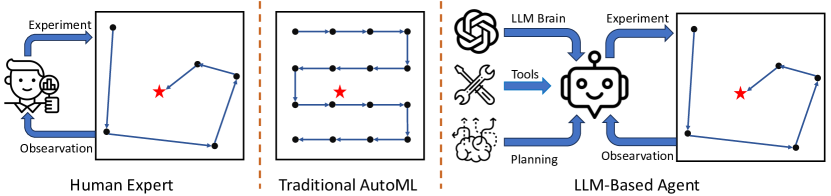
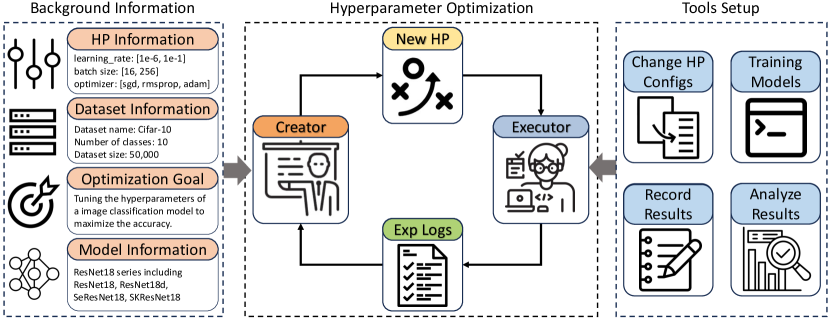
- AgentHPO employs two specialized LLM agents: the Creator agent, which interprets natural language task descriptions and generates initial hyperparameter configurations.
- The Executor agent trains models using the provided hyperparameters, records training metrics, and performs outcome analysis.
- The Creator agent iteratively refines hyperparameters based on feedback and performance data from the Executor, emulating expert reasoning.
- The framework uses natural language input to define task-specific objectives, datasets, and model structures, eliminating complex configuration steps.
- The system leverages the reasoning and tool-use capabilities of LLMs to explore the hyperparameter space efficiently and adaptively.
- The iterative loop between Creator and Executor enables self-improving optimization with minimal human oversight.
Experimental results
Research questions
- RQ1Can LLM-powered agents autonomously and effectively perform hyperparameter optimization across diverse machine learning tasks?
- RQ2How does the agent-based approach compare to traditional AutoML and human expert tuning in terms of trial efficiency and performance?
- RQ3To what extent can LLM agents provide interpretable and trustworthy hyperparameter configurations without expert intervention?
- RQ4What role does natural language input play in simplifying setup and improving accessibility for non-expert users?
- RQ5How do the specialized Creator and Executor agents collaborate to reduce the number of required trials while maintaining or improving model performance?
Key findings
- AgentHPO achieved performance on par with or better than the best human-tuned configurations across 12 representative machine learning tasks.
- The framework significantly reduced the number of required trials compared to traditional AutoML methods, improving efficiency.
- Users reported higher trust and interpretability due to the LLM's textual explanations of hyperparameter choices and optimization rationale.
- The natural language input interface simplified setup, reducing configuration errors and lowering the barrier to entry for non-expert users.
- The Creator and Executor agents demonstrated effective collaboration, with the Creator adapting hyperparameters based on historical training outcomes from the Executor.
- Empirical results show that AgentHPO generalizes well across diverse domains, including NLP, computer vision, and tabular data tasks.
Better researchstarts right now
From reading papers to final review, dramatically reduce your research time.
No credit card · Free plan available
This review was created by AI and reviewed by human editors.