
[Paper Review] Large Language Model Alignment: A Survey
A comprehensive survey of LLM alignment, detailing outer and inner alignment, interpretability, vulnerabilities, evaluation benchmarks, and future directions.
Recent years have witnessed remarkable progress made in large language models (LLMs). Such advancements, while garnering significant attention, have concurrently elicited various concerns. The potential of these models is undeniably vast; however, they may yield texts that are imprecise, misleading, or even detrimental. Consequently, it becomes paramount to employ alignment techniques to ensure these models to exhibit behaviors consistent with human values. This survey endeavors to furnish an extensive exploration of alignment methodologies designed for LLMs, in conjunction with the extant capability research in this domain. Adopting the lens of AI alignment, we categorize the prevailing methods and emergent proposals for the alignment of LLMs into outer and inner alignment. We also probe into salient issues including the models' interpretability, and potential vulnerabilities to adversarial attacks. To assess LLM alignment, we present a wide variety of benchmarks and evaluation methodologies. After discussing the state of alignment research for LLMs, we finally cast a vision toward the future, contemplating the promising avenues of research that lie ahead. Our aspiration for this survey extends beyond merely spurring research interests in this realm. We also envision bridging the gap between the AI alignment research community and the researchers engrossed in the capability exploration of LLMs for both capable and safe LLMs.
Motivation & Objective
- Motivate the need for LLM alignment to curb undesirable, misleading, or harmful outputs.
- Provide a holistic taxonomy of alignment research inspired by AI alignment (outer, inner, interpretability).
- Summarize major outer and inner alignment methods, mechanistic interpretability, and evaluation benchmarks.
- Identify vulnerabilities and future research directions to bridge AI alignment and LLM capability communities.
Proposed method
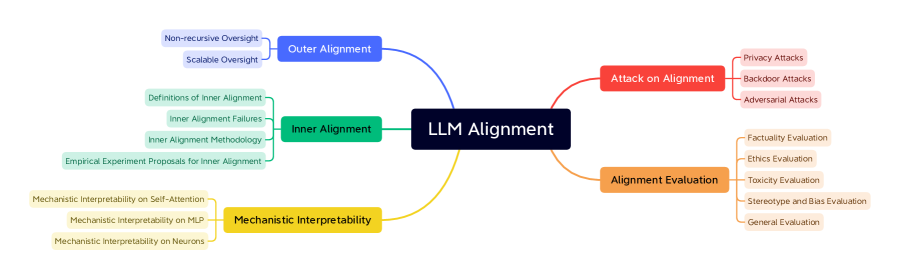
- Classifies LLM alignment methods into outer alignment, inner alignment, and mechanistic interpretability.
- Reviews non-recursive and scalable oversight approaches for outer alignment.
- Discusses vulnerabilities and adversarial attacks on aligned LLMs.
- surveys evaluation benchmarks for factuality, ethics, toxicity, bias, and general alignment.
- Proposes future research directions and field-building considerations.
Experimental results
Research questions
- RQ1What are the main components and approaches of outer alignment for LLMs?
- RQ2How is inner alignment defined and addressed in the LLM context, and what are its challenges?
- RQ3What role does mechanistic interpretability play in LLM alignment and safety?
- RQ4What benchmarks and evaluation methodologies exist for LLM alignment, and what do they assess?
- RQ5What future directions and pathways can advance LLM alignment research and field collaboration?
Key findings
- Outer alignment is pursued via non-recursive and scalable oversight, with scalable methods viewed as the most promising for aligning capable models to human values.
- Inner alignment and interpretability are essential components alongside outer alignment for ensuring models follow intended goals and are understandable.
- There are identified attack vectors (privacy, backdoor, adversarial attacks) and evaluation schemes (factuality, ethics, toxicity, bias) relevant to LLM alignment.
- The survey outlines future directions including theoretical work, automated alignment, transparency, and field-building to connect LLM and AI alignment communities.
Read this paper
Open the full text in the Nubint reader and ask about any passage as you read.
Read this paper on NubintThis review was generated by AI from the original paper. Please check the paper before citing it.