
[Paper Review] Large Language Model based Situational Dialogues for Second Language Learning
This paper proposes fine-tuned large language models (LLMs) for situational dialogues to enhance second language learners' conversational skills, combining open-ended engagement with scenario-based focus. The approach achieves strong performance on both in-domain and out-of-domain topics, with a novel automatic evaluation method using LLMs to enable efficient, reliable assessment, demonstrating generalization and scalability beyond manually designed dialogue systems.
In second language learning, scenario-based conversation practice is important for language learners to achieve fluency in speaking, but students often lack sufficient opportunities to practice their conversational skills with qualified instructors or native speakers. To bridge this gap, we propose situational dialogue models for students to engage in conversational practice. Our situational dialogue models are fine-tuned on large language models (LLMs), with the aim of combining the engaging nature of an open-ended conversation with the focused practice of scenario-based tasks. Leveraging the generalization capabilities of LLMs, we demonstrate that our situational dialogue models perform effectively not only on training topics but also on topics not encountered during training. This offers a promising solution to support a wide range of conversational topics without extensive manual work. Additionally, research in the field of dialogue systems still lacks reliable automatic evaluation metrics, leading to human evaluation as the gold standard (Smith et al., 2022), which is typically expensive. To address the limitations of existing evaluation methods, we present a novel automatic evaluation method that employs fine-tuned LLMs to efficiently and effectively assess the performance of situational dialogue models.
Motivation & Objective
- To address the lack of conversational practice opportunities for second language learners due to limited access to qualified instructors or native speakers.
- To develop a flexible, scalable alternative to task-oriented dialogue systems that require extensive expert-defined state and action spaces.
- To leverage the generalization capabilities of LLMs for zero-shot or few-shot performance on unseen conversational topics without manual reconfiguration.
- To propose a reliable, efficient automatic evaluation framework for dialogue models, reducing reliance on costly human evaluation.
- To ensure the dialogue system adapts to learners’ proficiency levels while maintaining safety and coherence in educational contexts.
Proposed method
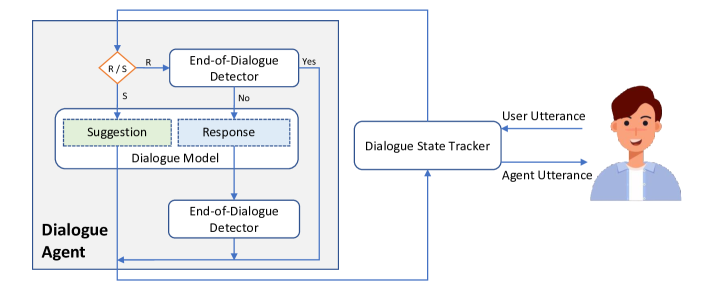
- Fine-tune LLMs (Qwen-1.8B, Qwen-7B, Qwen-14B) on scenario-based dialogue data to create dialogue agents that generate contextually appropriate responses.
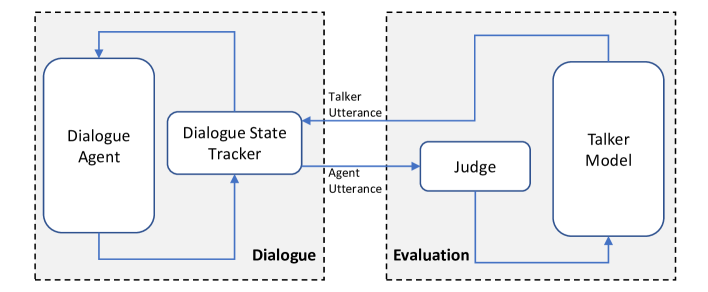
- Train a separate 'talker' model to generate user-side utterances, enabling full two-turn dialogue simulation with a suggestion mechanism at a 0.5 rate.
- Design a novel automatic evaluation framework using a fine-tuned LLM as a judge to assess response success rate, suggestion success rate, and session success rate.
- Use response success rate to evaluate individual utterance quality, suggestion success rate to assess helpfulness of model-provided hints, and session success rate to measure overall coherence and consistency.
- Apply the LLM-based judge to evaluate both in-domain and out-of-domain topics, enabling scalable and cost-effective model iteration.
- Compare the fine-tuned LLMs against a GPT-3.5-turbo prompt-based baseline to evaluate performance and inference cost trade-offs.
Experimental results
Research questions
- RQ1Can fine-tuned LLMs generalize to out-of-domain conversational topics without retraining or manual design?
- RQ2How effective is the proposed automatic evaluation method using a fine-tuned LLM judge compared to human evaluation?
- RQ3Can the dialogue system maintain coherence and relevance across full conversations while adapting to diverse topics?
- RQ4How does model size (e.g., 1.8B vs. 14B parameters) impact performance and reliability in situational dialogue tasks?
- RQ5To what extent can the system support learners at different proficiency levels without overcomplicating language output?
Key findings
- The Qwen-14B-based dialogue agent achieved the highest session success rate, with most conversations remaining error-free and coherent across 30 sessions per topic.
- The Qwen-7B and Qwen-14B models generalized effectively to 20 out-of-domain topics, showing minimal performance drop compared to in-domain topics.
- The fine-tuned LLM judge demonstrated reliable performance in evaluating both in-domain and out-of-domain dialogues, providing a scalable alternative to human evaluation.
- The GPT-3.5-turbo prompt-based baseline outperformed the Qwen-7B model but underperformed the Qwen-14B model, indicating a trade-off between cost and quality.
- The talker model successfully generated learner-like responses with appropriate suggestion rates, maintaining conversational flow without introducing errors.
- The proposed metrics—response success rate, suggestion success rate, and session success rate—effectively captured both utterance-level and dialogue-level quality.
Read this paper
Open the full text in the Nubint reader and ask about any passage as you read.
Read this paper on NubintThis review was generated by AI from the original paper. Please check the paper before citing it.