
[Paper Review] Large Language Model-Driven Classroom Flipping: Empowering Student-Centric Peer Questioning with Flipped Interaction
This paper proposes an LLM-driven classroom flipping framework that leverages flipped interaction—where LLMs generate questions instead of answers—to enhance peer questioning in hybrid and remote learning. By integrating prompt engineering with clicker quizzes and JiTT routines via a poll-prompt-quiz and quiz-prompt-discuss workflow, the approach enables student-centric, self-regulated learning and empowers instructors to personalize teaching in real time.
Reciprocal questioning is essential for effective teaching and learning, fostering active engagement and deeper understanding through collaborative interactions, especially in large classrooms. Can large language model (LLM), such as OpenAI's GPT (Generative Pre-trained Transformer) series, assist in this? This paper investigates a pedagogical approach of classroom flipping based on flipped interaction in LLMs. Flipped interaction involves using language models to prioritize generating questions instead of answers to prompts. We demonstrate how traditional classroom flipping techniques, including Peer Instruction and Just-in-Time Teaching (JiTT), can be enhanced through flipped interaction techniques, creating student-centric questions for hybrid teaching. In particular, we propose a workflow to integrate prompt engineering with clicker and JiTT quizzes by a poll-prompt-quiz routine and a quiz-prompt-discuss routine to empower students to self-regulate their learning capacity and enable teachers to swiftly personalize training pathways. We develop an LLM-driven chatbot software that digitizes various elements of classroom flipping and facilitates the assessment of students using these routines to deliver peer-generated questions. We have applied our LLM-driven chatbot software for teaching both undergraduate and graduate students from 2020 to 2022, effectively useful for bridging the gap between teachers and students in remote teaching during the COVID-19 pandemic years. In particular, LLM-driven classroom flipping can be particularly beneficial in large class settings to optimize teaching pace and enable engaging classroom experiences.
Motivation & Objective
- To address the challenge of maintaining student engagement and instructor responsiveness in large, hybrid, or remote classrooms post-COVID-19.
- To reduce instructor workload in creating assessment content by leveraging LLMs to generate peer-ready questions from student prompts.
- To support Just-in-Time Teaching (JiTT) and Peer Instruction through AI-generated, student-centered questions using flipped interaction.
- To develop a scalable, AI-augmented workflow that integrates LLMs with classroom interaction routines for real-time teaching adjustments.
- To promote self-regulated learning by enabling students to co-create and discuss questions, fostering deeper cognitive engagement.
Proposed method
- Employing 'flipped interaction'—a technique where LLMs are prompted to generate questions rather than answers—using prompt engineering to elicit pedagogically useful questions from student inputs.
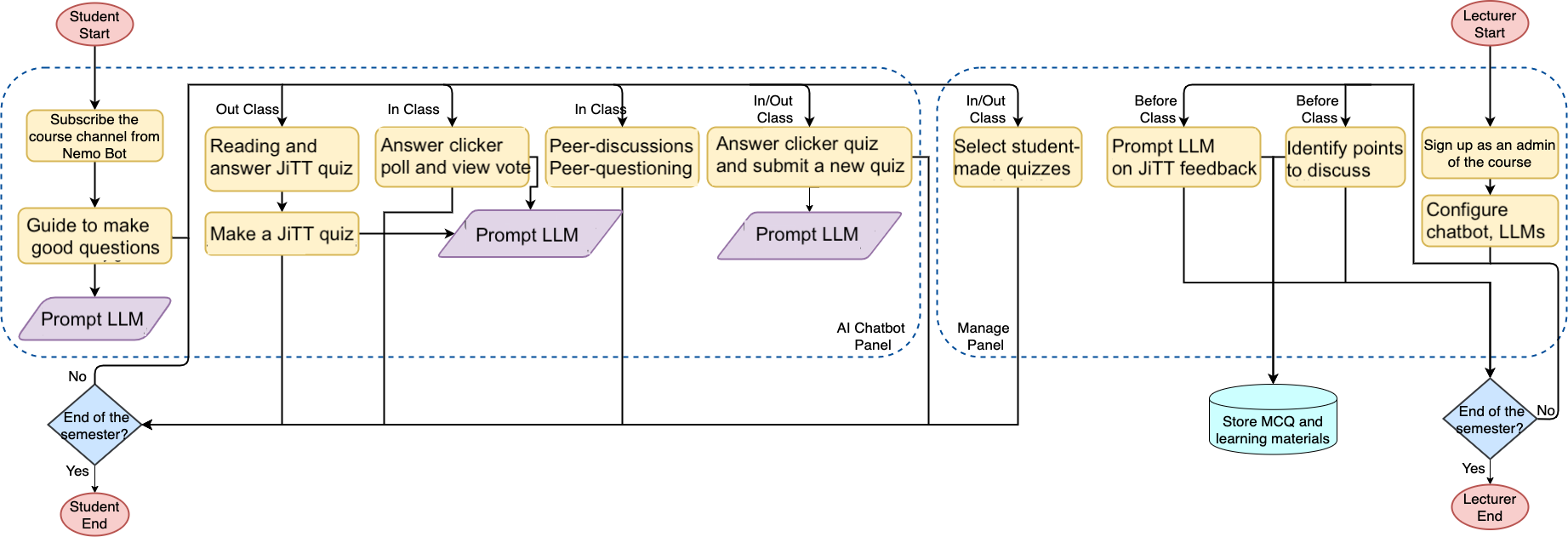
- Implementing a dual workflow: (1) poll-prompt-quiz for pre-class engagement and (2) quiz-prompt-discuss for in-class peer discussion and feedback.
- Designing an LLM-powered chatbot that digitizes classroom flipping elements, including quiz generation, question curation, and real-time feedback using the OpenAI API.
- Integrating the chatbot with JiTT and Peer Instruction models to align LLM outputs with established pedagogical frameworks.
- Using difficulty-level calibration (e.g., 5±1.8 to 8±0.5) to ensure question quality and alignment with learning objectives.
- Applying prompt templates that guide LLMs to generate questions of varying cognitive complexity, supporting formative assessment and adaptive teaching.

Experimental results
Research questions
- RQ1Can LLMs effectively generate high-quality, student-centric questions that support peer instruction and JiTT in hybrid learning environments?
- RQ2How can flipped interaction (LLM-generated questions instead of answers) be integrated into existing classroom flipping pedagogies to enhance student engagement?
- RQ3To what extent can LLM-driven chatbots reduce instructor workload while maintaining or improving assessment quality and learning outcomes?
- RQ4How can LLMs be used to personalize teaching pathways by analyzing student-generated questions and quiz responses in real time?
- RQ5What are the challenges in ensuring fairness, reducing bias, and maintaining data quality when using LLMs for educational assessment in diverse learning contexts?
Key findings
- The LLM-driven chatbot successfully digitized classroom flipping by generating peer-ready questions from student prompts, reducing instructor effort in content creation.
- The poll-prompt-quiz and quiz-prompt-discuss workflows enabled real-time teaching adjustments, with difficulty levels ranging from 5±1.8 to 8±0.5, indicating effective calibration.
- Student-generated questions, enhanced by LLMs, supported self-regulated learning and improved peer interaction in hybrid and remote settings.
- The framework demonstrated scalability and adaptability across both undergraduate and graduate courses from 2020 to 2022, especially during pandemic-era remote instruction.
- LLM integration enabled just-in-time teaching by allowing instructors to identify misconceptions and adjust pacing based on aggregated student question patterns.
- Preliminary results suggest that LLM-driven chatbots can support automated feedback and peer grading, though further validation is needed for broader assessment use.
Read this paper
Open the full text in the Nubint reader and ask about any passage as you read.
Read this paper on NubintThis review was generated by AI from the original paper. Please check the paper before citing it.