
[Paper Review] Large Language Model Is Not a Good Few-shot Information Extractor, but a Good Reranker for Hard Samples!
This paper demonstrates that large language models (LLMs) are ineffective as few-shot information extractors compared to fine-tuned small language models (SLMs), but excel at reranking hard samples that SLMs miss. The authors propose a filter-then-rerank framework where SLMs act as filters and LLMs as rerankers, achieving a consistent 2.4% F1-score improvement across multiple few-shot IE tasks with minimal latency and cost overhead.
Large Language Models (LLMs) have made remarkable strides in various tasks. Whether LLMs are competitive few-shot solvers for information extraction (IE) tasks, however, remains an open problem. In this work, we aim to provide a thorough answer to this question. Through extensive experiments on nine datasets across four IE tasks, we demonstrate that current advanced LLMs consistently exhibit inferior performance, higher latency, and increased budget requirements compared to fine-tuned SLMs under most settings. Therefore, we conclude that LLMs are not effective few-shot information extractors in general. Nonetheless, we illustrate that with appropriate prompting strategies, LLMs can effectively complement SLMs and tackle challenging samples that SLMs struggle with. And moreover, we propose an adaptive filter-then-rerank paradigm to combine the strengths of LLMs and SLMs. In this paradigm, SLMs serve as filters and LLMs serve as rerankers. By prompting LLMs to rerank a small portion of difficult samples identified by SLMs, our preliminary system consistently achieves promising improvements (2.4% F1-gain on average) on various IE tasks, with an acceptable time and cost investment.
Motivation & Objective
- To evaluate whether LLMs are effective few-shot information extractors compared to fine-tuned SLMs across diverse IE tasks.
- To investigate the performance gap between LLMs and SLMs under varying few-shot settings and data scarcity.
- To identify the types of samples where LLMs outperform SLMs, particularly hard samples beyond SLMs' capabilities.
- To design a hybrid framework that leverages the strengths of both LLMs and SLMs to improve few-shot IE performance.
Proposed method
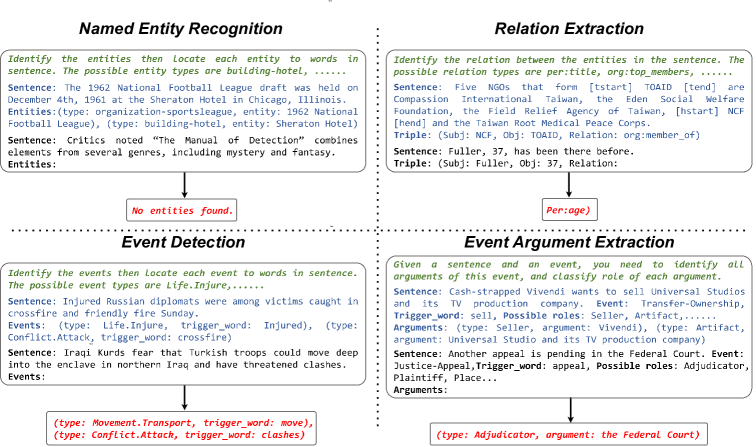
- The authors compare zero-shot in-context learning with LLMs against fine-tuned SLMs across nine datasets spanning four IE tasks: NER, relation extraction, event detection, and event argument extraction.
- They evaluate LLMs using varied prompting strategies, including instruction design, demonstration number, selection strategy, and prompt format, to assess robustness and sensitivity.
- Samples are categorized by difficulty based on SLMs' confidence scores, enabling analysis of LLMs' performance on easy vs. hard samples.
- A novel filter-then-rerank framework is proposed: SLMs first predict labels and filter out easy samples; hard samples are passed to LLMs for reranking using targeted prompting.
- Only the top-N most likely candidate labels from SLMs are fed to LLMs for reranking, minimizing inference cost and latency.
- The final prediction combines SLM outputs for easy samples and LLM reranked outputs for hard samples, leveraging complementary strengths.
Experimental results
Research questions
- RQ1Are LLMs competitive few-shot information extractors compared to fine-tuned SLMs across diverse low-resource IE tasks?
- RQ2How does the performance of LLMs vary across easy and hard samples, as measured by SLM confidence scores?
- RQ3Why do LLMs perform poorly on easy samples despite their strong reasoning abilities, and what causes their high false-positive rate?
- RQ4Can LLMs effectively improve SLM performance by reranking only the most challenging samples identified by SLMs?
- RQ5What is the optimal hybrid framework that combines SLMs and LLMs to maximize F1-score with acceptable cost and latency?
Key findings
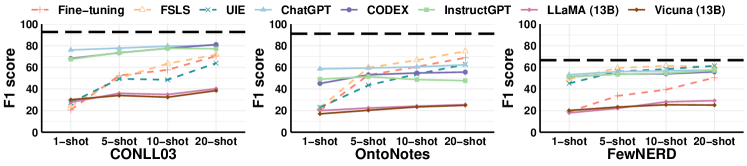
- LLMs consistently underperform fine-tuned SLMs in few-shot information extraction across nine datasets and four tasks, especially when training data exceeds 100 samples.
- LLMs exhibit significantly higher inference latency and cost compared to SLMs, making them less efficient for general few-shot IE.
- LLMs show strong performance on hard samples—those misclassified by SLMs—due to their reasoning and knowledge capabilities, but struggle with easy samples.
- LLMs have a high false-positive rate on easy negative samples, which causes their overall performance to collapse on easy examples.
- The proposed filter-then-rerank framework achieves an average 2.4% F1-score improvement across tasks by leveraging LLMs only on hard samples identified by SLMs.
- The framework maintains low additional cost and latency by reranking only a small subset of samples, proving effective and efficient for few-shot IE.
Read this paper
Open the full text in the Nubint reader and ask about any passage as you read.
Read this paper on NubintThis review was generated by AI from the original paper. Please check the paper before citing it.