
[Paper Review] Large Language Models are Capable of Offering Cognitive Reappraisal, if Guided
Guided by RESORT constitutions, LLMs can generate targeted cognitive reappraisals for emotional support, with expert psychologists rating improvements over baselines and open-source models approaching GPT-4 turbo performance; GPT-4 can moderately agree with expert evaluations when assessing reappraisals.
Large language models (LLMs) have offered new opportunities for emotional support, and recent work has shown that they can produce empathic responses to people in distress. However, long-term mental well-being requires emotional self-regulation, where a one-time empathic response falls short. This work takes a first step by engaging with cognitive reappraisals, a strategy from psychology practitioners that uses language to targetedly change negative appraisals that an individual makes of the situation; such appraisals is known to sit at the root of human emotional experience. We hypothesize that psychologically grounded principles could enable such advanced psychology capabilities in LLMs, and design RESORT which consists of a series of reappraisal constitutions across multiple dimensions that can be used as LLM instructions. We conduct a first-of-its-kind expert evaluation (by clinical psychologists with M.S. or Ph.D. degrees) of an LLM's zero-shot ability to generate cognitive reappraisal responses to medium-length social media messages asking for support. This fine-grained evaluation showed that even LLMs at the 7B scale guided by RESORT are capable of generating empathic responses that can help users reappraise their situations.
Motivation & Objective
- Motivate the use of cognitive appraisal-based interventions for long-term emotional well-being.
- Propose RESORT, a psychologically grounded framework of six appraisal dimensions, as LLM instructions.
- Evaluate whether LLMs can generate targeted reappraisals zero-shot under RESORT guidance via expert psychologists.
- Compare open-source LLMs and GPT-4 turbo in producing reappraisals and assess safety, factuality, and empathy.
Proposed method
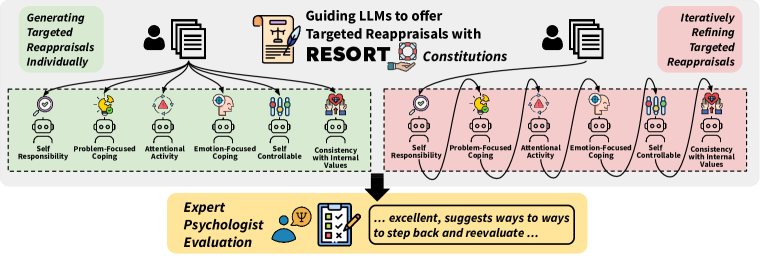
- Introduce RESORT, six appraisal dimensions with constitutions guiding reappraisal generation.
- Formulate two prompting strategies: individual guided reappraisal and iterative guided refinement.
- Optionally add explicit appraisal identification before generating reappraisals.
- Evaluate outputs with expert psychologists using alignment, empathy, harmfulness, and factuality criteria.
Experimental results
Research questions
- RQ1Can LLMs generate targeted cognitive reappraisals aligned with psychologically grounded constitutions (RESORT) in a zero-shot setting?
- RQ2Does explicit appraisal identification and/or iterative refinement improve alignment and empathy of reappraisals?
- RQ3Do open-source LLMs plus RESORT achieve comparable performance to GPT-4 turbo in producing reappraisals?
- RQ4What is the reliability and safety (harmfulness and factuality) of LLM-generated reappraisals compared to human-authored references?
Key findings
- LLMs guided by RESORT significantly improve alignment with constitutions compared with baselines.
- Explicit appraisal identification and iterative refinement further boost alignment and empathy scores.
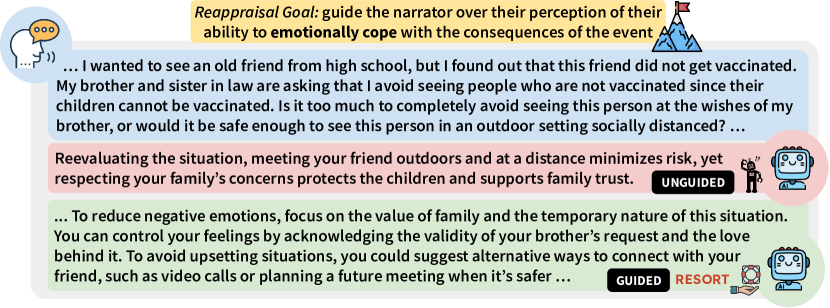
- Open-source models (LLaMA-2 13B-chat, Mistral 7B-instruct) achieve comparable performance to GPT-4 turbo on reappraisal tasks.
- GPT-4 can moderately agree with expert evaluators when assessing reappraisals, supporting its use as an automatic evaluator for prototyping.
- Most LLM-generated reappraisals (about 98% in the study) were rated as not harmful, with higher factuality than top Reddit comments in many cases.
Read this paper
Open the full text in the Nubint reader and ask about any passage as you read.
Read this paper on NubintThis review was generated by AI from the original paper. Please check the paper before citing it.