
[Paper Review] Large Language Models are Inconsistent and Biased Evaluators
The paper shows that LLM evaluators are biased and inconsistent across samples and prompts, proposes mitigation recipes, and demonstrates improvements on RoSE.
The zero-shot capability of Large Language Models (LLMs) has enabled highly flexible, reference-free metrics for various tasks, making LLM evaluators common tools in NLP. However, the robustness of these LLM evaluators remains relatively understudied; existing work mainly pursued optimal performance in terms of correlating LLM scores with human expert scores. In this paper, we conduct a series of analyses using the SummEval dataset and confirm that LLMs are biased evaluators as they: (1) exhibit familiarity bias-a preference for text with lower perplexity, (2) show skewed and biased distributions of ratings, and (3) experience anchoring effects for multi-attribute judgments. We also found that LLMs are inconsistent evaluators, showing low "inter-sample" agreement and sensitivity to prompt differences that are insignificant to human understanding of text quality. Furthermore, we share recipes for configuring LLM evaluators to mitigate these limitations. Experimental results on the RoSE dataset demonstrate improvements over the state-of-the-art LLM evaluators.
Motivation & Objective
- Assess biases and consistency of LLM-based evaluators in summarization tasks.
- Quantify familiarity bias, scoring biases, and anchoring effects using SummEval and RoSE datasets.
- Develop and validate practical recipes to mitigate identified issues.
- Compare enhanced LLM evaluators against state-of-the-art baselines on RoSE CNNDM and SAMSum partitions.
Proposed method
- Analyze LLM evaluators (GPT-3.5 and GPT-4) on SummEval and RoSE using multiple prompts and generation settings.
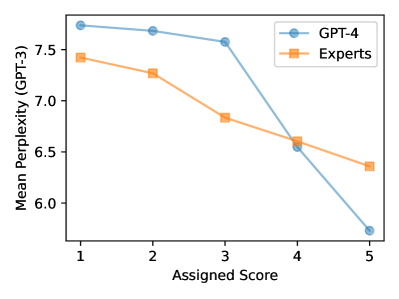
- Measure familiarity via perplexity correlations with ratings.
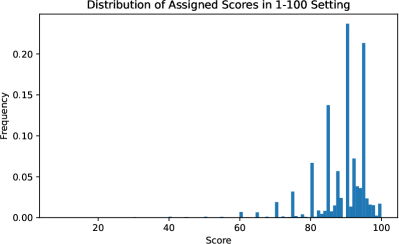
- Investigate scoring granularity by testing 1-5, 1-10, and 1-100 scales and averaging over multiple samples.
- Examine anchoring by predicting multiple attributes in a single generation and by reordering attributes.
- Use Krippendorff’s alpha to assess inter-sample consistency and inter-annotator agreement, and Kendall’s tau to compare with human judgments.
- Propose a recipe of mitigation strategies and validate on RoSE, comparing to G-Eval and Chiang & Lee (2023).
- Conduct a case study on RoSE CNNDM and SAMSum partitions to demonstrate performance gains.
Experimental results
Research questions
- RQ1Do LLM evaluators exhibit familiarity bias, scoring biases, and anchoring effects in summarization evaluation?
- RQ2How consistent are LLM evaluators across samples and prompt variations compared with human raters?
- RQ3Can a concrete set of mitigation recipes improve the reliability and alignment of LLM evaluators?
- RQ4Do the proposed methods yield statistically significant improvements on RoSE compared with state-of-the-art baselines?
Key findings
- LLM evaluators show familiarity bias, favoring low-perplexity summaries relative to human experts.
- LLMs exhibit scoring biases with round-number preferences and variable granularity.
- Anchoring effects appear when multiple attributes are predicted in one output, biasing subsequent scores.
- Inter-sample agreement for LLM evaluators is lower than human inter-annotator agreement, indicating self-inconsistency.
- Removing the source document substantially lowers evaluator performance, suggesting overreliance on source features.
- A combined recipe delivering 1-10 scoring with 0 temperature non-CoT prompts outperforms baselines on RoSE CNNDM and SAMSum partitions, achieving Kendall’s tau around 0.22 (in-domain) and 0.308 (SAMSum).
- The RoSE case study shows the proposed method outperforms G-Eval and Chiang & Lee (2023) on CNNDM and SAMSum with statistical significance (bootstrap).
Read this paper
Open the full text in the Nubint reader and ask about any passage as you read.
Read this paper on NubintThis review was generated by AI from the original paper. Please check the paper before citing it.