
[Paper Review] Large Language Models Are Semi-Parametric Reinforcement Learning Agents
The paper introduces Rememberer, an evolvable LLM-based agent with a persistent external experience memory updated via reinforcement learning, enabling semi-parametric RL without fine-tuning the LLM. It achieves state-of-the-art results on WebShop and WikiHow benchmarks.
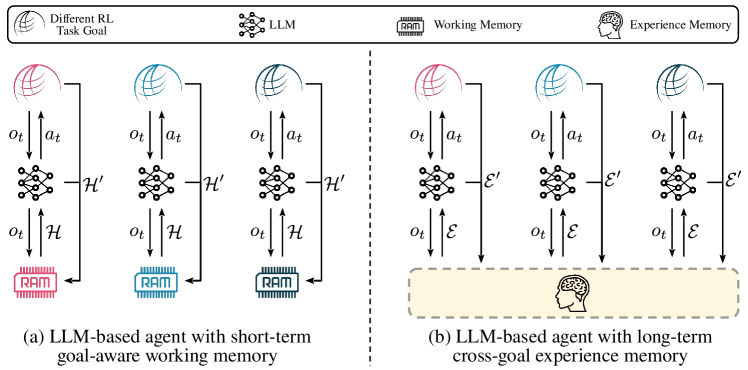
Inspired by the insights in cognitive science with respect to human memory and reasoning mechanism, a novel evolvable LLM-based (Large Language Model) agent framework is proposed as REMEMBERER. By equipping the LLM with a long-term experience memory, REMEMBERER is capable of exploiting the experiences from the past episodes even for different task goals, which excels an LLM-based agent with fixed exemplars or equipped with a transient working memory. We further introduce Reinforcement Learning with Experience Memory (RLEM) to update the memory. Thus, the whole system can learn from the experiences of both success and failure, and evolve its capability without fine-tuning the parameters of the LLM. In this way, the proposed REMEMBERER constitutes a semi-parametric RL agent. Extensive experiments are conducted on two RL task sets to evaluate the proposed framework. The average results with different initialization and training sets exceed the prior SOTA by 4% and 2% for the success rate on two task sets and demonstrate the superiority and robustness of REMEMBERER.
Motivation & Objective
- Motivate using long-term experience memory to enable LLM-based agents to learn from past episodes beyond fixed exemplars.
- Propose Reinforcement Learning with Experience Memory (RLEM) to update external memory rather than LLM parameters.
- Design Rememberer to selectively retrieve experiences and provide dynamic exemplars for in-context learning.
- Demonstrate robustness and performance gains on benchmark RL task sets WebShop and WikiHow.
Proposed method
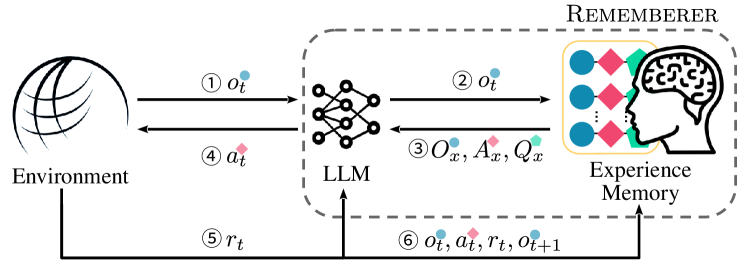
- Introduce an external, persistent experience memory for an LLM agent and define its interaction with the environment.
- Define Q-value updates in memory using a Bellman-like rule and optional n-step bootstrapping for stability.
- Use similarity-based retrieval from memory to form exemplars that guide the LLM through few-shot prompts.
- Present an action-advice prompt format with both encouraged and discouraged actions to leverage remembered experiences.
- Update memory through off-policy learning, without fine-tuning LLM parameters.
- Evaluate Rememberer on WebShop and WikiHow with comparisons to State-of-the-Art baselines.
Experimental results
Research questions
- RQ1Can an LLM-based agent learn from long-term experience memory without fine-tuning the model parameters?
- RQ2Does a semi-parametric RL framework with external memory improve performance on sequential decision tasks compared to fixed exemplars or pure RL/IL baselines?
- RQ3How should experiences be retrieved and presented to an LLM to maximize decision quality across tasks?
- RQ4What is the impact of bootstrapping and the inclusion of discouraged actions in the memory-exemplar prompts?
- RQ5How robust is Rememberer to different initial experiences and training sets?
Key findings
- Rememberer surpasses prior SOTA on WebShop with Avg Score 0.68 and Success Rate 0.39, vs ReAct 0.66 and 0.36 and LLM-only 0.55 and 0.29.
- On WikiHow, Rememberer achieves Avg Reward 2.63 and Success Rate 0.93, outperforming LLM-only 2.58/0.90 and Mobile-Env 2.50/0.89.
- Rememberer requires far fewer annotated samples (e.g., 10 tasks for 74 steps) than traditional RL/IL approaches to reach strong performance.
- Ablation shows that bootstrapping improves reward estimation accuracy and final performance, while removing observation similarity degrades results more than removing task similarity.
- The inclusion of discouraged actions and a two-component similarity (task and observation) significantly affects performance, with observation similarity being particularly crucial.
- Experiments indicate Rememberer is robust to different initial exemplars and training sets, maintaining improvements over fixed exemplars across settings.
Read this paper
Open the full text in the Nubint reader and ask about any passage as you read.
Read this paper on NubintThis review was generated by AI from the original paper. Please check the paper before citing it.