
[Paper Review] Large Language Models Based Automatic Synthesis of Software Specifications
This paper proposes SpecSyn, a novel framework that leverages BERT-based sequence-to-sequence learning to automatically synthesize software specifications from unstructured natural language sources such as manuals, comments, and forums. It achieves a 21% improvement in F1 score over prior state-of-the-art tools, marking the first end-to-end LLM-based approach for this task.
Software configurations play a crucial role in determining the behavior of software systems. In order to ensure safe and error-free operation, it is necessary to identify the correct configuration, along with their valid bounds and rules, which are commonly referred to as software specifications. As software systems grow in complexity and scale, the number of configurations and associated specifications required to ensure the correct operation can become large and prohibitively difficult to manipulate manually. Due to the fast pace of software development, it is often the case that correct software specifications are not thoroughly checked or validated within the software itself. Rather, they are frequently discussed and documented in a variety of external sources, including software manuals, code comments, and online discussion forums. Therefore, it is hard for the system administrator to know the correct specifications of configurations due to the lack of clarity, organization, and a centralized unified source to look at. To address this challenge, we propose SpecSyn a framework that leverages a state-of-the-art large language model to automatically synthesize software specifications from natural language sources. Our approach formulates software specification synthesis as a sequence-to-sequence learning problem and investigates the extraction of specifications from large contextual texts. This is the first work that uses a large language model for end-to-end specification synthesis from natural language texts. Empirical results demonstrate that our system outperforms prior the state-of-the-art specification synthesis tool by 21% in terms of F1 score and can find specifications from single as well as multiple sentences.
Motivation & Objective
- To address the challenge of manual configuration specification extraction in complex software systems.
- To reduce system failures caused by misconfigurations by automatically deriving valid configuration rules from unstructured sources.
- To develop an end-to-end framework that synthesizes specifications directly from natural language texts without relying on rule-based or syntactic parsing methods.
- To improve upon existing specification extraction tools by leveraging the contextual understanding of large language models.
- To provide system administrators with a reliable, centralized source of configuration rules extracted from diverse documentation sources.
Proposed method
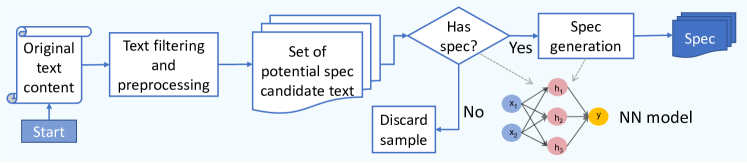
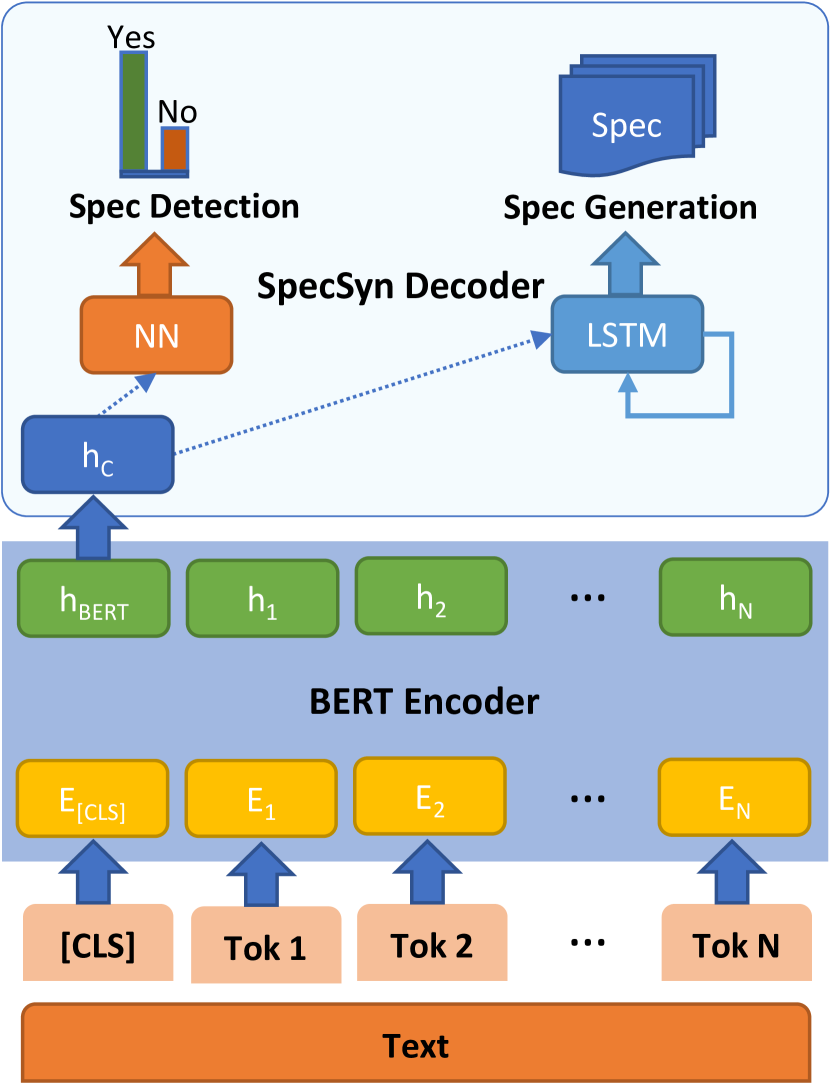
- Formulates software specification synthesis as a sequence-to-sequence learning problem using a fine-tuned BERT-based encoder-decoder architecture.
- Trains the model on curated datasets of configuration descriptions extracted from software manuals, code comments, and online forums.
- Employs data composition techniques to enhance generalization, combining multiple sentences into single input sequences for complex specification extraction.
- Uses a two-stage approach: single-sentence extraction for simple rules and two-sentence composition for complex, context-dependent specifications.
- Applies transfer learning via BERT’s pre-trained weights to capture semantic and syntactic patterns in configuration-related natural language.
- Optimizes the model using cross-entropy loss and evaluates performance using F1 score on a held-out test set.
Experimental results
Research questions
- RQ1Can a large language model effectively extract software configuration specifications from unstructured natural language texts?
- RQ2How does the performance of an LLM-based approach compare to traditional rule-based or syntactic parsing methods in specification extraction?
- RQ3To what extent can a sequence-to-sequence model generalize across diverse sources like manuals, code comments, and discussion forums?
- RQ4What is the impact of input sequence length and composition on specification extraction accuracy?
- RQ5Can the model handle both simple and complex specifications derived from single or multiple sentences?
Key findings
- SpecSyn achieves a 21% higher F1 score compared to the prior state-of-the-art specification synthesis tool, demonstrating significant performance gains.
- The model successfully extracts specifications from both single and multi-sentence contexts, with two-sentence inputs covering the majority of complex specification cases.
- Data composition techniques improve model generalization, enabling better performance with limited training data.
- The use of BERT-based fine-tuning enables effective understanding of configuration-related natural language, even in ambiguous or context-dependent phrasings.
- The model performs poorly on sequences longer than two sentences, indicating a need for longer-context modeling in future work.
- Empirical results confirm that LLM-based approaches outperform traditional syntactic and rule-based methods in specification extraction accuracy.
Read this paper
Open the full text in the Nubint reader and ask about any passage as you read.
Read this paper on NubintThis review was generated by AI from the original paper. Please check the paper before citing it.