
[Paper Review] Large Language Models Cannot Self-Correct Reasoning Yet
The paper argues that intrinsic self-correction (self-correcting without external feedback) does not reliably improve LLM reasoning; in fact, performance often declines, while external feedback or tools can help, and multi-agent debate largely matches self-consistency rather than true self-correction.
Large Language Models (LLMs) have emerged as a groundbreaking technology with their unparalleled text generation capabilities across various applications. Nevertheless, concerns persist regarding the accuracy and appropriateness of their generated content. A contemporary methodology, self-correction, has been proposed as a remedy to these issues. Building upon this premise, this paper critically examines the role and efficacy of self-correction within LLMs, shedding light on its true potential and limitations. Central to our investigation is the notion of intrinsic self-correction, whereby an LLM attempts to correct its initial responses based solely on its inherent capabilities, without the crutch of external feedback. In the context of reasoning, our research indicates that LLMs struggle to self-correct their responses without external feedback, and at times, their performance even degrades after self-correction. Drawing from these insights, we offer suggestions for future research and practical applications in this field.
Motivation & Objective
- Assess whether LLMs can self-correct reasoning without external feedback (intrinsic self-correction).
- Evaluate existing self-correction methods that use oracle feedback to guide correction.
- Examine whether multi-agent debate or self-consistency yields true reasoning improvements.
- Investigate when self-correction is beneficial, particularly as post-hoc prompting vs. pre-hoc prompting.
Proposed method
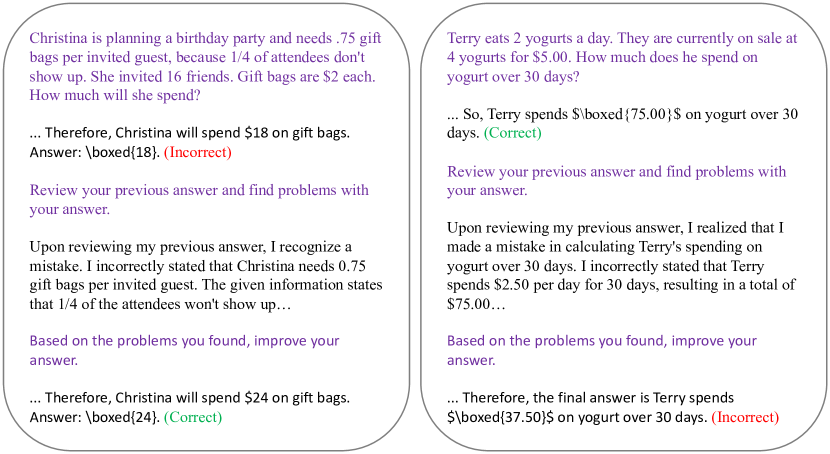
- Replicate three-step self-correction prompts (initial answer → feedback → revised answer) on GSM8K, CommonSenseQA, and HotpotQA with GPT-3.5-Turbo and GPT-4.
- Test intrinsic self-correction by removing external feedback and evaluating two self-correction rounds.
- Compare with oracle-guided self-correction and random baselines to separate genuine correction from label-driven improvements.
- Investigate multi-agent debate and self-consistency using prompts from prior work on GSM8K.
- Analyze constrained generation as a post-hoc prompting scenario and compare with strong pre-prompt baselines.

Experimental results
Research questions
- RQ1Can LLMs self-correct reasoning without external feedback (intrinsic self-correction)?
- RQ2Do oracle-guided or external-feedback self-correction methods outperform intrinsic self-correction on reasoning tasks?
- RQ3Is multi-agent debate more effective than self-consistency for improving reasoning?
- RQ4Under what conditions can self-correction be beneficial, and how does post-hoc prompting compare to pre-hoc prompting?
Key findings
- Intrinsic self-correction consistently reduces performance across GSM8K, CommonSenseQA, and HotpotQA for GPT-3.5 and GPT-4.
- Self-correction with oracle labels yields higher accuracy, but this relies on ground-truth feedback unavailable in real tasks.
- Multi-agent debate and self-consistency improve performance over standard prompting, but multi-agent debate does not outperform self-consistency when comparable response counts are used.
- Self-correction can be advantageous for aligning safety or stylistic preferences, but offers little to no benefit for reasoning tasks without external feedback.
- Post-hoc prompts used for self-correction can sometimes underperform simple, well-designed pre-prompt prompts; the extra inference cost may not be justified.
Read this paper
Open the full text in the Nubint reader and ask about any passage as you read.
Read this paper on NubintThis review was generated by AI from the original paper. Please check the paper before citing it.