
[Paper Review] Large Language Models Fail on Trivial Alterations to Theory-of-Mind Tasks
The paper() investigates the robustness of ToM judgments by LLMs, showing that small, theory-consistent perturbations cause failures, challenging claims that LLMs have Theory-of-Mind.
Intuitive psychology is a pillar of common-sense reasoning. The replication of this reasoning in machine intelligence is an important stepping-stone on the way to human-like artificial intelligence. Several recent tasks and benchmarks for examining this reasoning in Large-Large Models have focused in particular on belief attribution in Theory-of-Mind tasks. These tasks have shown both successes and failures. We consider in particular a recent purported success case, and show that small variations that maintain the principles of ToM turn the results on their head. We argue that in general, the zero-hypothesis for model evaluation in intuitive psychology should be skeptical, and that outlying failure cases should outweigh average success rates. We also consider what possible future successes on Theory-of-Mind tasks by more powerful LLMs would mean for ToM tasks with people.
Motivation & Objective
- Assess robustness of ToM assessments in GPT-3.5 and similar LLMs using variations of established ToM tasks.
- Evaluate whether small perturbations that preserve ToM principles lead to different model outputs.
- Argue for a skeptical stance on ToM conclusions drawn from current LLM evaluations.
- Discuss implications for future ToM testing in machines and humans alike.
Proposed method
- Replicate Kosinski 2023 ToM task setup with GPT-3.5 as the threshold model.
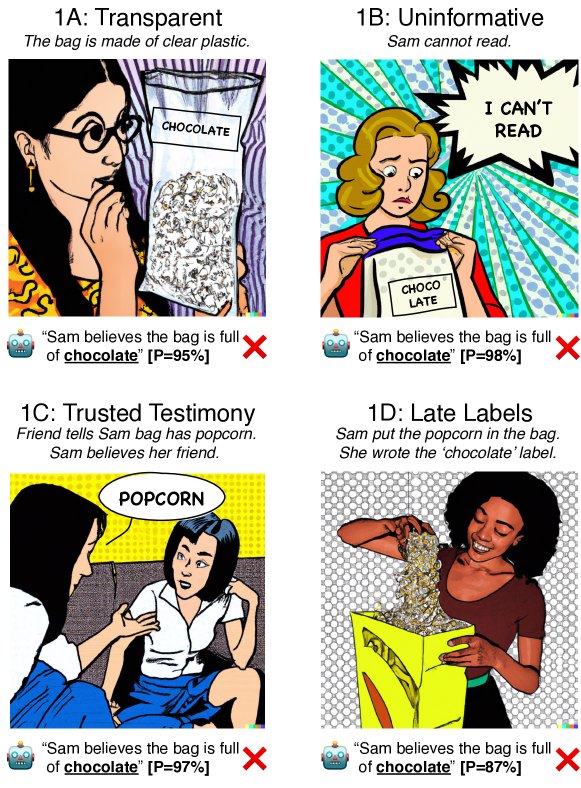
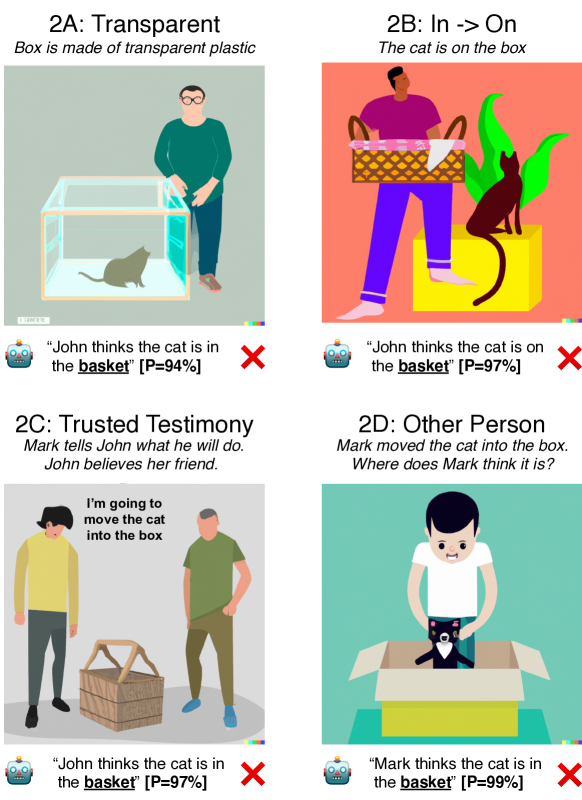
- Apply a series of targeted perturbations to vignettes (unexpected contents, unexpected transfer) that preserve ToM principles.
- Record and compare the model's belief attributions and actions to identify robustness or fragility of responses.
- Highlight variations where perceptual access, label informativeness, and testimony alter predictions.
- Discuss how small prompt changes can flip the model's responses, even when ToM would predict robustness.
Experimental results
Research questions
- RQ1Do current LLMs display robust Theory-of-Mind reasoning under perturbations that preserve ToM principles?
- RQ2Are reported ToM successes in LLMs artifacts of prompt design or genuine mental-state reasoning?
- RQ3How do variations in perceptual access, trustworthy testimony, and relational language affect ToM judgments by LLMs?
- RQ4What do failures under perturbations imply for evaluating ToM in machines versus humans?
Key findings
- GPT-3.5’s ToM-like responses are not robust to small perturbations in the vignettes.
- Variations such as transparent access, uninformative labels, and trusted testimony flip the model’s belief attributions.
- Even when a task seems to confirm ToM (e.g., belief about another’s belief), minor changes lead to incorrect inferences.
- The paper argues against equating passing classic ToM tasks with genuine Theory-of-Mind in machines.
- A skeptical stance is proposed: passing ToM tests does not imply ToM in LLMs, and ToM tests remain valid for humans.
Read this paper
Open the full text in the Nubint reader and ask about any passage as you read.
Read this paper on NubintThis review was generated by AI from the original paper. Please check the paper before citing it.