
[Paper Review] Large language models for aspect-based sentiment analysis
Fine-tuned GPT-3.5 achieves state-of-the-art 83.8 F1 on SemEval-2014 ABSA joint task, with a favorable cost-performance profile compared to GPT-4 and InstructABSA; zero/few-shot prompts help some settings but fine-tuning largely reduces the need for prompts.
Large language models (LLMs) offer unprecedented text completion capabilities. As general models, they can fulfill a wide range of roles, including those of more specialized models. We assess the performance of GPT-4 and GPT-3.5 in zero shot, few shot and fine-tuned settings on the aspect-based sentiment analysis (ABSA) task. Fine-tuned GPT-3.5 achieves a state-of-the-art F1 score of 83.8 on the joint aspect term extraction and polarity classification task of the SemEval-2014 Task 4, improving upon InstructABSA [@scaria_instructabsa_2023] by 5.7%. However, this comes at the price of 1000 times more model parameters and thus increased inference cost. We discuss the the cost-performance trade-offs of different models, and analyze the typical errors that they make. Our results also indicate that detailed prompts improve performance in zero-shot and few-shot settings but are not necessary for fine-tuned models. This evidence is relevant for practioners that are faced with the choice of prompt engineering versus fine-tuning when using LLMs for ABSA.
Motivation & Objective
- Assess the performance of GPT-4 and GPT-3.5 on the joint aspect term extraction and polarity classification ABSA task under zero-shot, few-shot, and fine-tuned settings.
Proposed method
- Evaluate on SemEval-2014 ABSA benchmark for laptop and restaurant reviews using F1 as the main metric.
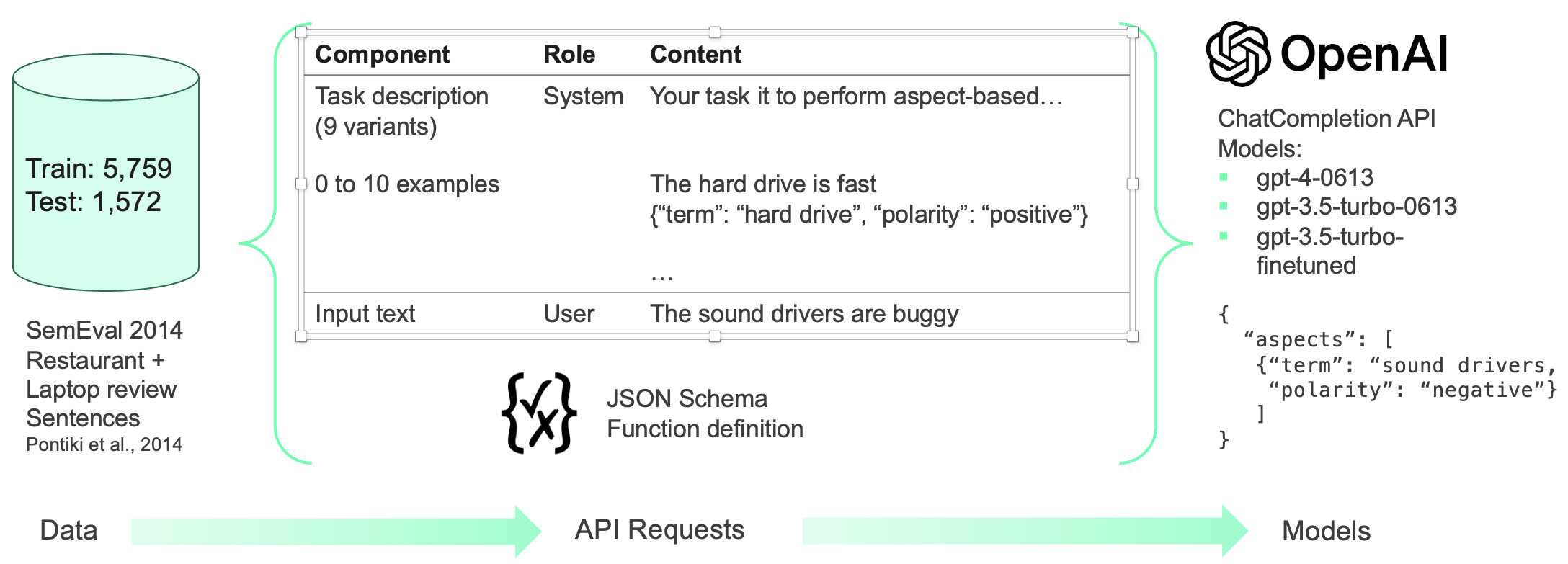
- Test multiple prompt variations, in-context example counts, and fine-tuning of GPT-3.5 via OpenAI API.
- Use a JSON schema and OpenAI function-calling to standardize model outputs.
- Compare against InstructABSA as a strong baseline.
- Analyze error types and cost-performance trade-offs across models.
- Examine whether detailed prompts are necessary for fine-tuned models.
Experimental results
Research questions
- RQ1How do GPT-4, GPT-3.5 (zero/few-shot), and fine-tuned GPT-3.5 perform on the joint ATE and polarity task for ABSA on SemEval-2014?
- RQ2What is the impact of prompt design, in-context examples, and fine-tuning on ABSA performance and cost?
- RQ3Do fine-tuned GPT-3.5 models outperform the prior state of the art (InstructABSA) on SemEval-2014 ABSA joint task?
- RQ4What error patterns do LLMs exhibit in ABSA, and how does fine-tuning affect false positives and negatives?
- RQ5What are the economic trade-offs (cost vs. F1) of using prompts vs. fine-tuning for ABSA with LLMs?
Key findings
- Fine-tuned GPT-3.5 achieves 83.8 F1 on the SemEval-2014 joint ABSA task, surpassing InstructABSA by 5.7%.
- GPT-3.5 and GPT-4 have different cost-performance profiles, with fine-tuned GPT-3.5 offering strong performance at lower cost.
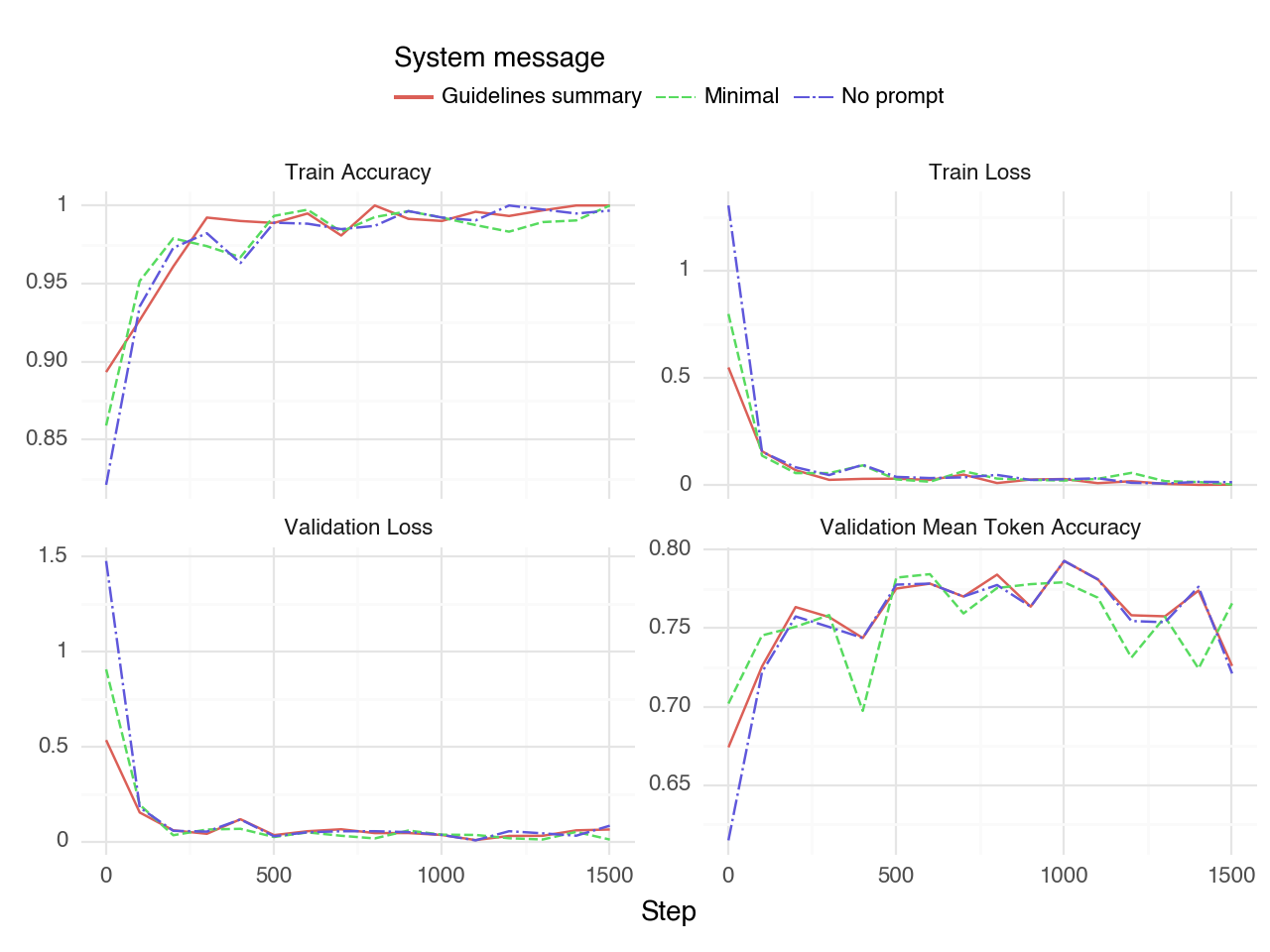
- Detailed prompts improve zero-shot and few-shot results for some settings, but are not necessary for fine-tuned models.
- Zero-shot GPT-4 can underperform GPT-3.5, while in-context examples boost GPT-4 to competitive levels.
- Error analysis shows the main gains come from reducing false positives of predicting non-gold aspect terms and improving polarity classification when terms are correctly extracted.
- Fine-tuned GPT-3.5 reduces false positives by up to ~88% for certain subtypes and achieves higher precision in aspect term extraction.
Read this paper
Open the full text in the Nubint reader and ask about any passage as you read.
Read this paper on NubintThis review was generated by AI from the original paper. Please check the paper before citing it.