
[Paper Review] Large Language Models for Education: A Survey and Outlook
A technology-centric survey of how large language models (LLMs) are used in education, covering student/teacher assistance, adaptive learning, datasets, benchmarks, risks, and future directions.
The advent of Large Language Models (LLMs) has brought in a new era of possibilities in the realm of education. This survey paper summarizes the various technologies of LLMs in educational settings from multifaceted perspectives, encompassing student and teacher assistance, adaptive learning, and commercial tools. We systematically review the technological advancements in each perspective, organize related datasets and benchmarks, and identify the risks and challenges associated with deploying LLMs in education. Furthermore, we outline future research opportunities, highlighting the potential promising directions. Our survey aims to provide a comprehensive technological picture for educators, researchers, and policymakers to harness the power of LLMs to revolutionize educational practices and foster a more effective personalized learning environment.
Motivation & Objective
- Provide a technology-focused overview of LLMs in education across applications and stakeholders.
- Summarize datasets and benchmarks publicly available for education-related LLM tasks.
- Identify risks, challenges, and responsible AI considerations in deploying LLMs in education.
- Propose future research opportunities to advance LLM-enabled personalized learning.
Proposed method
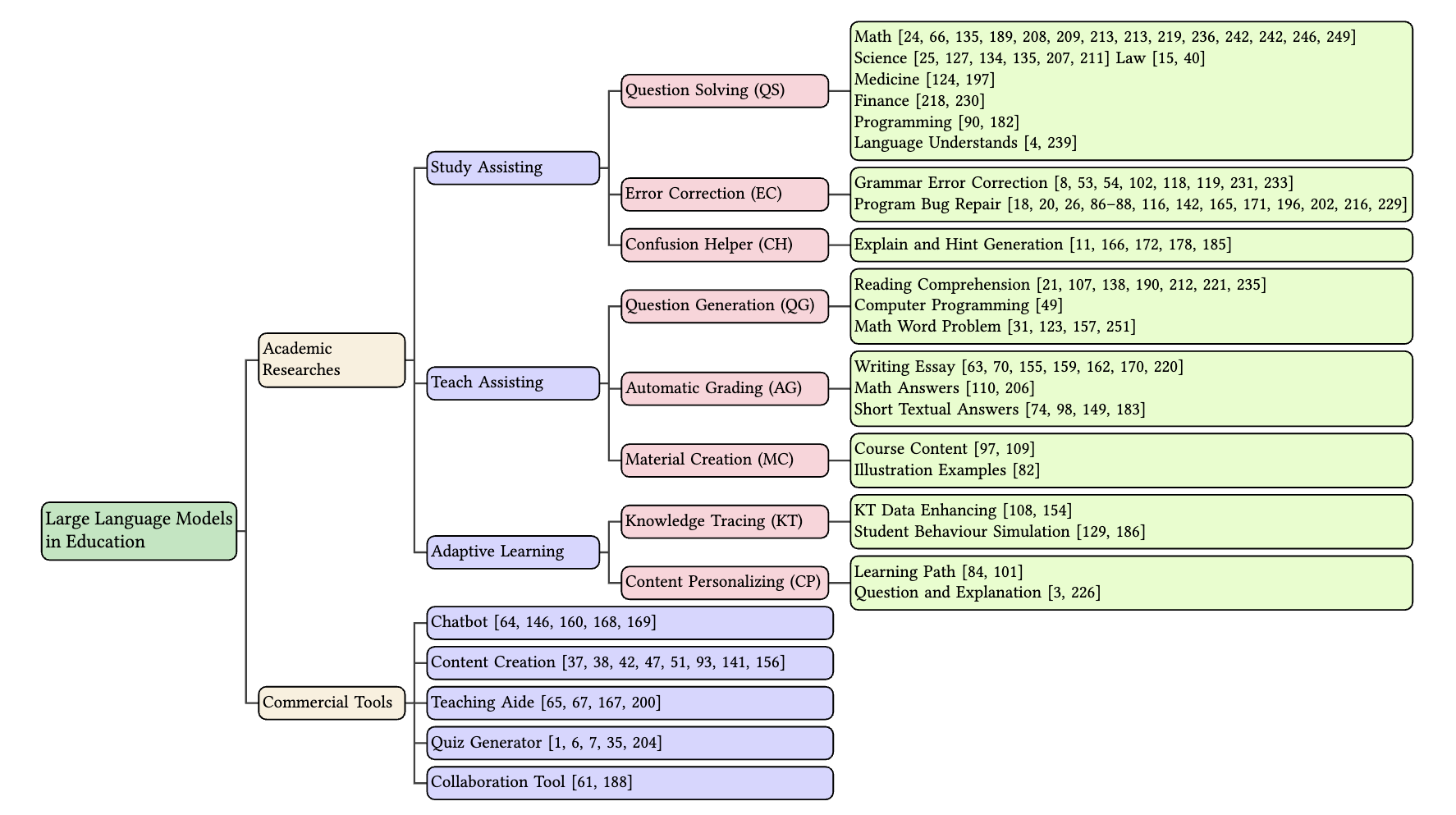
- Proposes a taxonomy of LLM applications in education covering student/teacher assistance, adaptive learning, and commercial tools.
- Systematically reviews technological advancements, related datasets and benchmarks.
- Discusses risks and guardrails for responsible AI and outlines future research directions.
Experimental results
Research questions
- RQ1What are the key educational applications of LLMs for students and teachers?
- RQ2What datasets and benchmarks exist for evaluating LLMs in education across tasks like question solving, error correction, question generation, and automatic grading?
- RQ3What risks, challenges, and governance considerations arise when deploying LLMs in education, and what future directions are suggested?
Key findings
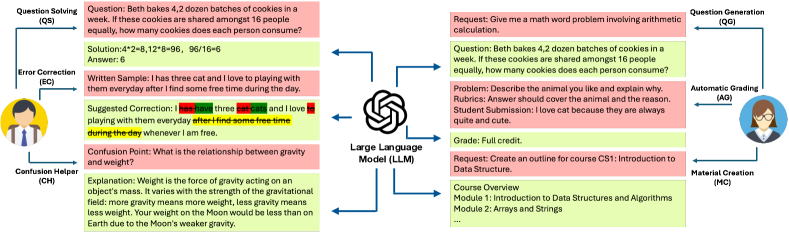
- LLMs have shown promise in a range of educational tasks, including question solving, error correction, confusion guidance, and automatic grading.
- A technology-centric taxonomy is proposed, detailing student/teacher assistance, adaptive learning, and education tools.
- Public datasets and benchmarks exist for QS, EC, QG, and AG, along with datasets for domain-specific education tasks.
- Risks discussed include fairness, bias, reliability, safety, privacy, transparency, accountability, and overreliance, with suggested guardrails and mitigation strategies.
- The paper outlines opportunities in adaptive learning, content personalization, material creation, and commercial education tools, plus future research directions.
Read this paper
Open the full text in the Nubint reader and ask about any passage as you read.
Read this paper on NubintThis review was generated by AI from the original paper. Please check the paper before citing it.