
[Paper Review] Large Language Models for Software Engineering: Survey and Open Problems
A survey of how large language models (LLMs) are applied to software engineering, outlining opportunities, open problems, and the need for hybrid SE–LLM approaches to ensure reliability and evaluation.
This paper provides a survey of the emerging area of Large Language Models (LLMs) for Software Engineering (SE). It also sets out open research challenges for the application of LLMs to technical problems faced by software engineers. LLMs' emergent properties bring novelty and creativity with applications right across the spectrum of Software Engineering activities including coding, design, requirements, repair, refactoring, performance improvement, documentation and analytics. However, these very same emergent properties also pose significant technical challenges; we need techniques that can reliably weed out incorrect solutions, such as hallucinations. Our survey reveals the pivotal role that hybrid techniques (traditional SE plus LLMs) have to play in the development and deployment of reliable, efficient and effective LLM-based SE.
Motivation & Objective
- Survey the emerging use of LLMs in software engineering across coding, requirements, design, repair, refactoring, performance, documentation, and analytics.
- Identify key challenges (e.g., hallucinations, oracle problem) and the role of automated testing and regression oacles in reliable LLM-based SE.
- Highlight the value of hybrid architectures combining traditional SE techniques with LLMs for reliable deployment.
- Discuss prompting, explanations, and evaluation methodologies needed for robust scientific assessment in LLM-based SE.
Proposed method
- Review and synthesize existing literature on LLMs for SE across multiple SE activities.
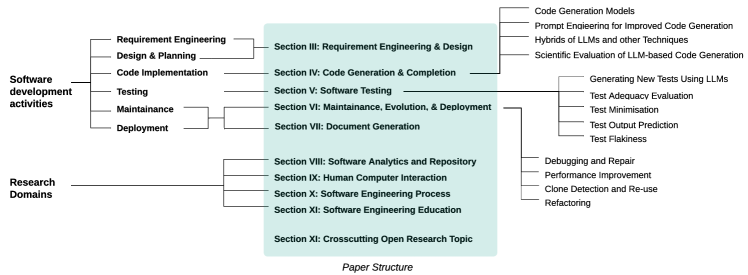
- Classify LLM categories (encoder-only, encoder-decoder, decoder-only) and code-generation models with examples and parameters.
- Discuss open problems and opportunities in requirements engineering, design, and code generation through LLMs.
- Examine prompt engineering, output explanations, and hybrid approaches as pathways to more reliable SE solutions.
- Address empirical evaluation issues including correctness, robustness, determinism, and security in LLM-based code generation.
Experimental results
Research questions
- RQ1What are the main software engineering tasks where LLMs are being applied, and what is the evidence of their effectiveness?
- RQ2What are the key open problems and research gaps in applying LLMs to SE, including hallucinations, evaluation, and oracle challenges?
- RQ3How can hybrid SE–LLM approaches be designed to improve reliability, safety, and performance in SE tasks?
- RQ4What is the role of prompt engineering and explanation generation in improving LLM-based SE outcomes?
- RQ5How should scientific evaluation be conducted for LLM-based SE given non-determinism and variability across executions?
Key findings
- LLMs enable broad SE applications from coding to documentation and analytics, but emergent properties introduce reliability challenges.
- Automated regression oracles and traditional testing techniques are central for validating LLM-generated SE artefacts; prompt engineering and explanations are active research areas.
- Code generation and completion show rapid progress; hybrid approaches (planning, API search, test-generation, and ranking) improve results.
- Empirical evaluation of LLM-based code generation highlights concerns about correctness, robustness, determinism, and security, requiring mature evaluation methods from SBSE and empirical SE.
- There is growing evidence for the value of hybrid systems and human-in-the-loop approaches to mitigate hallucinations and ensure safe deployment.
Read this paper
Open the full text in the Nubint reader and ask about any passage as you read.
Read this paper on NubintThis review was generated by AI from the original paper. Please check the paper before citing it.