
[Paper Review] Large Language Models for Time Series: A Survey
A comprehensive survey categorizing how large language models (LLMs) can be applied to time series analysis, detailing prompting, quantization, alignment, vision-bridge, and tool integration approaches, datasets, challenges, and future directions.
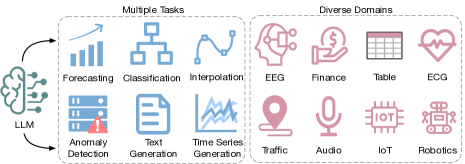
Large Language Models (LLMs) have seen significant use in domains such as natural language processing and computer vision. Going beyond text, image and graphics, LLMs present a significant potential for analysis of time series data, benefiting domains such as climate, IoT, healthcare, traffic, audio and finance. This survey paper provides an in-depth exploration and a detailed taxonomy of the various methodologies employed to harness the power of LLMs for time series analysis. We address the inherent challenge of bridging the gap between LLMs' original text data training and the numerical nature of time series data, and explore strategies for transferring and distilling knowledge from LLMs to numerical time series analysis. We detail various methodologies, including (1) direct prompting of LLMs, (2) time series quantization, (3) aligning techniques, (4) utilization of the vision modality as a bridging mechanism, and (5) the combination of LLMs with tools. Additionally, this survey offers a comprehensive overview of the existing multimodal time series and text datasets and delves into the challenges and future opportunities of this emerging field. We maintain an up-to-date Github repository which includes all the papers and datasets discussed in the survey.
Motivation & Objective
- Motivate the study of bridging modality gaps between text-trained LLMs and numerical time series data.
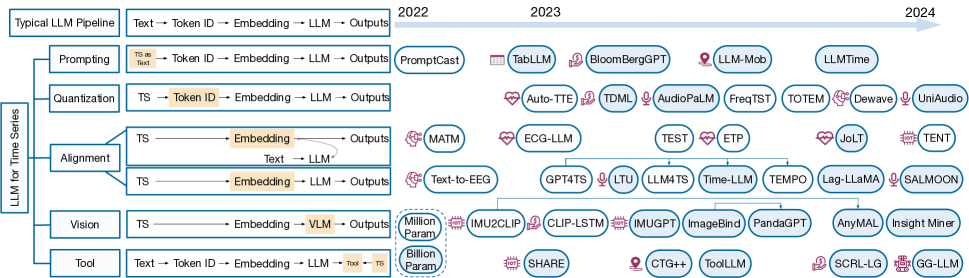
- Provide a taxonomy of five LLM-based methodologies for time series analysis (prompting, quantization, alignment, vision as bridge, tool integration).
- Survey representative models, formulations, and datasets across domains such as climate, IoT, healthcare, traffic, and finance.
- Identify challenges and future directions to advance LLM-enabled time series research.
Proposed method
- Direct prompting of LLMs by treating time series as text or prompts.
- Time series quantization to convert numerical series into discrete tokens (VQ-VAE, K-Means) for LLM processing.
- Alignment techniques to map time series embeddings to language space (contrastive losses, backbones) or end-to-end LLM backbones.
- Vision as bridge using visual representations and multimodal models to connect time series with LLMs.
- Tool integration where LLMs generate auxiliary tools (code, API calls) to support time series tasks.
Experimental results
Research questions
- RQ1How can LLMs trained on text be effectively leveraged for numerical time series analysis?
- RQ2What are the most effective taxonomies and techniques to bridge modality gaps between time series data and language models?
- RQ3Which datasets and multimodal configurations enable robust LLM-based time series analysis across domains?
- RQ4What are the trade-offs in prompting, quantization, alignment, vision-bridge, and tool-based approaches regarding data efficiency and tasks?
- RQ5What are the key challenges and future directions for multimodal and multitask LLM-enabled time series research?
Key findings
- A five-category taxonomy is proposed: Prompting, Time Series Quantization, Alignment, Vision as Bridge, and Tool Integration.
- Quantization and alignment approaches are more scalable for long sequences and multivariate time series than prompting alone.
- Vision-based bridging enables leveraging vision-language models to connect time series with textual and visual representations.
- Tool integration enables LLMs to output code or API calls to assist time series tasks without full end-to-end fine-tuning.
- A curated collection of multimodal time series and text datasets across IoT, finance, healthcare, audio, and more accompanies the taxonomy.
Read this paper
Open the full text in the Nubint reader and ask about any passage as you read.
Read this paper on NubintThis review was generated by AI from the original paper. Please check the paper before citing it.