
[Paper Review] Large Language Models in Cybersecurity: State-of-the-Art
A comprehensive literature review of how large language models (LLMs) are used for cyber defense and offense, mapped to NIST framework and MITRE ATT&CK, and highlighting research gaps.
The rise of Large Language Models (LLMs) has revolutionized our comprehension of intelligence bringing us closer to Artificial Intelligence. Since their introduction, researchers have actively explored the applications of LLMs across diverse fields, significantly elevating capabilities. Cybersecurity, traditionally resistant to data-driven solutions and slow to embrace machine learning, stands out as a domain. This study examines the existing literature, providing a thorough characterization of both defensive and adversarial applications of LLMs within the realm of cybersecurity. Our review not only surveys and categorizes the current landscape but also identifies critical research gaps. By evaluating both offensive and defensive applications, we aim to provide a holistic understanding of the potential risks and opportunities associated with LLM-driven cybersecurity.
Motivation & Objective
- Characterize defensive and adversarial applications of LLMs in cybersecurity.
- Map LLM-enabled cyberdefense approaches to the NIST Cybersecurity Framework functions (Identify, Protect, Detect, Respond, Recover).
- Identify key research gaps and opportunities for post-attack (Recovery) scenarios.
- Provide a taxonomy of LLM-driven strategies in cyber defense and attack based on current literature.
Proposed method
- Review and synthesize existing literature on LLMs in cybersecurity.
- Classify defensive applications according to the NIST framework (Identify, Protect, Detect, Respond, Recover).
- Catalog adversarial/attacker uses of LLMs under the MITRE ATT&CK framework.
- Summarize core techniques, models, and data sources used in cited works.
- Identify gaps and future research directions based on observed trends.
Experimental results
Research questions
- RQ1What defensive applications of LLMs in cybersecurity are most developed and how do they align with the NIST framework?
- RQ2What offensive/adversarial capabilities do LLMs introduce in cybersecurity, and how do these map to attacker tactics (MITRE ATT&CK)?
- RQ3What are the major gaps, especially in post-attack (Identify/Respond/Recover) areas, in current LLM-based cybersecurity research?
Key findings
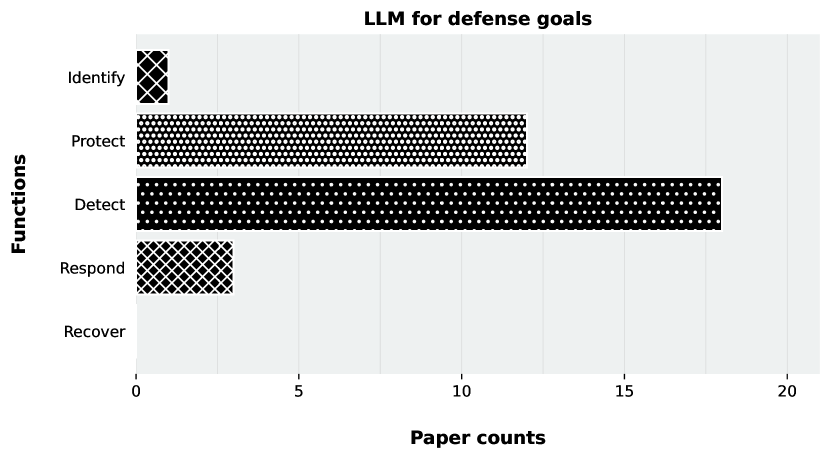
- Most studies focus on Protect and Detect functions of the NIST framework for LLM-based cyber defense.
- There is a notable research gap in post-attack scenarios, particularly Recover and, to some extent, Respond.
- A wide range of defense-oriented works include anomaly detection, vulnerability assessment, secure coding, phishing and malware detection, and CTI processing.
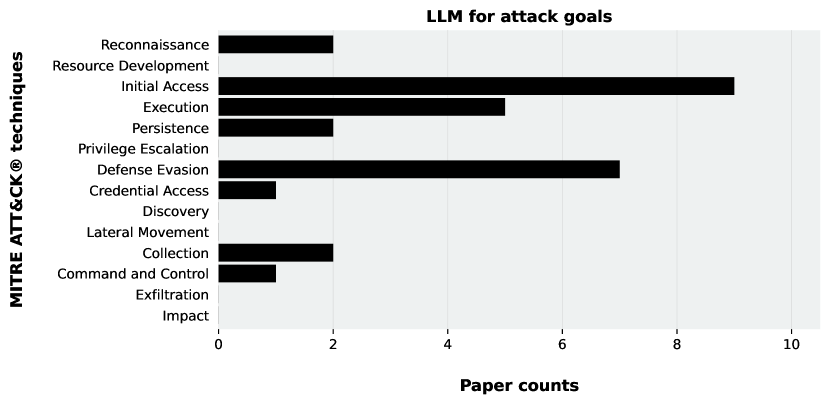
- Adversarial literature shows LLMs can be used for reconnaissance, initial access, and execution via scripted, prompting, and code-generation techniques.
- Several works assess LLMs for red-teaming, phishing site detection, smart-contract auditing, and automated penetration testing, illustrating dual-use potential.
- The literature review includes multiple domain-specific models (CyBERT, SecureBERT, SecureFalcon, etc.) and practical deployments (PENtestGPT, ShelLM, etc.).
Read this paper
Open the full text in the Nubint reader and ask about any passage as you read.
Read this paper on NubintThis review was generated by AI from the original paper. Please check the paper before citing it.