
[Paper Review] Large Language Models in Qualitative Research: Uses, Tensions, and Intentions
The paper presents twenty qualitative researchers' perspectives on using large language models (LLMs) in qualitative research, highlighting potential uses, tensions, and the need for ethical guidelines and design principles for LLM-assisted analysis.
Qualitative researchers use tools to collect, sort, and analyze their data. Should qualitative researchers use large language models (LLMs) as part of their practice? LLMs could augment qualitative research, but it is unclear if their use is appropriate, ethical, or aligned with qualitative researchers' goals and values. We interviewed twenty qualitative researchers to investigate these tensions. Many participants see LLMs as promising interlocutors with attractive use cases across the stages of research, but wrestle with their performance and appropriateness. Participants surface concerns regarding the use of LLMs while protecting participant interests, and call attention to an urgent lack of norms and tooling to guide the ethical use of LLMs in research. We document the rapid and broad adoption of LLMs across surfaces, which can interfere with intentional use vital to qualitative research. We use the tensions surfaced by our participants to outline recommendations for researchers considering using LLMs in qualitative research and design principles for LLM-assisted qualitative research tools.
Motivation & Objective
- Assess how LLMs are currently adopted into qualitative research processes and forecast future incorporation.
- Identify perceived gains and losses, tensions, and ethical considerations in adopting LLMs for qualitative work.
- Propose guidance and design principles for ethical, effective use of LLMs in qualitative data analysis tools.
Proposed method
- Conducted twenty semi-structured interviews with qualitative and mixed-method researchers across disciplines.
- Applied inductive thematic analysis inspired by grounded theory to derive themes from interview transcripts.
- Used a collaborative coding process with Dedoose, while limiting LLM use to literature search and verification.
- Reported on participants' practices, concerns, and perceived ethical implications to identify norms and tooling gaps.
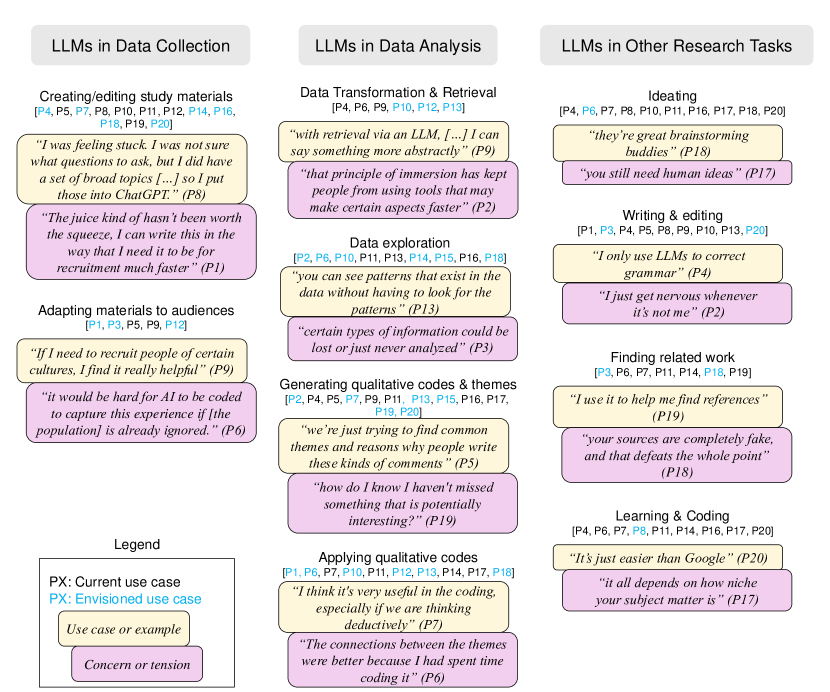
Experimental results
Research questions
- RQ1How are LLMs being adopted into qualitative research processes today and how might they be incorporated in the future?
- RQ2What do qualitative researchers say they stand to lose or gain from adopting LLMs into their research processes, and what tensions might arise?
- RQ3What are potential models for the ethical incorporation of LLMs into the qualitative research process?
Key findings
- Researchers see LLMs as promising interlocutors across data collection and analysis, but worry about performance and appropriateness.
- There are concerns about ethics, unequal technology adoption, model bias, and data privacy that impede adoption.
- There is an urgent lack of norms and tooling to guide ethical LLM use in qualitative research.
- ChatGPT dominates user experiences and colors perceptions of LLM capabilities and ethical considerations.
- Some researchers use LLMs to generate recruitment materials, assist coding, or brainstorm, while others resist due to concerns about data privacy and loss of depth.
- Guidelines for future qualitative researchers and design principles for LLM-based QDA tools are needed to align with qualitative aims.
Read this paper
Open the full text in the Nubint reader and ask about any passage as you read.
Read this paper on NubintThis review was generated by AI from the original paper. Please check the paper before citing it.