
[Paper Review] Large Language Models(LLMs) on Tabular Data: Prediction, Generation, and Understanding -- A Survey
This survey reviews how LLMs are applied to tabular data across prediction, data generation, and table understanding tasks, offering a taxonomy of techniques, datasets, metrics, and future directions.
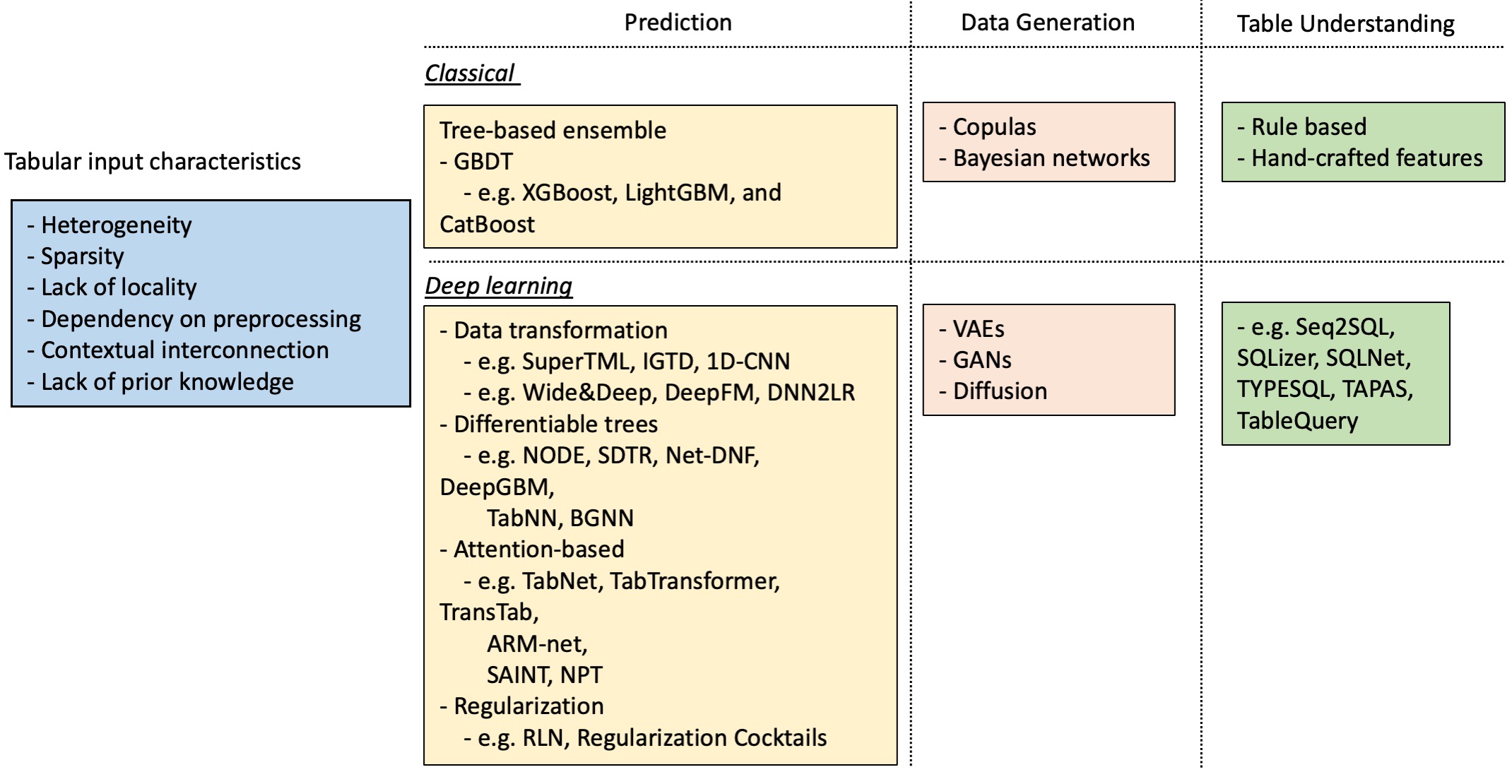
Recent breakthroughs in large language modeling have facilitated rigorous exploration of their application in diverse tasks related to tabular data modeling, such as prediction, tabular data synthesis, question answering, and table understanding. Each task presents unique challenges and opportunities. However, there is currently a lack of comprehensive review that summarizes and compares the key techniques, metrics, datasets, models, and optimization approaches in this research domain. This survey aims to address this gap by consolidating recent progress in these areas, offering a thorough survey and taxonomy of the datasets, metrics, and methodologies utilized. It identifies strengths, limitations, unexplored territories, and gaps in the existing literature, while providing some insights for future research directions in this vital and rapidly evolving field. It also provides relevant code and datasets references. Through this comprehensive review, we hope to provide interested readers with pertinent references and insightful perspectives, empowering them with the necessary tools and knowledge to effectively navigate and address the prevailing challenges in the field.
Motivation & Objective
- Summarize the characteristics and challenges of tabular data and traditional methods.
- Propose a taxonomy of techniques for adapting LLMs to tabular data across tasks such as prediction, generation, QA, and understanding.
- Review datasets and evaluation metrics used for LLMs on tabular data and map them to tasks.
- Identify limitations, gaps, and future research directions in the field.
- Provide references to relevant code and datasets for practitioners.
Proposed method
- Survey and taxonomy of datasets, metrics, and methodologies used for LLMs on tabular data.
- Categorization of techniques into serialization, table manipulation, prompt engineering, and end-to-end system design.
- Discussion of how LLMs are leveraged for prediction, data augmentation/generation, and question answering/table understanding.
- Analysis of robustness, perturbations, and the impact of table structure and preprocessing on LLM performance.
- Synthesis of open problems and future research directions with practical references.

Experimental results
Research questions
- RQ1What techniques enable effective use of LLMs on tabular data across tasks?
- RQ2How do LLMs perform on prediction, generation, and QA tasks with tabular data across datasets?
- RQ3What datasets and metrics best benchmark LLM-based tabular data methods?
- RQ4What are the main limitations and future directions for LLMs on tabular data?
Key findings
- LLMs offer in-context learning and instruction-following capabilities that can be harnessed for tabular data tasks.
- Serialization format and input representation choices significantly influence performance and token efficiency, with HTML/XML formats sometimes aiding GPT-style models but increasing token usage.
- Prompt engineering, chain-of-thought strategies, self-consistency, and retrieval-augmented generation improve performance on tabular tasks, especially with larger models.
- Traditional tabular baselines like gradient-boosted trees remain strong benchmarks for prediction, though deep learning approaches can excel on very large or highly categorical datasets.
- The paper provides a structured taxonomy of datasets, metrics, and techniques and highlights open problems such as bias, hallucination, representation of numerical data, interpretability, and standardized benchmarks.
Read this paper
Open the full text in the Nubint reader and ask about any passage as you read.
Read this paper on NubintThis review was generated by AI from the original paper. Please check the paper before citing it.