
[Paper Review] Large Language Models Perform Diagnostic Reasoning
DR-CoT prompting improves diagnostic accuracy of LLMs for automatic diagnosis by about 15% over standard prompting, with an 18% gain in out-domain settings.
We explore the extension of chain-of-thought (CoT) prompting to medical reasoning for the task of automatic diagnosis. Motivated by doctors' underlying reasoning process, we present Diagnostic-Reasoning CoT (DR-CoT). Empirical results demonstrate that by simply prompting large language models trained only on general text corpus with two DR-CoT exemplars, the diagnostic accuracy improves by 15% comparing to standard prompting. Moreover, the gap reaches a pronounced 18% in out-domain settings. Our findings suggest expert-knowledge reasoning in large language models can be elicited through proper promptings.
Motivation & Objective
- Motivate extending chain-of-thought prompting to medical reasoning for automatic diagnosis.
- Propose Diagnostic-Reasoning CoT (DR-CoT) to elicit expert-like reasoning in LLMs.
- Develop a few-shot LLM-based dialogue system for automatic diagnosis.
- Introduce a language-model-role-playing evaluation framework to simulate patient-doctor interactions.
Proposed method
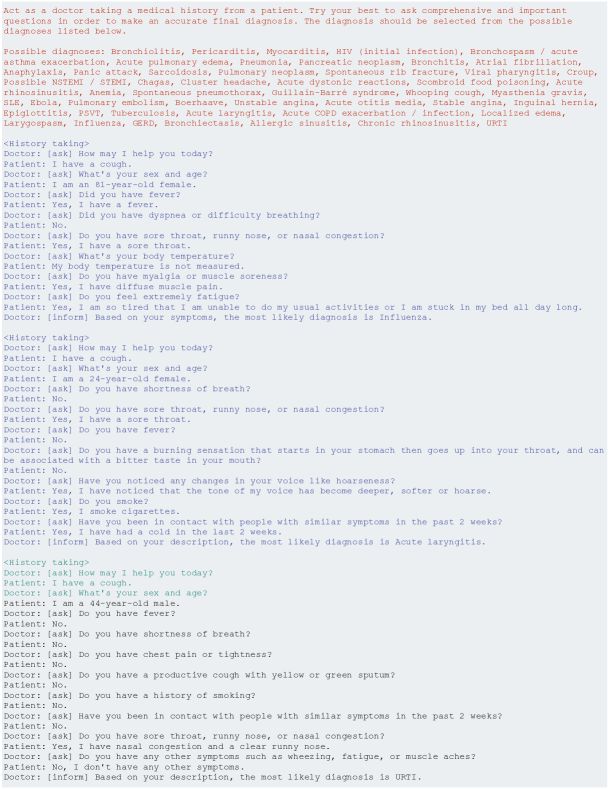
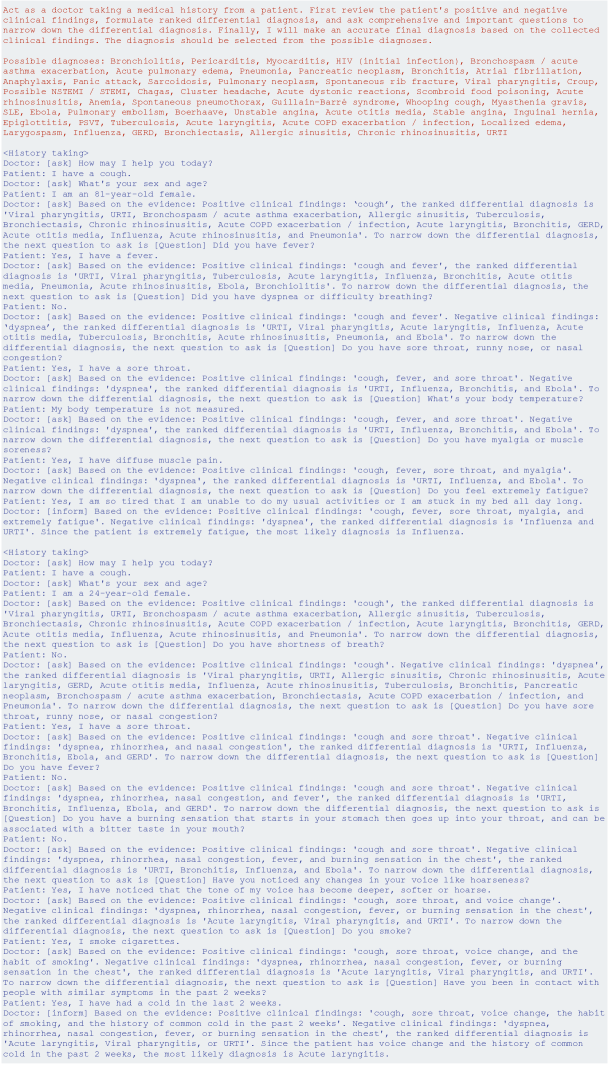
- Prompt LLMs with a two-shot DR-CoT template to guide evidence gathering and differential diagnosis generation.
- Augment the instruction to summarize evidence and formulate a differential diagnosis before formulating the next question.
- Replace standard prompts with a DR-CoT-driven prompt that ties evidence to a ranked differential and next query.
- Use a non-pipelined, few-shot dialogue setup where the model generates questions and a final diagnosis.
- Evaluate using a language-model-role-playing framework where the LLM acts as both doctor and patient in self-chat dialogues.
- Conduct experiments on the DDXPlus dataset with in-domain and out-domain splits.
Experimental results
Research questions
- RQ1Can DR-CoT prompting improve diagnostic accuracy of LLM-based automatic diagnosis compared to standard prompting?
- RQ2Does DR-CoT generalize to out-domain initial evidences beyond the exemplars?
- RQ3Does the DR-CoT approach lead to more informative questioning that supports correct diagnoses?
- RQ4Is a language-model-role-playing evaluation framework a viable proxy for realistic DSAD assessment?
Key findings
- DR-CoT prompting yields a 15% improvement in diagnostic accuracy over standard prompting.
- The accuracy improvement with DR-CoT is 18% in out-domain settings.
- Two-shot exemplars with DR-CoT significantly enhance convergence speed and diagnostic performance.
- A physician-evaluated human study supports that DR-CoT prompts help the model ask more critical questions.
- The evaluation framework using role-playing between doctor and patient enables automated, end-to-end assessment.
Read this paper
Open the full text in the Nubint reader and ask about any passage as you read.
Read this paper on NubintThis review was generated by AI from the original paper. Please check the paper before citing it.