
[Paper Review] Large language models surpass human experts in predicting neuroscience results
LLMs outperform human neuroscience experts on BrainBench, a forward-looking benchmark, with BrainGPT (LoRA-fine-tuned) achieving further gains; models calibrate confidence and can integrate information across abstracts.
Scientific discoveries often hinge on synthesizing decades of research, a task that potentially outstrips human information processing capacities. Large language models (LLMs) offer a solution. LLMs trained on the vast scientific literature could potentially integrate noisy yet interrelated findings to forecast novel results better than human experts. To evaluate this possibility, we created BrainBench, a forward-looking benchmark for predicting neuroscience results. We find that LLMs surpass experts in predicting experimental outcomes. BrainGPT, an LLM we tuned on the neuroscience literature, performed better yet. Like human experts, when LLMs were confident in their predictions, they were more likely to be correct, which presages a future where humans and LLMs team together to make discoveries. Our approach is not neuroscience-specific and is transferable to other knowledge-intensive endeavors.
Motivation & Objective
- Motivate studying whether LLMs can forecast experimental neuroscience results by leveraging vast literature.
- Evaluate forward-looking predictive ability of general LLMs versus human experts on neuroscience abstracts.
- Assess how model confidence relates to accuracy in forward-looking predictions.
- Investigate whether specialized neuroscience fine-tuning (BrainGPT) improves predictive performance.
Proposed method
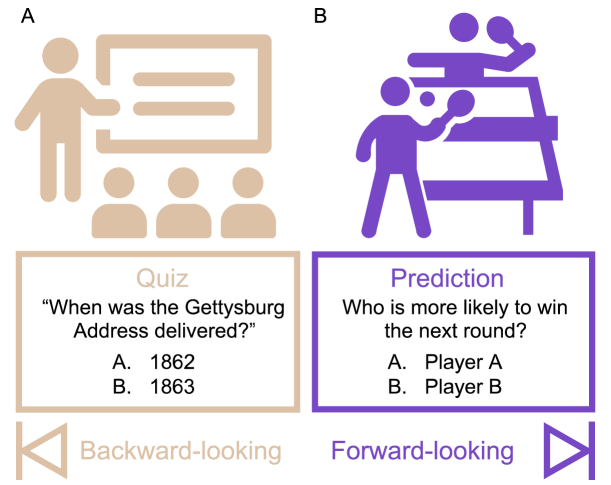
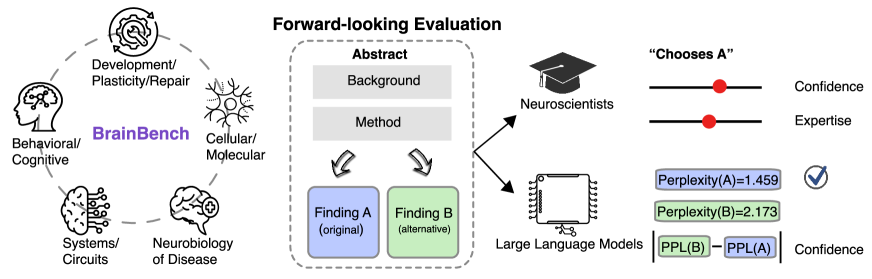
- Create BrainBench, a forward-looking benchmark using dual abstracts (original vs. altered) from Journal of Neuroscience across five domains.
- Evaluate multiple general-purpose LLMs and human experts on selecting the original abstract.
- Score predictions by comparing perplexities; original chosen if its perplexity is lower than the altered one.
- Assess calibration by correlating confidence (perplexity difference) with accuracy.
- Fine-tune a pretrained LLM (Llama-2-7B) with neuroscience data using LoRA to create BrainGPT and measure performance changes.
Experimental results
Research questions
- RQ1Can LLMs predict neuroscience study outcomes better than human experts on forward-looking benchmarks?
- RQ2Does specialized neuroscience fine-tuning (BrainGPT) improve forward-looking predictive performance beyond base LLMs?
- RQ3Are LLM predictions calibrated, i.e., does higher confidence correlate with higher accuracy?
- RQ4Do LLMs integrate information across abstracts (methods, background) versus relying on local text to predict results?
Key findings
- LLMs averaged 81.4% accuracy, outperforming human experts at 63.4%.
- Top 20% of human experts achieved 66.2% accuracy, still below LLM performance.
- Smaller models (e.g., Llama2-7B, Mistral-7B) performed comparably to larger models.
- Chat/instruction-tuned variants underperformed base models, suggesting conversational alignment harms scientific inference.
- BrainGPT (LoRA-fine-tuned) yielded a 3% improvement in BrainBench performance over the base model.
- LLMs integrated information across the full abstract to achieve superior predictions, not just local results passages.
- LLMs’ confidence was positively correlated with accuracy (calibrated predictions).
- BrainBench items did not show memorization signals, indicating models generalize to novel items.
Read this paper
Open the full text in the Nubint reader and ask about any passage as you read.
Read this paper on NubintThis review was generated by AI from the original paper. Please check the paper before citing it.