
[Paper Review] Large Language Models to Enhance Bayesian Optimization
LLAMBO integrates large language models with Bayesian optimization to improve hyperparameter tuning by zero-shot warmstarting, enhancing surrogate modeling via in-context learning, and conditionally sampling high-potential points.
Bayesian optimization (BO) is a powerful approach for optimizing complex and expensive-to-evaluate black-box functions. Its importance is underscored in many applications, notably including hyperparameter tuning, but its efficacy depends on efficiently balancing exploration and exploitation. While there has been substantial progress in BO methods, striking this balance remains a delicate process. In this light, we present LLAMBO, a novel approach that integrates the capabilities of Large Language Models (LLM) within BO. At a high level, we frame the BO problem in natural language, enabling LLMs to iteratively propose and evaluate promising solutions conditioned on historical evaluations. More specifically, we explore how combining contextual understanding, few-shot learning proficiency, and domain knowledge of LLMs can improve model-based BO. Our findings illustrate that LLAMBO is effective at zero-shot warmstarting, and enhances surrogate modeling and candidate sampling, especially in the early stages of search when observations are sparse. Our approach is performed in context and does not require LLM finetuning. Additionally, it is modular by design, allowing individual components to be integrated into existing BO frameworks, or function cohesively as an end-to-end method. We empirically validate LLAMBO's efficacy on the problem of hyperparameter tuning, highlighting strong empirical performance across a range of diverse benchmarks, proprietary, and synthetic tasks.
Motivation & Objective
- Explore whether LLMs can enhance key BO components (surrogate model, candidate sampler) using in-context learning.
- Develop a modular, end-to-end LLAMBO framework that does not require LLM fine-tuning.
- Demonstrate that LLAMBO improves early-stage BO performance when observations are sparse.
- Show that LLAMBO can be integrated into existing BO pipelines for hyperparameter tuning.
Proposed method
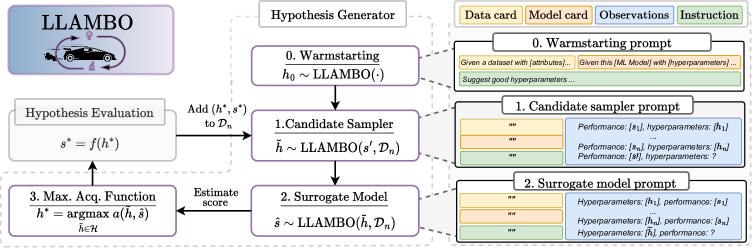
- Translate BO components into natural language prompts to leverage LLMs in zero-shot and few-shot settings.
- Use discriminative (p(s|h;Dn)) and generative (p(h|s;Dn)) surrogate modeling via in-context learning, with MC sampling for uncertainty.
- Implement a sampling mechanism that draws candidate points conditioned on a target value s′, guided by in-context learning.
- Promote robustness via prompt design, including problem description, data/model cards, and shuffled in-context examples.
- Evaluate LLAMBO on Bayesmark for hyperparameter tuning with GPT-3.5, comparing against GP-SM alternatives and ablations.
Experimental results
Research questions
- RQ1Can LLMs, via in-context learning, enhance the surrogate model and candidate point sampler in Bayesian optimization?
- RQ2How effectively can LLM-augmented BO components operate together as an end-to-end pipeline?
- RQ3What benefits arise from zero-shot warmstarting using LLM priors in BO performance?
- RQ4Does LLAMBO maintain performance across diverse benchmarks and tasks without LLM fine-tuning?
Key findings
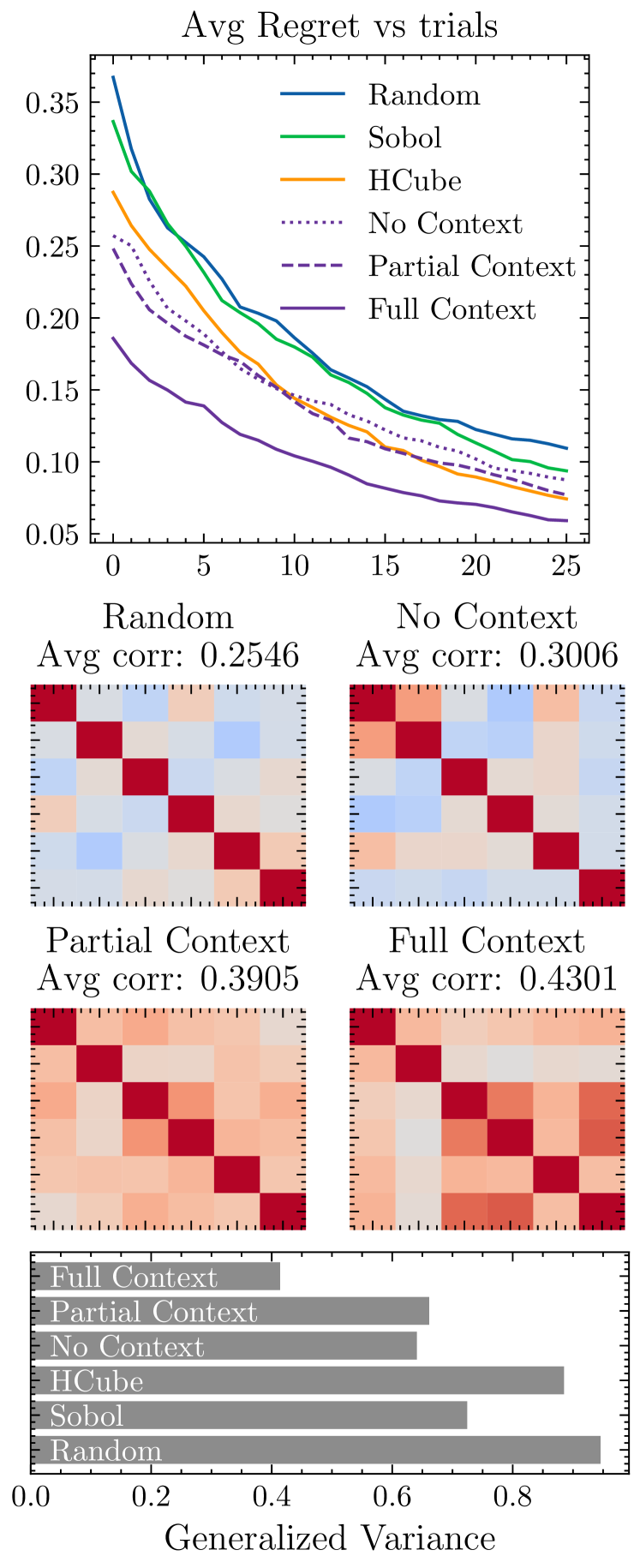
- LLAMBO improves zero-shot warmstarting compared to random, with dataset context boosting early search performance.
- Discriminative LLAMBO outperforms baselines in prediction across sample counts, with better exploitation at n>5.
- Generative LLAMBO (p(h|s;Dn)) yields higher score correlations and lower regret, especially at low sample counts.
- A sampling approach conditioning on a target s′ can yield high-quality points, with α balancing exploration and exploitation.
- End-to-end LLAMBO delivers best tuning performance on Bayesmark across public and private/synthetic datasets, particularly in early search stages.
Read this paper
Open the full text in the Nubint reader and ask about any passage as you read.
Read this paper on NubintThis review was generated by AI from the original paper. Please check the paper before citing it.