
[Paper Review] Large Multimodal Agents: A Survey
This survey analyzes LLM-driven large multimodal agents (LMAs), proposes a four-type taxonomy, reviews collaboration frameworks, and offers a standardized evaluation framework and future directions.
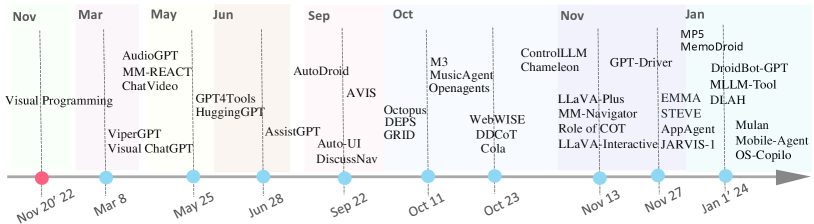
Large language models (LLMs) have achieved superior performance in powering text-based AI agents, endowing them with decision-making and reasoning abilities akin to humans. Concurrently, there is an emerging research trend focused on extending these LLM-powered AI agents into the multimodal domain. This extension enables AI agents to interpret and respond to diverse multimodal user queries, thereby handling more intricate and nuanced tasks. In this paper, we conduct a systematic review of LLM-driven multimodal agents, which we refer to as large multimodal agents ( LMAs for short). First, we introduce the essential components involved in developing LMAs and categorize the current body of research into four distinct types. Subsequently, we review the collaborative frameworks integrating multiple LMAs , enhancing collective efficacy. One of the critical challenges in this field is the diverse evaluation methods used across existing studies, hindering effective comparison among different LMAs . Therefore, we compile these evaluation methodologies and establish a comprehensive framework to bridge the gaps. This framework aims to standardize evaluations, facilitating more meaningful comparisons. Concluding our review, we highlight the extensive applications of LMAs and propose possible future research directions. Our discussion aims to provide valuable insights and guidelines for future research in this rapidly evolving field. An up-to-date resource list is available at https://github.com/jun0wanan/awesome-large-multimodal-agents.
Motivation & Objective
- Introduce the core components of LMAs (perception, planning, action, memory).
- Propose a four-type taxonomy of LMAs and discuss design trade-offs.
- Review multi-agent collaboration frameworks to enhance performance.
- Outline evaluation methodologies and propose a standardized framework for LMAs.
- Summarize applications and suggest future research directions.
Proposed method
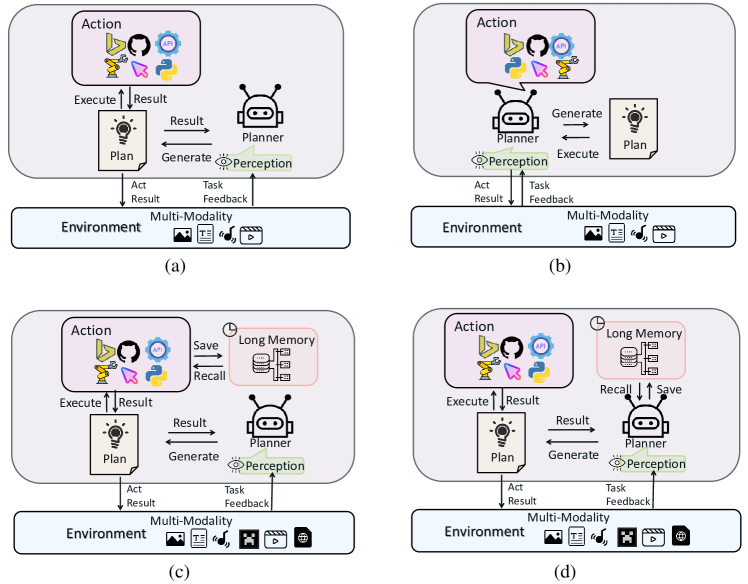
- Classify existing studies into four LMA types based on planners and memory (Types I–IV).
- Describe perception, planning, action, and memory components and their implementations (tables and figures referenced).
- Discuss collaboration frameworks for multiple LMAs and memory-enabled architectures.
- Summarize evaluation approaches, including subjective and objective metrics, benchmarks, and challenges.
- Provide an up-to-date resource list for LMAs via a public repository.
Experimental results
Research questions
- RQ1What are the essential components of LMAs and how do they interact?
- RQ2How can LMAs be categorized into a comprehensive taxonomy (Types I–IV) based on planner type and memory?
- RQ3What collaboration frameworks enable effective multi-agent LMA systems?
- RQ4How should LMAs be evaluated to enable fair comparison and progress tracking?
- RQ5What are the key real-world applications and future directions for LMAs?
Key findings
- LMAs are categorized into four types (Types I–IV) based on planner characteristics and memory integration.
- Memory mechanisms (short/long-term) significantly influence LMA capabilities and generalization.
- A unified evaluation framework and benchmarks are needed to standardize comparisons across LMAs.
- Collaborative multi-agent frameworks can improve task performance and distribute workload among agents.
- The survey highlights broad applications (GUI automation, robotics, game AI, autonomous driving, video understanding, and more) and provides a GitHub resource for up-to-date LMAs.
Read this paper
Open the full text in the Nubint reader and ask about any passage as you read.
Read this paper on NubintThis review was generated by AI from the original paper. Please check the paper before citing it.