
[Paper Review] Large Multimodal Models: Notes on CVPR 2023 Tutorial
This paper summarizes a CVPR 2023 tutorial on large multimodal models (LMMs), presenting a framework for building open-source, instruction-tuned LMMs like LLaVA and MiniGPT-4 using vision-language pre-training and instruction tuning. It demonstrates that open-source LMMs can achieve strong performance on multimodal reasoning and visual chat tasks, approaching—but not yet matching—OpenAI's multimodal GPT-4 in complex reasoning and scalability.
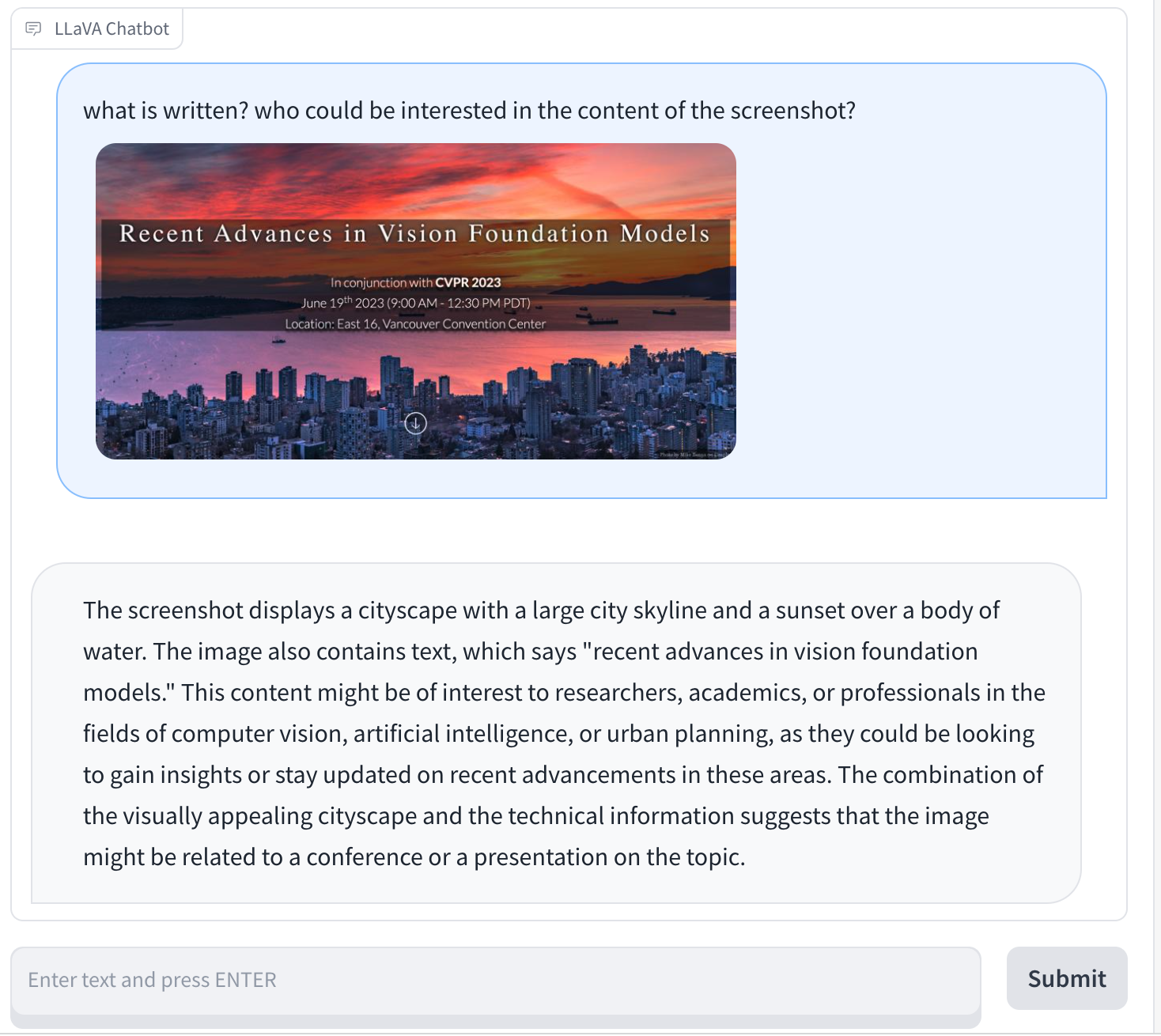
This tutorial note summarizes the presentation on ``Large Multimodal Models: Towards Building and Surpassing Multimodal GPT-4'', a part of CVPR 2023 tutorial on ``Recent Advances in Vision Foundation Models''. The tutorial consists of three parts. We first introduce the background on recent GPT-like large models for vision-and-language modeling to motivate the research in instruction-tuned large multimodal models (LMMs). As a pre-requisite, we describe the basics of instruction-tuning in large language models, which is further extended to the multimodal space. Lastly, we illustrate how to build the minimum prototype of multimodal GPT-4 like models with the open-source resource, and review the recently emerged topics.
Motivation & Objective
- To provide a comprehensive, accessible overview of large multimodal models (LMMs) for researchers and students unfamiliar with the field.
- To explain the foundational role of instruction tuning in enabling multimodal chat capabilities, inspired by GPT-4’s success.
- To demonstrate how to build a minimal prototype of a multimodal GPT-4-like model using open-source components such as LLaVA and vision-language datasets.
- To survey recent advancements in LMMs, including multi-modal extensions, in-context learning, parameter-efficient fine-tuning, and domain-specific applications.
- To assess the current state of open-source LMMs relative to proprietary models like OpenAI’s multimodal GPT-4, identifying gaps and opportunities.
Proposed method
- Adapts instruction tuning techniques from large language models (LLMs) to the multimodal setting, enabling models to follow natural language instructions.
- Uses a two-stage training process: first aligning visual and textual representations via image-caption pairs, then fine-tuning on instruction-following data using LLMs like GPT-4.
- Employs a vision encoder (e.g., CLIP or ViT) to extract visual features and a frozen LLM (e.g., LLaMA) to generate text, connected via a learnable projection module.
- Leverages self-instruct methods to generate high-quality instruction-following data from captions, enabling efficient fine-tuning of LMMs.
- Applies curriculum learning to gradually increase the complexity of instruction data, improving zero-shot generalization and reasoning in biomedical LMMs.
- Utilizes open-source datasets such as PubMed Central for biomedical vision-language pre-training and fine-tunes LLaVA on domain-specific data to create LLaVA-Med.
Experimental results
Research questions
- RQ1How can instruction tuning be effectively extended from text-only LLMs to multimodal models for visual reasoning and dialogue?
- RQ2What is the minimal architecture and training protocol required to build a functional, open-source multimodal GPT-4-like model?
- RQ3To what extent can open-source LMMs match the reasoning and multimodal understanding capabilities of proprietary models like OpenAI’s GPT-4?
- RQ4How can domain-specific LMMs be efficiently trained with limited data and compute, while preserving high performance on specialized tasks?
- RQ5What are the key emerging trends and challenges in scaling, evaluating, and deploying LMMs beyond vision-language tasks?
Key findings
- Open-source LMMs such as LLaVA and MiniGPT-4 can reproduce many capabilities of GPT-4 in visual question answering and image captioning, demonstrating strong zero-shot generalization.
- LLaVA-Med, a fine-tuned version of LLaVA on biomedical data, achieves accurate, knowledge-grounded responses to open-ended questions about pathology images, outperforming general-domain LLaVA.
- The use of GPT-4 to self-instruct instruction-following data from captions enables efficient fine-tuning of LMMs with high-quality, diverse instruction examples.
- Despite progress, open-source models still lag behind GPT-4 in complex visual reasoning tasks requiring high-resolution image understanding and long-context reasoning.
- Emerging topics such as multimodal in-context learning, parameter-efficient fine-tuning, and multi-modal benchmarks are accelerating the development of robust, scalable LMMs.
- Domain-specific LMMs like PathAsst and PMC-VQA show that specialized models can be more effective and privacy-preserving than general models in sensitive fields like biomedicine.

Read this paper
Open the full text in the Nubint reader and ask about any passage as you read.
Read this paper on NubintThis review was generated by AI from the original paper. Please check the paper before citing it.