
[Paper Review] Large-scale Reinforcement Learning for Diffusion Models
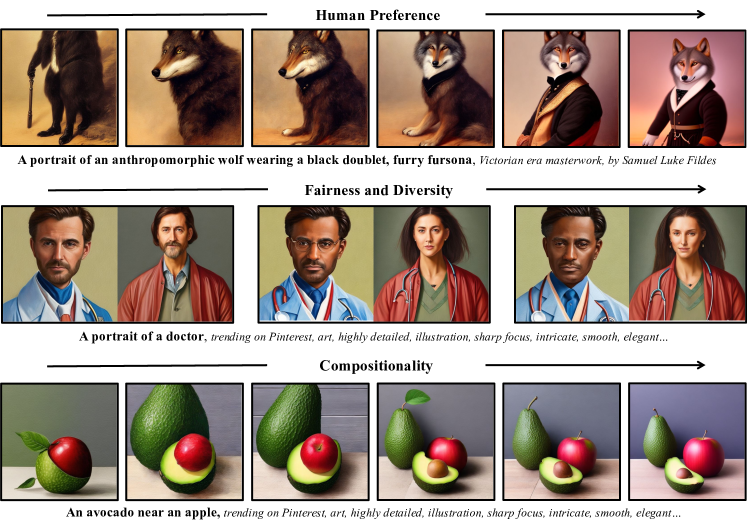
This paper proposes a large-scale reinforcement learning (RL) framework to fine-tune diffusion models using diverse reward functions—such as human preference, compositionality, and fairness—across millions of prompts. By leveraging scalable RL training with distribution-based rewards and multi-objective optimization, the method improves Stable Diffusion models to generate images preferred by humans 80.3% of the time, while enhancing compositional accuracy and diversity without requiring inference-time intervention or synthetic data.
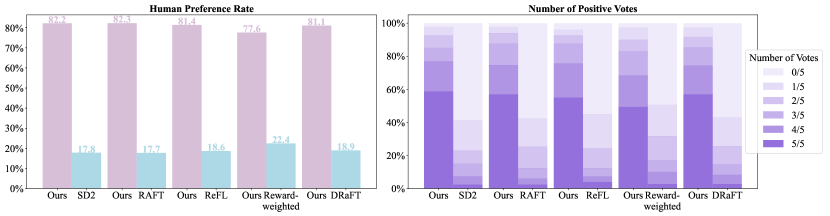
Text-to-image diffusion models are a class of deep generative models that have demonstrated an impressive capacity for high-quality image generation. However, these models are susceptible to implicit biases that arise from web-scale text-image training pairs and may inaccurately model aspects of images we care about. This can result in suboptimal samples, model bias, and images that do not align with human ethics and preferences. In this paper, we present an effective scalable algorithm to improve diffusion models using Reinforcement Learning (RL) across a diverse set of reward functions, such as human preference, compositionality, and fairness over millions of images. We illustrate how our approach substantially outperforms existing methods for aligning diffusion models with human preferences. We further illustrate how this substantially improves pretrained Stable Diffusion (SD) models, generating samples that are preferred by humans 80.3% of the time over those from the base SD model while simultaneously improving both the composition and diversity of generated samples.
Motivation & Objective
- To address limitations in text-to-image diffusion models, such as poor compositional fidelity, aesthetic mismatch, and societal bias, which stem from web-scale pretraining on uncurated data.
- To overcome the scalability and generalization limitations of prior RL-based fine-tuning methods, which are restricted to small sets of prompts or narrow domains.
- To develop a generic, scalable RL framework that enables multi-objective optimization using arbitrary reward functions without requiring auxiliary inputs or inference-time modifications.
- To improve pretrained diffusion models like Stable Diffusion in a way that enhances both quality and ethical alignment while preserving diversity and controllability.
Proposed method
- The method formulates RL fine-tuning as a policy optimization problem, maximizing the expected reward over generated images under a diffusion model's sampling process.
- It employs a distribution-based reward function to encourage diversity in generated samples by penalizing mode collapse and promoting coverage of the output space.
- Multi-objective RL is implemented using a weighted combination of reward functions, including human preference, compositional accuracy, and fairness metrics, enabling simultaneous optimization across objectives.
- The approach uses off-policy RL algorithms with experience replay and target networks to stabilize training across millions of prompts and diverse reward signals.
- It avoids gradient backpropagation through the full generative process by using reward signals derived from pre-trained reward models, enabling non-differentiable reward functions.
- The method is applied end-to-end to fine-tune the diffusion model’s parameters using a large-scale dataset of text prompts and corresponding reward signals.
Experimental results
Research questions
- RQ1Can large-scale reinforcement learning effectively improve text-to-image diffusion models across multiple objectives, including human preference, compositionality, and fairness, at scale?
- RQ2How does the proposed distribution-based reward function enhance sample diversity compared to standard RL fine-tuning approaches?
- RQ3To what extent can multi-objective RL training improve a base diffusion model without requiring additional inference-time guidance or synthetic data?
- RQ4How does the performance of the RL-fine-tuned model compare to baseline methods in human preference evaluations across diverse prompts?
- RQ5Can the proposed method generalize across millions of prompts and maintain improvements in both quality and ethical alignment?
Key findings
- The RL-fine-tuned model achieves a human preference score of 80.3% on average, significantly outperforming the base Stable Diffusion v2 model.
- The method improves compositional accuracy by enabling the model to better align generated images with complex, multi-object relationships described in prompts.
- The distribution-based reward function effectively increases sample diversity, reducing mode collapse and improving coverage of the output distribution.
- The model demonstrates improved fairness and reduced stereotyping across multiple bias benchmarks without requiring synthetic data augmentation.
- The approach generalizes across millions of prompts and maintains consistent performance improvements across all evaluated objectives: preference, composition, and fairness.
- The method achieves state-of-the-art results in human preference evaluation while avoiding the memory and computational overhead of gradient-based reward optimization.
Read this paper
Open the full text in the Nubint reader and ask about any passage as you read.
Read this paper on NubintThis review was generated by AI from the original paper. Please check the paper before citing it.