
[Paper Review] Large-Scale Unsupervised Object Discovery
This paper proposes LOD (Large-Scale Object Discovery), a novel unsupervised object discovery method that formulates UOD as a ranking problem over region proposals using graph-based eigenvalue and PageRank techniques. It achieves state-of-the-art performance on both single- and multi-object discovery, outperforming prior methods by over 37% on 1.7M-image datasets and enabling the first fully unsupervised pipeline using self-supervised features.
Existing approaches to unsupervised object discovery (UOD) do not scale up to large datasets without approximations that compromise their performance. We propose a novel formulation of UOD as a ranking problem, amenable to the arsenal of distributed methods available for eigenvalue problems and link analysis. Through the use of self-supervised features, we also demonstrate the first effective fully unsupervised pipeline for UOD. Extensive experiments on COCO and OpenImages show that, in the single-object discovery setting where a single prominent object is sought in each image, the proposed LOD (Large-scale Object Discovery) approach is on par with, or better than the state of the art for medium-scale datasets (up to 120K images), and over 37% better than the only other algorithms capable of scaling up to 1.7M images. In the multi-object discovery setting where multiple objects are sought in each image, the proposed LOD is over 14% better in average precision (AP) than all other methods for datasets ranging from 20K to 1.7M images. Using self-supervised features, we also show that the proposed method obtains state-of-the-art UOD performance on OpenImages. Our code is publicly available at https://github.com/huyvvo/LOD.
Motivation & Objective
- Address the scalability limitations of existing unsupervised object discovery (UOD) methods on large-scale datasets.
- Overcome the computational bottlenecks of combinatorial optimization and sequential processing in prior UOD approaches.
- Enable fully unsupervised UOD by integrating self-supervised features without reliance on pre-trained detection models.
- Achieve high performance in both single-object and multi-object discovery across diverse dataset sizes, including OpenImages with 1.7M images.
- Demonstrate robustness to long-tail object distributions by maintaining performance on rare classes despite low frequency.
Proposed method
- Reformulate UOD as a graph ranking problem where nodes are region proposals and edges are weighted by region similarity and objectness scores.
- Use the principal eigenvector of a normalized graph Laplacian to identify well-connected, object-like regions, enabling efficient computation.
- Apply personalized PageRank to refine object discovery by leveraging the eigenvector as a personalization vector for improved localization.
- Combine eigen-based ranking and PageRank into a hybrid algorithm named LOD, designed for distributed and scalable execution.
- Integrate self-supervised features (e.g., from MoCo or SimCLR) to eliminate dependency on supervised region proposals or features.
- Use a post-processing clustering step on top-ranked proposals to discover object categories without annotations.

Experimental results
Research questions
- RQ1Can unsupervised object discovery be effectively reformulated as a scalable graph ranking problem to overcome computational bottlenecks in existing methods?
- RQ2How does the performance of a graph-based ranking approach compare to combinatorial optimization methods in both single- and multi-object discovery settings?
- RQ3Can self-supervised features enable a fully unsupervised UOD pipeline without any supervision in region proposals or features?
- RQ4Does the proposed method maintain strong performance on rare object classes despite long-tail distributions in large-scale datasets?
- RQ5To what extent does the ranking-based approach generalize across datasets of varying sizes, from 20K to 1.7M images?
Key findings
- LOD achieves state-of-the-art performance in single-object discovery on COCO (120K images), with an AP@[50:95] of 1.98, outperforming prior methods on this scale.
- On OpenImages (1.7M images), LOD improves multi-object discovery AP@[50:95] by over 37% compared to the only other method capable of scaling to this size.
- Using self-supervised features, LOD achieves an AP@[50:95] of 1.86 on OpenImages 1.7M, demonstrating the first fully unsupervised UOD pipeline with SOTA results.
- LOD shows minimal correlation (−0.09) between performance and object category frequency, indicating strong generalization to rare classes.
- LOD achieves a purity of 68.6 on VOC_all using top proposals, surpassing the 61.8 purity obtained with full-image features, showing improved localization quality.
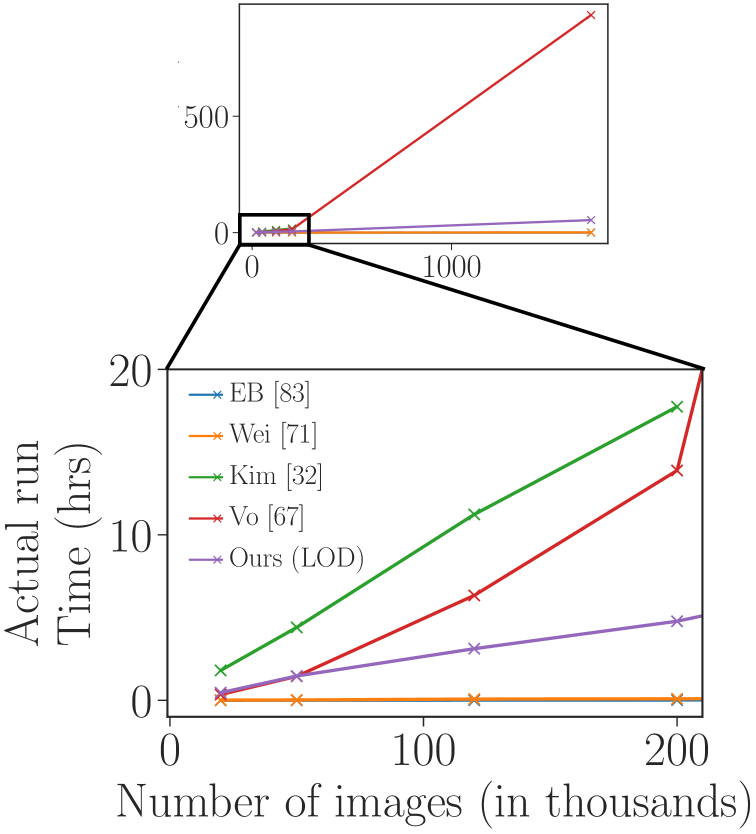
- The method scales efficiently to 1.7M images—87× larger than the previous SOTA—thanks to its distributed, eigenvalue- and PageRank-based design.
Read this paper
Open the full text in the Nubint reader and ask about any passage as you read.
Read this paper on NubintThis review was generated by AI from the original paper. Please check the paper before citing it.