
[Paper Review] Late Breaking Results: Fortifying Neural Networks: Safeguarding Against Adversarial Attacks with Stochastic Computing
The paper proposes using stochastic computing in the inference phase, especially in early convolutional layers, to improve neural networks' robustness against adversarial attacks, demonstrated on LeNet-5 (MNIST) and ResNet-20 (CIFAR-10) with L2/Carlini-Wagner attacks.
In neural network (NN) security, safeguarding model integrity and resilience against adversarial attacks has become paramount. This study investigates the application of stochastic computing (SC) as a novel mechanism to fortify NN models. The primary objective is to assess the efficacy of SC to mitigate the deleterious impact of attacks on NN results. Through a series of rigorous experiments and evaluations, we explore the resilience of NNs employing SC when subjected to adversarial attacks. Our findings reveal that SC introduces a robust layer of defense, significantly reducing the susceptibility of networks to attack-induced alterations in their outcomes. This research contributes novel insights into the development of more secure and reliable NN systems, essential for applications in sensitive domains where data integrity is of utmost concern.
Motivation & Objective
- Assess whether stochastic computing (SC) can bolster neural network resilience to adversarial attacks.
- Identify which layers and bit-stream configurations in SC contribute most to robustness.
- Evaluate SC-based defense on both simple (LeNet-5/MNIST) and complex (ResNet-20/CIFAR-10) architectures.
Proposed method
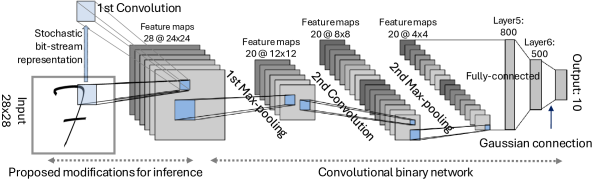
- Replace multiplication in targeted convolutional layers with SC-based bit-stream multipliers using bit-wise AND operations.
- Encode inputs and weights as stochastic bit-streams generated via quasi-randomSobol sequences.
- Concentrate SC application on first convolutional layer(s) to reduce complexity while maintaining accuracy.
- Use inference-only modification; training phase remains unchanged.
- Evaluate defense against white-box L2 (Carlini-Wagner) adversarial attacks on MNIST and CIFAR-10 datasets.
Experimental results
Research questions
- RQ1Does introducing SC in early layers improve robustness against adversarial perturbations without retraining?
- RQ2Which layer(s) and bit-stream lengths optimize the robustness-accuracy trade-off under attacks?
- RQ3Can SC-based inference defend complex networks (ResNet-20) on CIFAR-10 against L2 adversaries?
- RQ4How does SC-based defense compare with existing defenses in terms of misclassification under attack?
Key findings
- SC in the first convolutional layer significantly improves robustness, while SC in the second layer alone is less beneficial for small bit-streams.
- LeNet-5 on MNIST maintains near-original accuracy before attack (≈99%), and after attack under SC defense, accuracy improves to as high as 79% for certain configurations.
- ResNet-20 on CIFAR-10 shows robustness gains with longer bit-streams (e.g., N=256) to reach conventional accuracy levels; SC defense yields up to 85% accuracy after attack in some configurations.
- Under attack, the safeguarded model misclassifies at a substantially lower rate (e.g., 10% misclassification) compared to reported state-of-the-art benchmarks.
- The approach avoids retraining and can adapt to both simple and complex networks, offering a practical defense for secure AI systems.
- The study demonstrates that stochastic processing can maintain or recover accuracy in the presence of adversarial manipulation during inference.
Read this paper
Open the full text in the Nubint reader and ask about any passage as you read.
Read this paper on NubintThis review was generated by AI from the original paper. Please check the paper before citing it.