
[Paper Review] Latency and Privacy-Aware Resource Allocation in Vehicular Edge Computing
This paper proposes a privacy and latency-aware resource allocation approach for Vehicular Edge Computing (VEC) that divides edge processing into user and RSU/cloud layers, and uses a heuristic to assign tasks based on privacy, real-time needs, and processing resources.
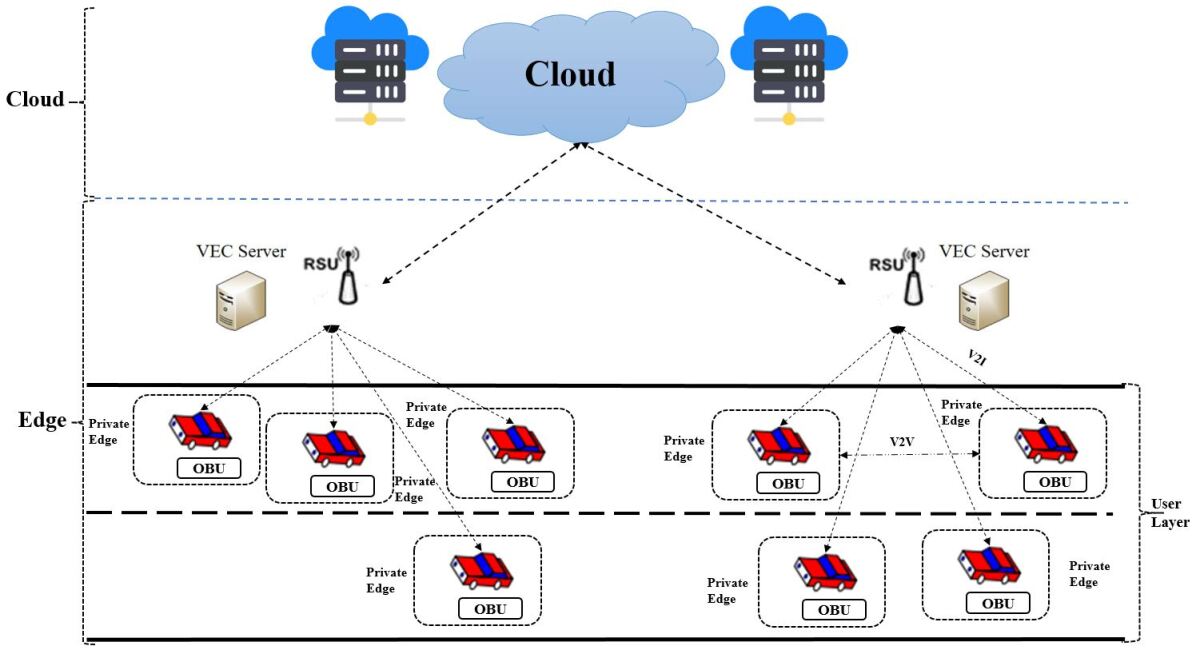
The rapid increase in the number of connected vehicles has led to the generation of vast amounts of data. As a significant portion of this data pertains to vehicle-to-vehicle and vehicle-to-infrastructure communications, it is predominantly generated at the edge. Considering the enormous volume of data, real-time applications, and privacy concerns, it is crucial to process the data at the edge. Neglecting the management of processing resources in vehicular edge computing (VEC) could lead to numerous challenges as a substantial number of vehicles with diverse safety, economic, and entertainment applications, along with their data processing, emerge in the near future [1]. Previous research in VEC resource allocation has primarily focused on issues such as response time and privacy preservation techniques. However, an approach that takes into account privacy-aware resource allocation based on vehicular network architecture and application requirements has not yet been proposed. In this paper, we present a privacy and latency-aware approach for allocating processing resources at the edge of the vehicular network, considering the specific requirements of different applications. Our approach involves categorizing vehicular network applications based on their processing accuracy, real-time processing needs, and privacy preservation requirements. We further divide the vehicular network edge into two parts: the user layer (OBUs) is considered for processing applications with privacy requirements, while the allocation of resources in the RSUs and cloud layer is based on the specific needs of different applications. In this study, we evaluate the quality of service based on parameters such as privacy preservation, processing cost, meeting deadlines, and result quality. Comparative analyses demonstrate that our approach enhances service quality by 55% compared to existing state-of-the-art methods.
Motivation & Objective
- Motivate the need for privacy-aware, low-latency resource management in VEC due to growing V2V/V2I data.
- Define a heterogeneous VEC architecture and classify applications by privacy, latency, and accuracy requirements.
- Develop a resource allocation framework that assigns processing tasks to edge, RSU, or cloud based on application type.
- Incorporate a privacy-preserving split by processing private data on user devices (OBUs) and non-private data in cloud/RSU.
- Evaluate the proposed system against state-of-the-art methods in terms of QoS, QoR, and processing cost.
Proposed method
- Model the VEC architecture with edge (OBUs), RSUs, and cloud layers.
- Classify applications by privacy, real-time needs, and accuracy requirements to determine processing location.
- Propose a heuristic PVEC algorithm that assigns Private and Real-Time tasks to the user edge, while routing non-private tasks to RSUs or cloud and applying approximate processing where acceptable.
- Define QoS as a function of processing cost, missed deadlines, and privacy.
- Define processing cost as PT * SRP for cloud processing only.
- Use approximate processing for applications not requiring exact results to save edge resources.
Experimental results
Research questions
- RQ1How should processing be allocated across edge, RSU, and cloud to satisfy privacy and latency requirements of diverse VEC applications?
- RQ2What is the impact on QoS, QoR, and cost when applying a privacy- and latency-aware resource allocation in VEC?
- RQ3Can approximate processing on resource-constrained edge devices maintain acceptable QoR while reducing cost?
- RQ4How does segregating private applications to the user layer affect overall system performance and privacy guarantees?
Key findings
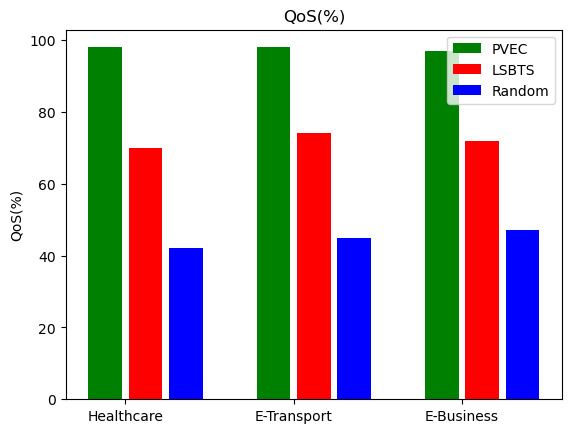
- The PVEC approach raises QoS by 30-55% relative to baseline methods (LSBTS and Random) across Healthcare, E-Transport, and E-Business workloads.
- Approximate processing at the edge yields a negligible QoR loss with a 5% band error and 95% confidence interval.
- The method reduces cloud processing cost by 49-63% versus baselines.
- Edge processing is preferred for real-time, approximate, and private data tasks, while cloud processing handles accurate, soft real-time, and less private data.
- The proposed framework achieves about a 55% improvement in QoS over state-of-the-art in their evaluation.
Read this paper
Open the full text in the Nubint reader and ask about any passage as you read.
Read this paper on NubintThis review was generated by AI from the original paper. Please check the paper before citing it.