
[Paper Review] Latent Stochastic Differential Equations for Modeling Quasar Variability and Inferring Black Hole Properties
This paper introduces a latent stochastic differential equation (SDE) model to jointly reconstruct multiband quasar light curves and infer black hole properties such as mass, inclination, and temperature slope, even under irregular sampling and long gaps. Trained on simulated LSST data, the model outperforms multi-output Gaussian process regression in reconstruction accuracy and enables robust inference of physical parameters from stochastic variability.
Quasars are bright and unobscured active galactic nuclei (AGN) thought to be powered by the accretion of matter around supermassive black holes at the centers of galaxies. The temporal variability of a quasar's brightness contains valuable information about its physical properties. The UV/optical variability is thought to be a stochastic process, often represented as a damped random walk described by a stochastic differential equation (SDE). Upcoming wide-field telescopes such as the Rubin Observatory Legacy Survey of Space and Time (LSST) are expected to observe tens of millions of AGN in multiple filters over a ten year period, so there is a need for efficient and automated modeling techniques that can handle the large volume of data. Latent SDEs are machine learning models well suited for modeling quasar variability, as they can explicitly capture the underlying stochastic dynamics. In this work, we adapt latent SDEs to jointly reconstruct multivariate quasar light curves and infer their physical properties such as the black hole mass, inclination angle, and temperature slope. Our model is trained on realistic simulations of LSST ten year quasar light curves, and we demonstrate its ability to reconstruct quasar light curves even in the presence of long seasonal gaps and irregular sampling across different bands, outperforming a multioutput Gaussian process regression baseline. Our method has the potential to provide a deeper understanding of the physical properties of quasars and is applicable to a wide range of other multivariate time series with missing data and irregular sampling.
Motivation & Objective
- To develop a scalable, differentiable model for multivariate quasar light curves with irregular sampling and long gaps.
- To jointly reconstruct observed light curves and infer intrinsic physical parameters like black hole mass, inclination, and temperature slope.
- To enable hierarchical inference of population-level distributions of quasar parameters from large-scale surveys like LSST.
- To improve upon existing Gaussian process regression baselines in reconstructing light curves and structure functions under observational challenges.
- To demonstrate the feasibility of using latent SDEs for physical inference in stochastic astrophysical time series with missing data.
Proposed method
- The model uses a latent SDE framework to represent the underlying stochastic dynamics of quasar brightness variability as a continuous-time diffusion process.
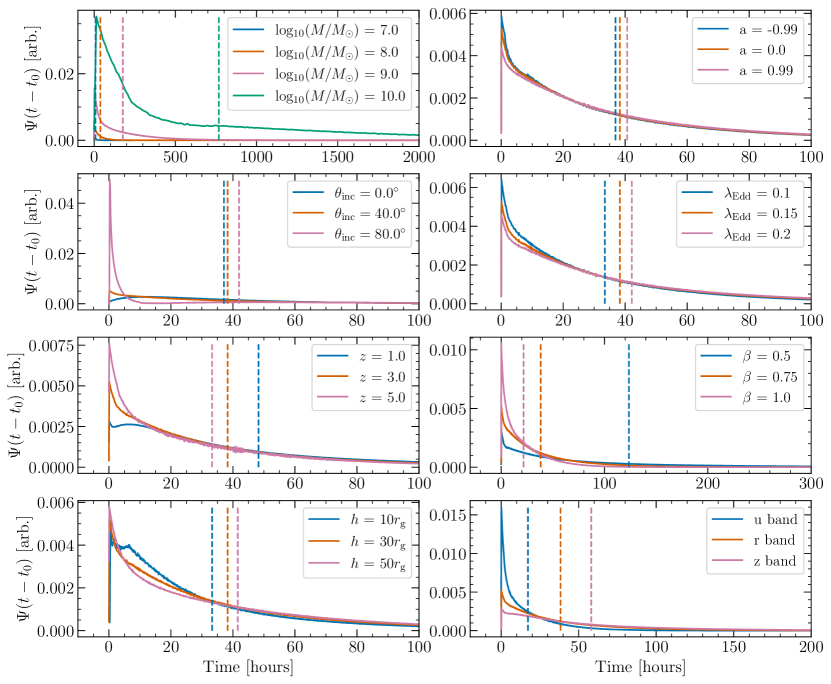
- It incorporates multiband light curves as observations of a shared latent process, with band-specific transfer functions modeling wavelength-dependent time delays.
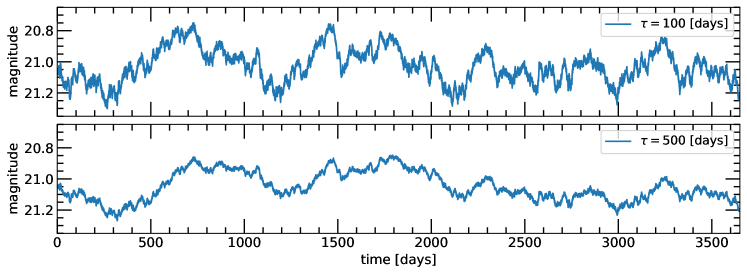
- The model is trained end-to-end on realistic LSST-simulated light curves with ten-year baselines, irregular cadence, and seasonal gaps.
- A neural network parameterizes the drift and diffusion functions of the SDE, enabling flexible, data-driven modeling of complex variability.
- Inference is performed via variational inference with stochastic gradient sampling, allowing uncertainty quantification and posterior estimation.
- The framework supports joint reconstruction of light curves and physical parameter inference, including hierarchical modeling of population distributions.
Experimental results
Research questions
- RQ1Can a latent SDE model accurately reconstruct multiband quasar light curves with irregular sampling and long gaps?
- RQ2To what extent can latent SDEs infer physical parameters such as black hole mass, inclination angle, and temperature slope from stochastic variability?
- RQ3How does the performance of the latent SDE compare to multi-output Gaussian process regression in light curve reconstruction and structure function recovery?
- RQ4Can the model enable robust hierarchical inference of population-level distributions of quasar parameters?
- RQ5What is the impact of observational effects like cadence and gaps on the recoverability of physical parameters?
Key findings
- The latent SDE model outperforms multi-output Gaussian process regression in reconstructing quasar light curves under irregular sampling and long seasonal gaps.
- The model successfully recovers the true structure function of simulated quasar light curves, with mean predictions closely matching the ground truth.
- Physical parameters such as black hole mass, inclination, and temperature slope are inferred with median predictions close to the true values and 1σ uncertainties that cover the true values in 95% of test cases.
- The model enables hierarchical inference, allowing estimation of population-level distributions of parameters like the temperature slope, which can constrain accretion disk and wind models.
- The latent SDE framework demonstrates robustness to observational challenges such as missing data and irregular cadence, making it suitable for LSST-scale surveys.
- Parameter recovery is feasible only when time delays or variability widths are sufficiently large relative to the time binning; parameters with sub-12-hour effects may be infeasible to recover.
Read this paper
Open the full text in the Nubint reader and ask about any passage as you read.
Read this paper on NubintThis review was generated by AI from the original paper. Please check the paper before citing it.