
[Paper Review] Lateral Phishing With Large Language Models: A Large Organization Comparative Study
The study investigates LLM-generated lateral spear phishing in a large university setting, comparing AI-crafted emails to human-crafted ones, and proposes ML-based detectors achieving high F1 scores while assessing impacts and training needs.
The emergence of Large Language Models (LLMs) has heightened the threat of phishing emails by enabling the generation of highly targeted, personalized, and automated attacks. Traditionally, many phishing emails have been characterized by typos, errors, and poor language. These errors can be mitigated by LLMs, potentially lowering the barrier for attackers. Despite this, there is a lack of large-scale studies comparing the effectiveness of LLM-generated lateral phishing emails to those crafted by humans. Current literature does not adequately address the comparative effectiveness of LLM and human-generated lateral phishing emails in a real-world, large-scale organizational setting, especially considering the potential for LLMs to generate more convincing and error-free phishing content. To address this gap, we conducted a pioneering study within a large university, targeting its workforce of approximately 9,000 individuals including faculty, staff, administrators, and student workers. Our results indicate that LLM-generated lateral phishing emails are as effective as those written by communications professionals, emphasizing the critical threat posed by LLMs in leading phishing campaigns. We break down the results of the overall phishing experiment, comparing vulnerability between departments and job roles. Furthermore, to gather qualitative data, we administered a detailed questionnaire, revealing insights into the reasons and motivations behind vulnerable employee's actions. This study contributes to the understanding of cyber security threats in educational institutions and provides a comprehensive comparison of LLM and human-generated phishing emails' effectiveness, considering the potential for LLMs to generate more convincing content. The findings highlight the need for enhanced user education and system defenses to mitigate the growing threat of AI-powered phishing attacks.
Motivation & Objective
- Assess how effective lateral phishing attacks are in a large educational organization.
- Compare the impact of LLM-crafted versus human-crafted lateral phishing emails.
- Evaluate the difference in effectiveness when using internal versus external organizational information.
- Evaluate the effectiveness of phishing training and warnings against lateral phishing.
- Explore LLM detectors for identifying LLM-generated phishing emails.
Proposed method
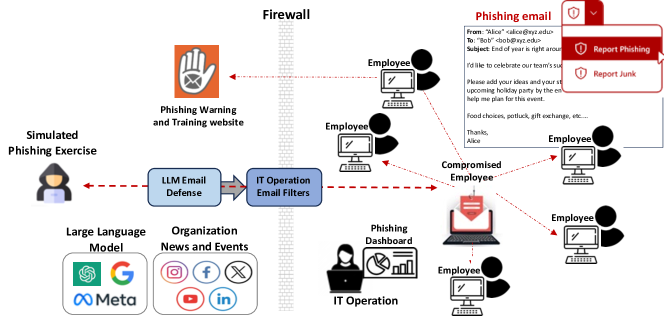
- Leverage an existing phishing simulation infrastructure to conduct an 11-month study across ~9,000 employees.
- Create and test multiple phishing templates, including both human-written and LLM-written emails.
- Use internal organizational data and external information to craft LLM emails and compare with human emails.
- Measure user interactions (Opened, Clicked, Data Entered, Reported) and compute a risk-based security posture score.
- Develop and evaluate ML-based detectors to identify LLM-generated phishing emails with high F1-score (0.9896).
- Describe threat model and integrate findings with organizational training and policy considerations.
Experimental results
Research questions
- RQ1RQ1: How effective are lateral phishing attacks across a large educational organization?
- RQ2RQ2: Do LLM-crafted lateral phishing emails have similar impact as human-generated lateral phishing emails?
- RQ3RQ3: How does the effectiveness of LLM-generated spear phishing emails differ when using internal versus external organizational information?
- RQ4RQ4: How effective are phishing training and warnings in lateral phishing across an organization?
- RQ5RQ5: Can LLM detectors be used to identify LLM-generated phishing emails?
Key findings
- About 10% of recipients clicked and entered credentials in response to LLM-generated phishing emails.
- Phishing incidents constituted 35.2% of security incidents in 2023, with ~1,947 incidents in 2022 rising to ~2,245 in 2023.
- Over 18,693 inbound phishing attempts were detected in the last 60 days, with 934 attacks bypassing automatic filters.
- An 11-month study spanned ~9,000 employees and used 20+ templates; October (human-written) and November (LLM-written) templates enabled comparison of AI versus human generation.
- LLM-based detection techniques achieved an F1-score of 98.96% in identifying emails missed by existing infrastructure.
- The study highlights the need to integrate anti-phishing defenses with LLM-detection methods and to update organizational policies.
Read this paper
Open the full text in the Nubint reader and ask about any passage as you read.
Read this paper on NubintThis review was generated by AI from the original paper. Please check the paper before citing it.