
[Paper Review] LDM3D: Latent Diffusion Model for 3D
LDM3D extends latent diffusion to jointly generate RGB and depth maps from text prompts, enabling RGBD outputs and immersive 360° experiences via DepthFusion and TouchDesigner.
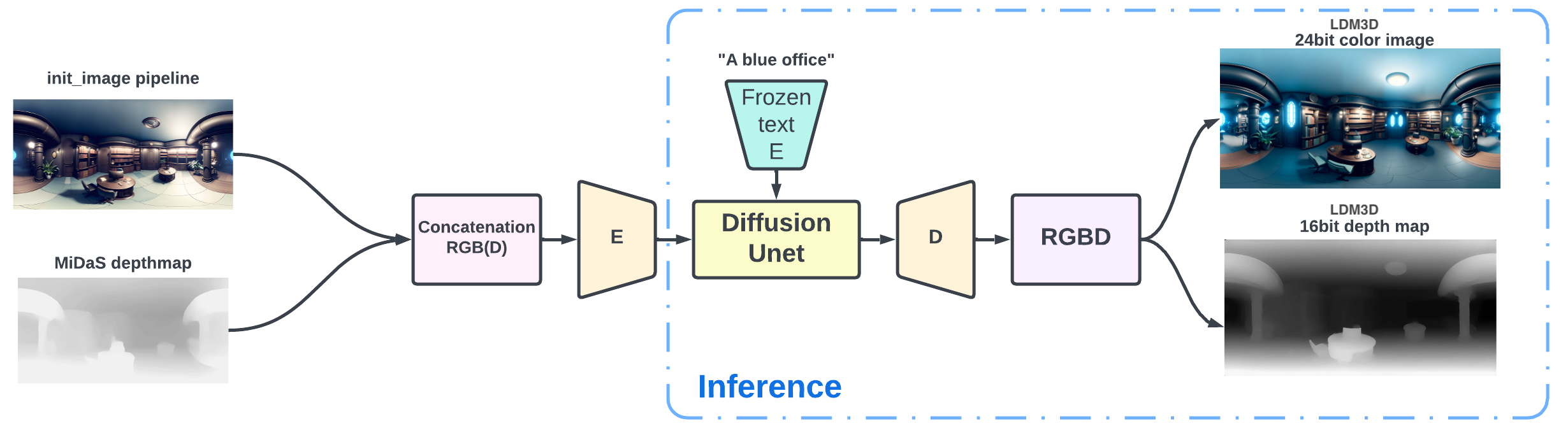
This research paper proposes a Latent Diffusion Model for 3D (LDM3D) that generates both image and depth map data from a given text prompt, allowing users to generate RGBD images from text prompts. The LDM3D model is fine-tuned on a dataset of tuples containing an RGB image, depth map and caption, and validated through extensive experiments. We also develop an application called DepthFusion, which uses the generated RGB images and depth maps to create immersive and interactive 360-degree-view experiences using TouchDesigner. This technology has the potential to transform a wide range of industries, from entertainment and gaming to architecture and design. Overall, this paper presents a significant contribution to the field of generative AI and computer vision, and showcases the potential of LDM3D and DepthFusion to revolutionize content creation and digital experiences. A short video summarizing the approach can be found at https://t.ly/tdi2.
Motivation & Objective
- Motivate generation of coherent RGBD outputs (RGB images plus depth maps) from textual prompts.
- Leverage a KL-regularized latent diffusion framework adapted from Stable Diffusion for RGBD synthesis.
- Fine-tune a KL-autoencoder to handle concatenated RGB and depth inputs in latent space.
- Demonstrate an immersive 360° pipeline (DepthFusion) leveraging the generated RGBD data.
- Evaluate image fidelity and depth accuracy against established baselines to validate quality.
Proposed method
- Use a 1.6B parameter KL-regularized diffusion model derived from Stable Diffusion v1.4 with modifications to produce RGBD outputs.
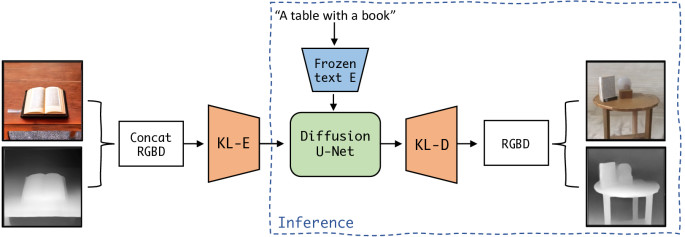
- Preprocess data by converting 16-bit depth maps to 3-channel RGB-like arrays and concatenating with RGB images to form 6-channel inputs (512x512x6).
- Fine-tune a KL-autoencoder on RGBD tuples (image, depth, caption) with a downsampling factor of 8 and a joint perceptual/adversarial loss.
- Fine-tune the diffusion model in latent space using frozen autoencoder representations (64x64x4) and a diffusion loss L_LDM3D with predicted noise, starting from Stable Diffusion v1.4 weights.
- Condition text with a frozen CLIP-text encoder and apply cross-attention to map prompts to U-Net layers.
- Evaluate using MS-COCO FID, IS, CLIP, and depth metrics aligned to ZoeDepth; compare against SD baselines and DPT-Large depth estimates.
Experimental results
Research questions
- RQ1Can an RGBD diffusion model generate high-quality RGB images and accurate depth maps from a single text prompt?
- RQ2How does joint RGBD training influence depth quality and image fidelity compared to RGB-only diffusion models?
- RQ3What are the effects of conditioning strength (guidance scale), DDIM steps, and training progression on RGBD outputs?
- RQ4Can the generated RGBD outputs be effectively used to create immersive 360° experiences (DepthFusion) in TouchDesigner?
- RQ5How does LDM3D compare to baselines in image and depth evaluation metrics on standard datasets?
Key findings
- LDM3D achieves competitive FID and CLIP scores compared to Stable Diffusion baselines with the same parameter count on MS-COCO (512x512) using 50 DDIM steps.
- Depth evaluation aligned to ZoeDepth shows LDM3D achieving AbsRel 0.0911 and RMSE 0.334 meters, close to DPT-Large's 0.0779 AbsRel and 0.297 RMSE.
- Autoencoder fine-tuning with RGBD input yields a small relative FID degradation (pre-trained KL-AE, RGB rFID 0.763 vs. fine-tuned KL-AE, RGBD rFID 1.966) but enables effective RGBD generation.
- LDM3D outputs high-quality depth maps that align with input prompts as indicated by CLIP similarity improvements and qualitative depth visualizations.
- The DepthFusion pipeline demonstrably converts generated RGBD outputs into immersive 360° views using TouchDesigner, enabling interactive experiences.
Read this paper
Open the full text in the Nubint reader and ask about any passage as you read.
Read this paper on NubintThis review was generated by AI from the original paper. Please check the paper before citing it.