
[Paper Review] Leak Proof PDBBind: A Reorganized Dataset of Protein-Ligand Complexes for More Generalizable Binding Affinity Prediction
The paper introduces LP-PDBBind, a cleaned and leak-proof reorganization of PDBBind, retrains four scoring functions on it, and demonstrates improved generalization on independent benchmarks like BDB2020+ for 3D-structure–based methods, while highlighting limited gains for purely sequence-based models.
Many physics-based and machine-learned scoring functions (SFs) used to predict protein-ligand binding free energies have been trained on the PDBBind dataset. However, it is controversial as to whether new SFs are actually improving since the general, refined, and core datasets of PDBBind are cross-contaminated with proteins and ligands with high similarity, and hence they may not perform comparably well in binding prediction of new protein-ligand complexes. In this work we have carefully prepared a cleaned PDBBind data set of non-covalent binders that are split into training, validation, and test datasets to control for data leakage, defined as proteins and ligands with high sequence and structural similarity. The resulting leak-proof (LP)-PDBBind data is used to retrain four popular SFs: AutoDock Vina, Random Forest (RF)-Score, InteractionGraphNet (IGN), and DeepDTA, to better test their capabilities when applied to new protein-ligand complexes. In particular we have formulated a new independent data set, BDB2020+, by matching high quality binding free energies from BindingDB with co-crystalized ligand-protein complexes from the PDB that have been deposited since 2020. Based on all the benchmark results, the retrained models using LP-PDBBind consistently perform better, with IGN especially being recommended for scoring and ranking applications for new protein-ligand systems.
Motivation & Objective
- Address data leakage and non-uniform quality in the PDBBind dataset by creating a cleaned, non-covalent, and leak-proof split (LP-PDBBind).
- Assess how retraining existing scoring functions on LP-PDBBind affects generalization to new protein-ligand complexes.
- Provide an independent benchmark (BDB2020+) to evaluate the transferred performance of retrained models.
- Offer guidance on which model families benefit most from the leak-proof data splitting and 3D-structure–based representations.
Proposed method
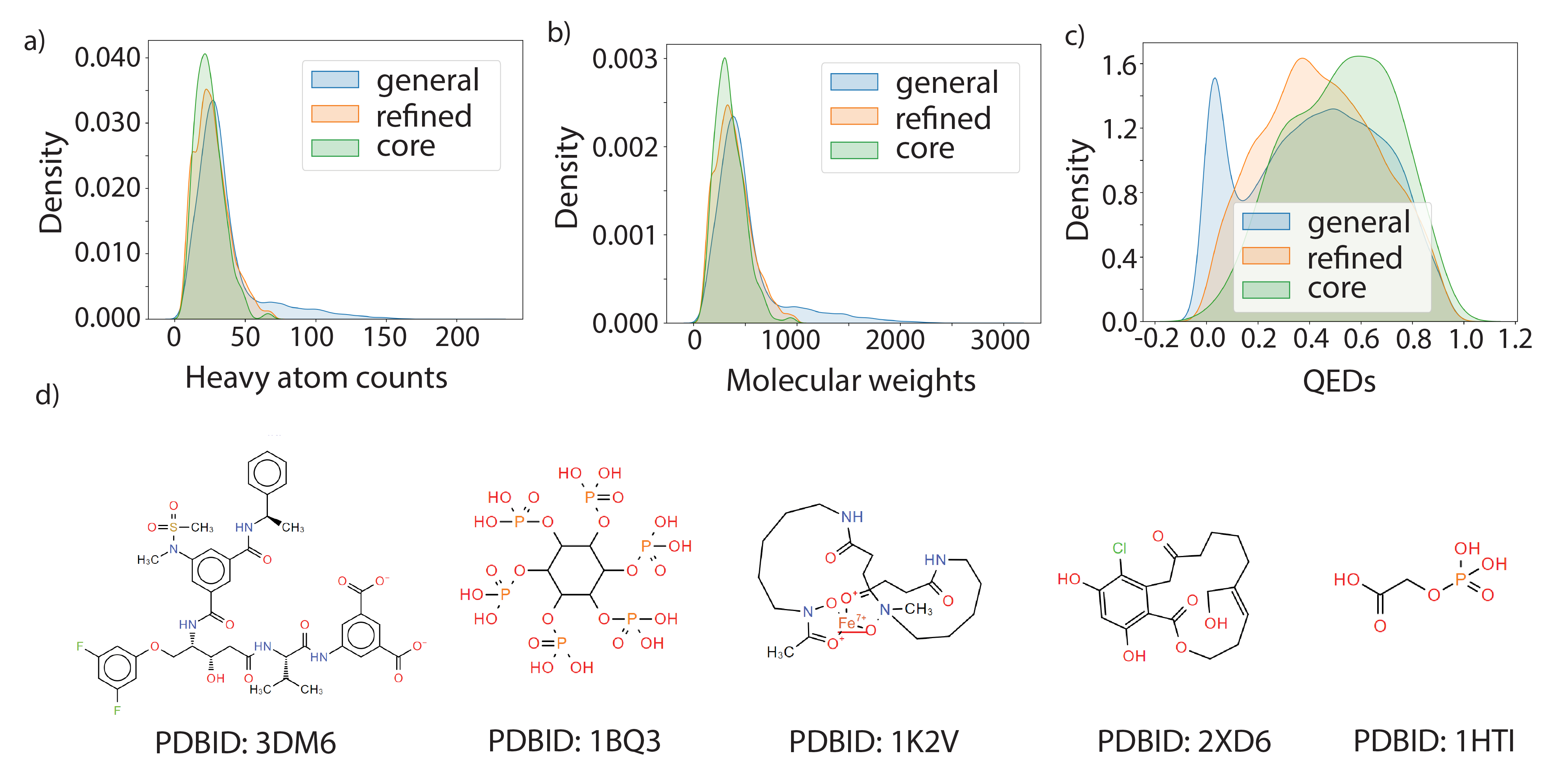
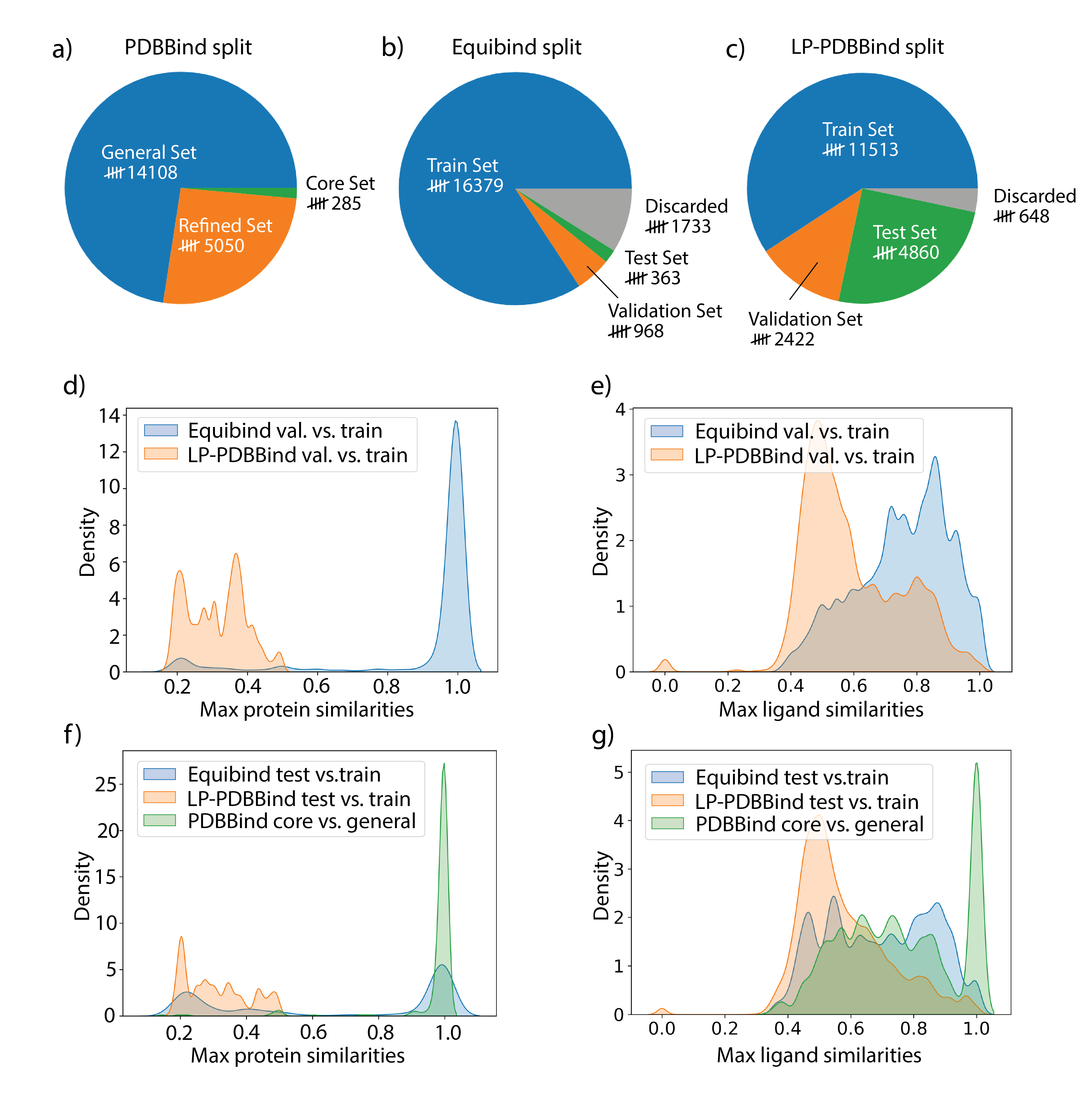
- Clean and filter PDBBind to produce a non-covalent, high-quality subset (CL1, with optional CL2/CL3) and define a similarity-based leakage-control splitting by protein category.
- Compute ligand similarities via Morgan fingerprints and Dice similarity; compute protein similarities via sequence alignment within categories; apply an iterative seed-based splitting to minimize train-test leakage.
- Retrain four scoring function families on LP-PDBBind: AutoDock Vina (reweighted 3D terms), RF-Score (random forest on atom-type contacts), IGN (graph neural network on 3D structures), and DeepDTA (sequence/SMILES-based baseline).
- Construct BDB2020+ by matching recent BindingDB records to PDB structures with similar similarity controls, creating an independent benchmark for evaluation.
Experimental results
Research questions
- RQ1Does removing data leakage via LP-PDBBind improve the generalization of existing SFs to novel protein-ligand complexes?
- RQ2How do 3D-structure–based models compare to sequence-based models when trained on LP-PDBBind and evaluated on independent benchmarks?
- RQ3What is the effect of retraining on LP-PDBBind on performance metrics across training, validation, and testing sets and on independent benchmarks like BDB2020+?
- RQ4Which model families show the most robust transferability to novel complexes and independent datasets after leak-proof retraining?
Key findings
- Retraining on LP-PDBBind improves 3D-structure–based models (IGN, AutoDock Vina, RF-Score) on independent benchmarks like BDB2020+, indicating better generalization.
- IGN consistently performs among the best for scoring and ranking new protein-ligand systems after retraining.
- DeepDTA (1D sequence-based) shows reduced generalization after retraining and performs worse on independent benchmarks compared to 3D-based models.
- Original MLSF models exhibit inflated performance on leakage-prone cores due to training data overlap; LP-PDBBind reveals their true generalization gaps.
- The LP-PDBBind split yields a larger test set with controlled similarity to training data, providing a more realistic assessment of transferability.
Read this paper
Open the full text in the Nubint reader and ask about any passage as you read.
Read this paper on NubintThis review was generated by AI from the original paper. Please check the paper before citing it.