
[Paper Review] Learn Global and Optimize Local: A Data-Driven Methodology for Last-Mile Routing
This paper proposes a data-driven, hierarchical routing methodology that learns global zone sequences from historical delivery data and optimizes local stop sequences within zones to better align with real-world driver behavior. By combining travel times and historical zone transitions in a weighted cost matrix, the approach achieves high route prediction accuracy (AUC of 0.991) and outperforms baseline TSP models in the Last-Mile Routing Research Challenge.
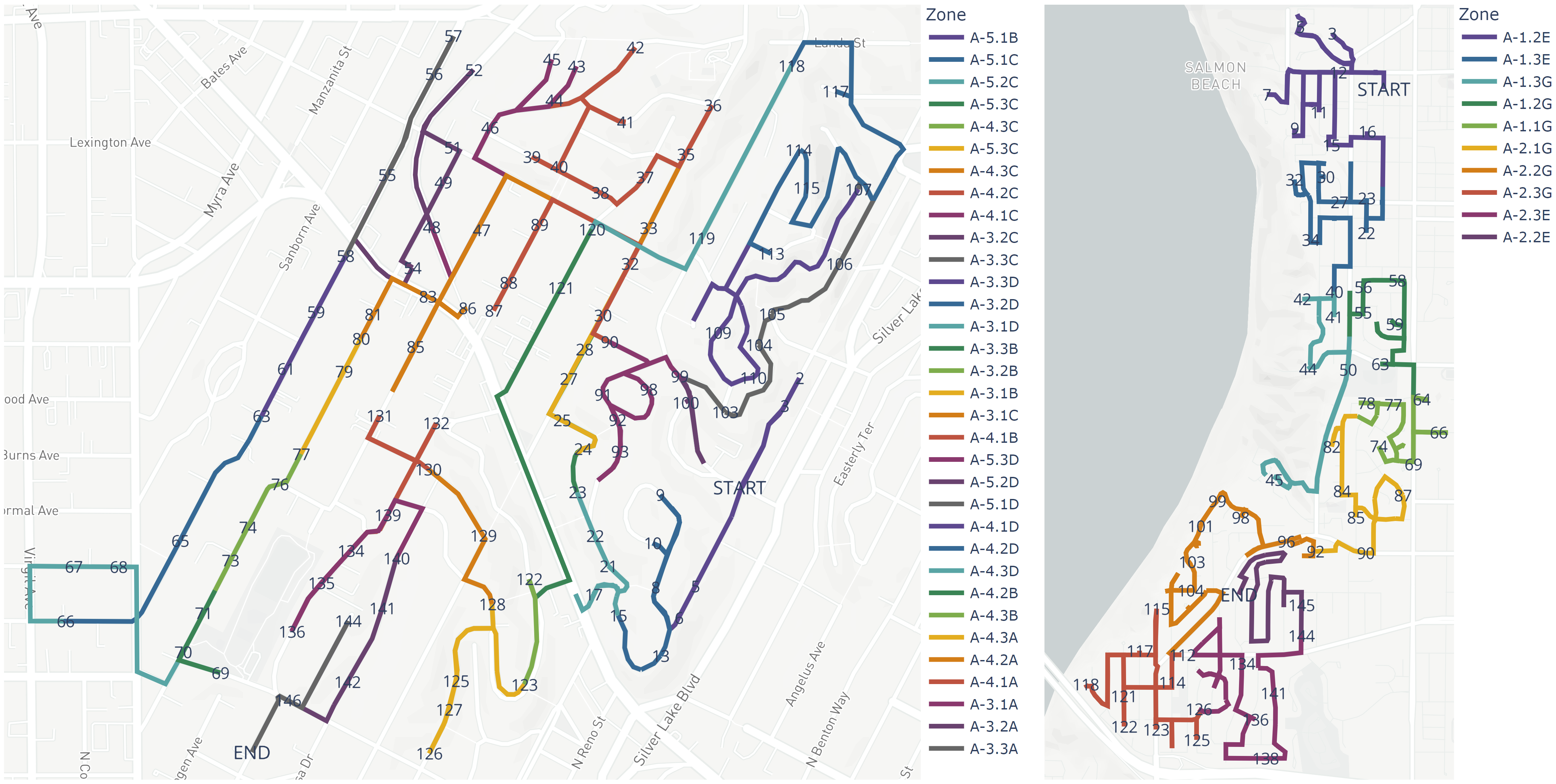
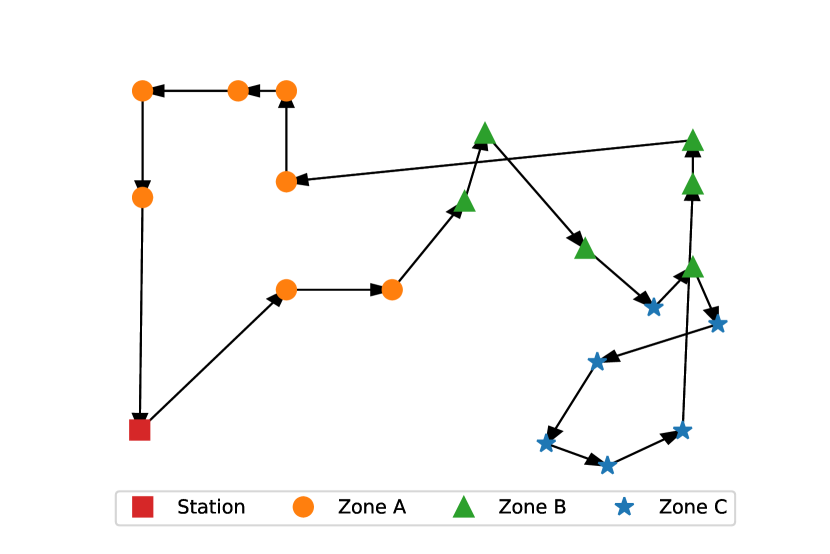
In last-mile routing, the task of finding a route is often framed as a Traveling Salesman Problem to minimize travel time and associated cost. However, solutions stemming from this approach do not match the realized paths as drivers deviate due to navigational considerations and preferences. To prescribe routes that incorporate this tacit knowledge, a data-driven model is proposed that aligns well with the hierarchical structure of delivery data wherein each stop belongs to a zone - a geographical area. First, on the global level, a zone sequence is established as a result of a minimization over a cost matrix which is a weighted combination of historical information and distances (travel times) between zones. Subsequently, within zones, sequences of stops are determined, such that, integrated with the predetermined zone sequence, a full solution is obtained. The methodology is particularly promising as it propels itself within the top-tier of submissions to the Last-Mile Routing Research Challenge, while it maintains an elegant decomposition that ensures a feasible implementation into practice. The concurrence between prescribed and realized routes underpins the adequateness of a hierarchical breakdown of the problem and the fact that drivers make a series of locally optimal decisions when navigating. Furthermore, experimenting with the balance between historical information and distance exposes that historic information is pivotal in deciding a starting zone of a route. The experiments also reveal that at the end of a route, historical information can best be discarded, making the time it takes to return to the station the primary concern.
Motivation & Objective
- Address the gap between theoretically optimal routes and actual driver deviations in last-mile delivery.
- Develop a scalable, practical routing methodology that incorporates drivers’ tacit knowledge and preferences.
- Improve route prediction accuracy by leveraging historical routing data at the zone level rather than stop level.
- Demonstrate that a hierarchical decomposition of the TSP into global (zone) and local (within-zone) optimization enhances real-world feasibility and performance.
- Provide a framework that can be updated in real time using daily realized routes, supporting dynamic route prescription.
Proposed method
- Model last-mile routing as a two-stage process: first, determine an optimal sequence of zones using a Traveling Salesman Problem (TSP) on a cost matrix combining travel times and historical zone transition frequencies.
- Construct a weighted cost matrix where distance (travel time) and historical transition counts are combined with a tunable weight parameter (optimal near 0.9).
- For each zone, solve a separate TSP (or OTSP) to determine the optimal sequence of stops, ensuring local optimality within each zone.
- Use zone-level data to learn transition probabilities, reducing data sparsity compared to stop-level modeling.
- Apply different weightings to station-to-zone and zone-to-station transitions, reflecting that drivers prioritize return time at route end.
- Enable real-time retraining by updating the historical transition count matrix with new daily route data.
Experimental results
Research questions
- RQ1How can historical delivery data be leveraged to predict driver routes more accurately than standard TSP formulations?
- RQ2To what extent does a hierarchical decomposition of last-mile routing into zone-level and within-zone optimization improve alignment with real-world driver behavior?
- RQ3What is the optimal balance between travel time and historical transition frequency in the cost matrix for zone sequence prediction?
- RQ4How do driver preferences at the start versus end of a route affect the weighting of cost matrix components?
- RQ5Can the model be updated in real time using daily realized routes to maintain predictive accuracy?
Key findings
- The proposed method achieved an AUC of 0.991 in route prediction, significantly outperforming baseline TSP models and ranking in the top tier of the Last-Mile Routing Research Challenge.
- A weighted combination of travel time and historical zone transitions (with optimal weight near 0.9) yielded the best performance, indicating a strong trade-off between distance and driver preference.
- The model performs best when travel time is weighted more heavily in zone-to-zone transitions than in station-to-zone transitions, reflecting that drivers prioritize route start decisions less on time and more on sequence.
- At the end of a route, historical information becomes less relevant, and minimizing return time to the station is the dominant factor in route choice.
- The approach remains robust to misspecification of the weight parameter, with performance stable across a wide range of values.
- The remaining learning gap is small—only 0.009 AUC—indicating that the model captures most of the predictable structure in driver behavior with only 5,112 training routes.
Read this paper
Open the full text in the Nubint reader and ask about any passage as you read.
Read this paper on NubintThis review was generated by AI from the original paper. Please check the paper before citing it.